Last updated 2026-07-26
TL;DR
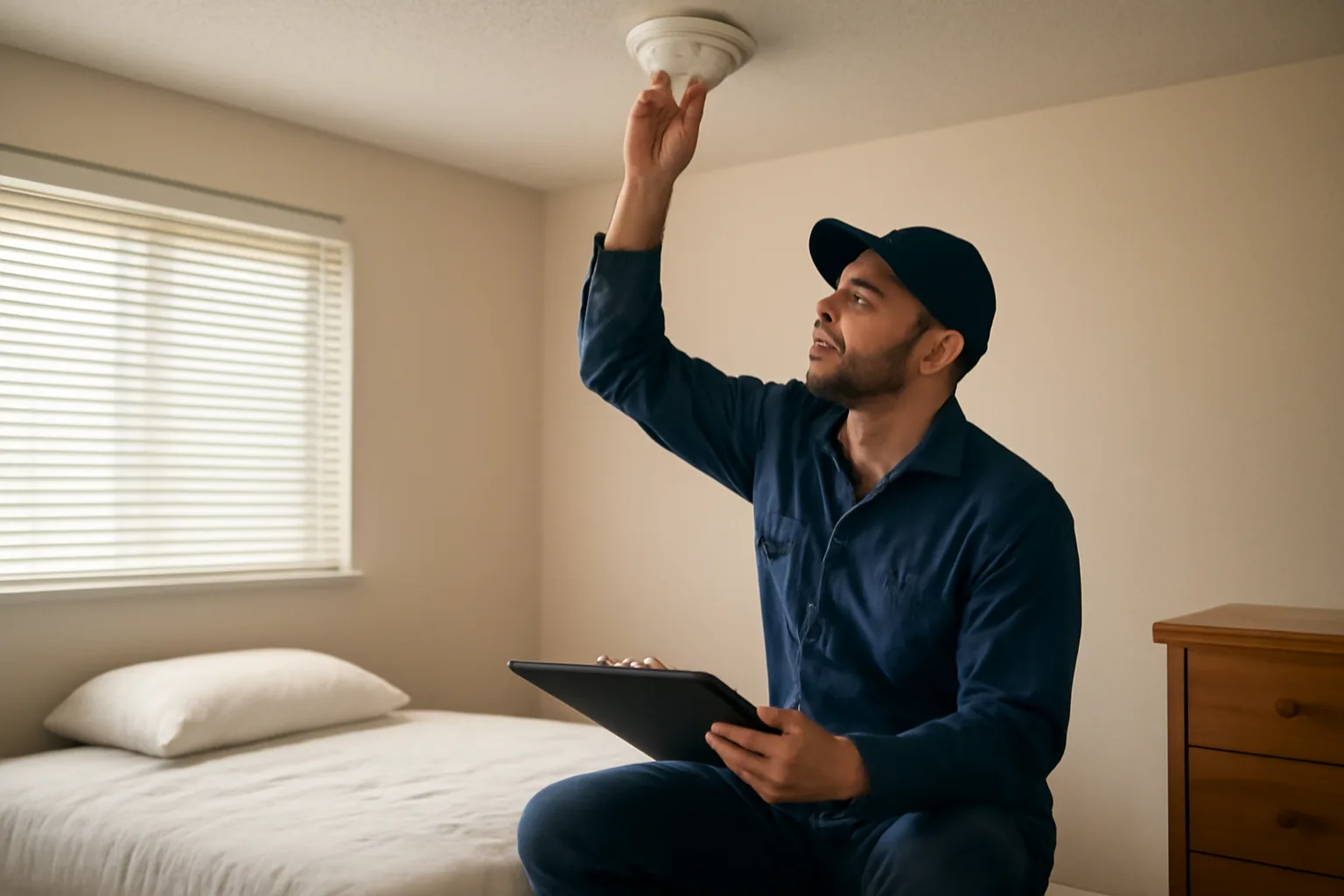
A rental inspection is a code officer checking your unit against local health and safety standards, usually smoke/CO alarms, electrical, plumbing, exits, and structural condition. Most take 20 to 60 minutes per unit. You'll get a pass, a list of violations with a reinspection date, or (rarely) an order to fix an immediate life-safety hazard on the spot.
What actually happens during a rental inspection?
An inspector shows up (usually by appointment, sometimes with a tenant present), walks through the unit room by room, and checks it against a written property maintenance code. Most cities use some version of the International Property Maintenance Code (IPMC) as their base standard, sometimes with local amendments layered on top [1]. The inspector isn't judging your décor or whether the paint color is ugly. They're checking whether the unit is safe to live in. Expect the inspector to test smoke alarms and carbon monoxide detectors, check that windows open and lock, look at the water heater and furnace, run water in sinks and tubs to check for leaks, flip light switches, and look under sinks for mold or water damage. They'll check exterior stuff too: handrails, steps, gutters, peeling exterior paint (especially on pre-1978 homes, which triggers separate federal lead paint rules under 24 CFR Part 35 [2]). Most single-unit inspections take somewhere between 20 and 60 minutes, depending on the size of the property and how many issues the inspector finds along the way. A duplex or small multifamily building takes longer because each unit gets its own pass. At the end, you get one of three outcomes: a pass (often called a certificate of compliance or a passed inspection report), a list of violations with a deadline to fix them and a reinspection date, or, in rare cases involving an immediate hazard like exposed wiring or a gas leak, an order to correct it immediately or vacate the unit.
What can a landlord look at during an inspection?
| Kitchen | Stove/oven function, GFCI outlets near water, sink leaks, ventilation | |
|---|---|---|
| Bathroom | GFCI outlets, exhaust fan or window, tub/shower caulking, water pressure | |
| Bedrooms | Egress window size (usually a minimum opening required by code), smoke alarm presence | |
| Electrical | Panel condition, no exposed wiring, working outlets, proper grounding | |
| Heating/plumbing | Furnace or boiler condition, water heater temperature/pressure relief valve, no active leaks | |
| Exterior | Handrails on steps with 3+ risers (common IPMC threshold), peeling paint, gutters, pest entry points | The egress window rule matters more than most landlords realize. Many building codes, following the International Residential Code, require bedrooms to have an emergency escape window with a minimum net clear opening (commonly around 5.7 square feet, with minimum height and width dimensions), unless the room has another approved exit [3]. If a previous owner finished a basement bedroom without adding a proper egress window, that's a common inspection failure. A municipal inspector generally cannot search drawers, closets used for personal storage, or ask a tenant to move furniture so they can inspect underneath it, unless there's a specific safety concern like suspected mold or a hazard the tenant flagged themselves. If you want to know who actually walks the unit in California specifically, see the section below. |
A rental inspector generally has authority to look at anything connected to health, safety, and code compliance: smoke detectors, electrical panels, plumbing fixtures, egress windows, heating systems, stairs, railings, and structural elements like the foundation or roof if accessible. They are not there to inspect your tenant's personal belongings, search for evidence of a crime, or open closed containers. Here's a rough breakdown of what gets checked room by room. | Area | What's typically checked |
Who is responsible for the rental property walk-through inspection in California?
In California, responsibility depends on which program is triggering the inspection. There's no single statewide mandatory rental inspection law. Instead, individual cities and counties run their own Rental Housing Inspection Programs (sometimes called Proactive Rental Inspection Programs), and the walk-through is done by that city's code enforcement or building and safety department, not by the state. For example, Los Angeles runs its Systematic Code Enforcement Program (SCEP) under the Los Angeles Housing Department, which inspects rental units on a rotating cycle and charges an annual per-unit fee (the city's current SCEP fee schedule is on LAHD's site; confirm the exact figure with your city rental licensing office since it's adjusted periodically) [4]. Oakland, San Francisco, and other California cities run their own separate programs with their own inspectors and fee schedules. Outside of city rental inspection programs, California's Civil Code also gives tenants a right to request repairs and, separately, gives landlords a statutory right to enter for inspection purposes with proper notice under Civil Code Section 1954, which generally requires reasonable notice, presumed to be 24 hours in writing, before entering for repairs or to show the unit [5]. That's a landlord-tenant entry right, distinct from a city code inspector's visit. Bottom line for California landlords: figure out whether your city has a mandatory rental inspection program first (many do, many don't), then check whether the inspection is city-staff-run or, in some jurisdictions, allows a private licensed inspector to certify compliance instead. The office name and process vary enough between cities that you should confirm directly with your city's housing or code enforcement department rather than assume it works like the city next door.
How much notice does a landlord have to give before an inspection?
For a landlord entering to inspect their own property (not a government inspection), most states require at least 24 hours' written notice, though the exact number and required delivery method vary. California's Civil Code Section 1954 presumes 24 hours is reasonable notice for entry to make repairs or show the unit, delivered personally, left with someone of suitable age at the residence, or posted and mailed [5]. Other states set different defaults: some require 48 hours, some don't specify a number and just say reasonable notice. For a government code inspection, notice requirements come from the local ordinance creating the inspection program, not general landlord-tenant law. Cities typically mail or email a notice with a scheduled date weeks in advance, and many let you reschedule once if the date doesn't work. If you ignore the notice entirely, most ordinances allow the city to seek an administrative warrant to enter without your consent, which is slower and more expensive for everyone involved than just showing up for the scheduled slot. A tenant can generally refuse entry if proper notice wasn't given, except in a genuine emergency (fire, flooding, gas leak). If a tenant refuses a properly noticed government inspection, that becomes a landlord-city problem to sort out, and in many programs it's the landlord's job to grant access, sometimes even needing to coordinate scheduling directly with the tenant.
What can't a landlord do in Ohio during or around an inspection?
Ohio's landlord-tenant law, codified at Ohio Revised Code Section 5321.04, spells out landlord obligations, and Section 5321.05 covers tenant obligations, but the entry rules sit in Section 5321.04(A)(8), which requires landlords to give tenants reasonable notice of intent to enter and to enter only at reasonable times, except in emergencies [6]. Ohio courts and the statute generally treat 24 hours as reasonable notice, though the statute itself doesn't pin an exact number, so 'reasonable' has some flex depending on circumstances. What a landlord cannot do in Ohio: enter without notice for non-emergency purposes, enter at unreasonable hours (showing up at 11pm to 'inspect' isn't going to fly), use entry as a form of harassment, or retaliate against a tenant for requesting repairs or reporting a code violation. Ohio Revised Code Section 5321.02 specifically prohibits landlord retaliation, including raising rent, decreasing services, or threatening eviction, in response to a tenant reporting a housing code violation to authorities [7]. Ohio also doesn't have a statewide mandatory rental licensing or inspection program the way some states do. Instead, individual cities like Cleveland, Cincinnati, and Toledo run their own rental registration and inspection ordinances at the municipal level. So the specific notice period, fee, and inspection cycle in Ohio depends entirely on which city's ordinance applies to you, confirm with your city rental licensing office for the exact numbers.
Why do landlords require renters insurance before or during a lease?
Landlords require renters insurance mainly to shift liability risk away from the landlord's own policy. If a tenant's guest slips and falls, or the tenant's cooking starts a kitchen fire, a landlord's own property insurance covers the building, not the tenant's personal liability or belongings. A renters insurance policy (often costing somewhere in the range of $15 to $30 a month nationally, though it varies a lot by state and coverage amount) typically includes liability coverage that can cover the landlord's legal costs if the tenant's negligence causes damage or injury. There's a connection to inspections here too. A unit that fails an inspection for something like a missing smoke detector or a tripping hazard becomes a much bigger liability exposure if there's no renters insurance in place and someone gets hurt before the repair happens. Some landlords require proof of renters insurance as a lease condition specifically because it reduces the landlord's exposure between the time a hazard is identified and the time it's fixed. Requiring renters insurance is generally legal in most states as a lease condition, as long as it's applied consistently and doesn't function as a pretext for discrimination. It's not something inspectors check for directly (inspectors care about the physical unit, not your insurance paperwork), but it's a smart layer of protection to require regardless of whether your city mandates inspections.
What is landlording, and what is a landlord, exactly?
A landlord is the legal owner (or an authorized agent of the owner) of residential or commercial property who rents that property to a tenant in exchange for rent, under a lease or rental agreement. Landlording is the informal term for the whole set of responsibilities that come with owning rental property: collecting rent, maintaining the unit, handling repairs, following state and local landlord-tenant law, and managing the relationship with tenants day to day. Most states legally define a landlord through their version of the Uniform Residential Landlord and Tenant Act (URLTA) or a state-specific landlord-tenant code, which typically obligates the landlord to keep the property in a condition that complies with local housing and building codes, make repairs to keep the unit fit and habitable, and maintain common areas in multi-unit buildings [8]. That's the legal skeleton. In practice, landlording also means budgeting for vacancy, screening tenants, understanding your city's rental registration and licensing rules if any apply, and knowing when you need to call an actual attorney instead of guessing. If you're brand new to this, it helps to read up on general landlord responsibilities and how tenant rights work in your state before your first inspection notice ever shows up, rather than learning it reactively after a violation letter.
How do you become a landlord, step by step?
Becoming a landlord starts before you own any property, with the financial and legal groundwork, not with finding a tenant. Here's the realistic sequence most first-time landlords go through. First, buy or already own a property zoned or permitted for rental use, and confirm your city allows the type of rental you want to run (some cities restrict short-term rentals or cap the number of unrelated tenants per unit). Second, check whether your city or county requires a rental license, registration, or a certificate of occupancy before you can legally rent it out; many mandatory-licensing cities require this before the first tenant moves in, not after. Third, get landlord liability insurance (different from a standard homeowner's policy) and understand your state's security deposit rules, since most states cap the amount and set return deadlines (commonly 14 to 30 days after move-out, depending on the state). Fourth, write or have an attorney review a lease that complies with your state's landlord-tenant law. Fifth, screen tenants consistently and legally under the Fair Housing Act, which prohibits discrimination based on race, color, national origin, religion, sex, familial status, and disability . Sixth, if your city requires a rental inspection before occupancy or on a recurring cycle, schedule it early. Cities with mandatory programs often won't renew or issue a license until the unit passes, and scrambling to fix violations against a hard deadline is a common way landlords rack up avoidable code enforcement fines. This is genuinely where a lot of first-time landlords get tripped up. The paperwork side of licensing (application forms, proof of insurance, inspection scheduling, fee payment) is bureaucratic and city-specific enough that it's worth organizing before your inspection date rather than during the week of it. That's the exact gap our $79 Rental Packet Builder is built to close: a one-time packet that walks you through what your specific city typically asks for so you're not guessing at the counter.
What rights do tenants have without a signed lease?
A tenant without a signed lease still has rights. In most states, once a tenant moves in and pays rent, they become a tenant-at-will (sometimes called a month-to-month tenant), governed by the same basic landlord-tenant law as someone with a written lease, just without the specific terms a written lease would lock in. A tenant-at-will generally still has the right to a habitable unit, protection from illegal lockouts or utility shutoffs (self-help eviction is illegal in essentially every state; the landlord has to go through the court eviction process), the right to proper notice before the landlord ends the tenancy (commonly 30 days for month-to-month, though some states require more depending on how long the tenant has lived there), and the same protections against discrimination and retaliation as any other tenant. What a tenant without a lease typically doesn't have is a locked-in rent amount or term length. A landlord can usually raise rent or end a month-to-month tenancy with proper notice, whereas a signed fixed-term lease locks both parties in until the term ends (barring a lease violation). Without a lease, the terms default to whatever your state's statute says applies to an oral or implied tenancy, which is exactly why relying on a verbal agreement is risky for both sides. If you're navigating this as a tenant, tenants rights and renters rights resources for your specific state are worth reading before assuming anything.
What happens if you fail a rental inspection?
Failing a rental inspection isn't usually the end of the world, but ignoring the failure notice can turn into one. Most cities issue a notice of violation listing each item that failed, along with a required correction date, commonly somewhere between 10 and 30 days depending on severity and the specific city's ordinance (confirm the exact window with your city rental licensing office, since it varies by jurisdiction and by how serious the violation is). Minor items (a burnt-out smoke detector battery, a loose handrail) usually get a straightforward reinspection once fixed, sometimes with a reinspection fee attached. More serious violations (no working smoke detectors at all, exposed electrical wiring, an inoperable heating system in winter) can trigger a much faster timeline, sometimes requiring correction within 24 to 72 hours, because those are treated as immediate life-safety hazards rather than routine maintenance items. If you miss the correction deadline without requesting an extension, cities generally escalate to fines, which vary enormously by jurisdiction; some cities start around $100 to $250 per violation per day for continued noncompliance, others structure it differently as a flat penalty plus a hold on your rental license renewal. In the more serious cases, cities can suspend your rental license entirely, which in a mandatory-licensing jurisdiction can mean you legally cannot collect rent or you must stop operating the rental until you pass reinspection. That's a real financial hit, more than a paperwork inconvenience, so treat a failed inspection notice with the urgency it deserves rather than letting it sit in a drawer.
Do you have to be present for a rental inspection?
It depends on your city's ordinance and whether the tenant is present instead. Many cities require either the landlord or an authorized agent (like a property manager) to be present to grant the inspector access, since the inspector generally needs someone with legal authority over the unit there to let them in and answer questions about the property's systems. Some cities allow the tenant to grant access on the landlord's behalf, especially for routine cyclical inspections where the tenant has been given notice and agrees to be home. If you can't be there yourself, most programs let you designate a property manager or another authorized adult to stand in for you, but check your specific ordinance since some require the actual license holder or owner of record to be present for certain inspection types. Either way, it's smart to be there yourself for at least the first inspection of a given unit, because you'll learn firsthand what your local inspector actually flags, which is more useful than any generic checklist for predicting what they'll look at next time.
Frequently asked questions
How long does a rental inspection usually take?
Most single-unit rental inspections take 20 to 60 minutes. Larger properties or multi-unit buildings take longer since each unit typically gets inspected separately. The exact time depends on the unit's size, how many issues the inspector finds, and whether they need to test multiple systems like plumbing, electrical, and HVAC.
What can a landlord look at during an inspection?
A landlord or city inspector can check smoke and CO alarms, electrical panels and outlets, plumbing fixtures and water heaters, egress windows, heating systems, stairs and railings, and general structural condition. They generally cannot search personal belongings, closets, or drawers unrelated to a safety concern.
Who does the rental property walk-through inspection in California?
It depends on the city. California has no single statewide mandatory inspection program; individual cities like Los Angeles (through its Systematic Code Enforcement Program) run their own inspections via city code enforcement or building and safety staff. Confirm which department handles it with your specific city's housing office.
How much notice does a landlord have to give before entering to inspect?
Most states require at least 24 hours' notice for landlord entry to inspect or repair, though some require 48 hours or use a general 'reasonable notice' standard without a fixed number. California's Civil Code Section 1954 presumes 24 hours in writing is reasonable. Check your specific state's statute since it varies.
What can't a landlord do in Ohio regarding entry and inspections?
Under Ohio Revised Code 5321.04, a landlord must give reasonable notice and enter only at reasonable times, except in emergencies. Ohio Revised Code 5321.02 bans retaliation, meaning a landlord can't raise rent, cut services, or threaten eviction because a tenant reported a code violation.
Why do landlords require renters insurance?
Landlords require renters insurance to shift liability for a tenant's negligence, like a kitchen fire or a guest's injury, away from the landlord's own policy. It typically costs $15 to $30 a month nationally and covers the tenant's liability and personal belongings, reducing the landlord's legal and financial exposure.
What is landlording?
Landlording is the day-to-day work of owning and renting out residential property: collecting rent, maintaining the unit to code, handling repairs, screening tenants, and following state and local landlord-tenant law. It's the informal umbrella term for everything a landlord does beyond just holding the title.
What rights do tenants have without a signed lease?
A tenant without a lease is generally a tenant-at-will or month-to-month tenant under state law, with the same core rights: a habitable unit, protection from illegal lockouts, proper notice before eviction, and fair housing protections. What they usually lack is a locked-in rent amount or fixed term length.
What happens if a rental unit fails inspection?
The city issues a violation notice with a correction deadline, often 10 to 30 days for standard issues or as little as 24 to 72 hours for immediate hazards like exposed wiring. Missing the deadline typically triggers fines or a hold on your rental license, confirm exact timelines with your city.
Do I have to be present for my rental's inspection?
Usually yes, or you need to designate an authorized agent like a property manager, since most cities require someone with legal authority over the unit to grant the inspector access. Some cyclical inspection programs allow a tenant to grant access instead. Check your city's specific ordinance.
How do you become a landlord?
Buy or own a rental-eligible property, confirm zoning and any local licensing requirements, get landlord liability insurance, learn your state's security deposit and eviction rules, write a compliant lease, screen tenants under Fair Housing Act rules, and schedule any required rental inspection before your first tenant moves in.
What's the difference between a code inspection and a landlord walkthrough?
A code inspection is done by a government official checking the unit against local health and safety code, often tied to a licensing requirement. A landlord walkthrough is the landlord's own periodic check of the property's condition, governed by state notice rules, not municipal code enforcement authority.
Can a tenant refuse a rental inspection?
A tenant can generally refuse entry if the landlord or city didn't give proper notice, but can't indefinitely block a properly noticed inspection required under a city ordinance or a valid lease provision. Repeated refusal can become a landlord-city compliance issue or, in some programs, a lease violation.
Sources
- International Code Council, International Property Maintenance Code overview: Most cities base rental inspection standards on the International Property Maintenance Code
- HUD, 24 CFR Part 35 Lead-Based Paint requirements: Pre-1978 rental units trigger separate federal lead paint disclosure and inspection rules
- International Code Council, International Residential Code emergency escape openings: Bedrooms generally require an emergency escape and rescue opening of a minimum size
- California Legislative Information, Civil Code Section 1954: California presumes 24 hours written notice is reasonable for landlord entry to repair or inspect
- Ohio Legislature, Ohio Revised Code Section 5321.04: Ohio landlords must give reasonable notice and enter only at reasonable times except in emergencies
- Ohio Legislature, Ohio Revised Code Section 5321.02: Ohio law prohibits landlord retaliation against tenants who report code violations
- Uniform Law Commission, Uniform Residential Landlord and Tenant Act: Many states base landlord habitability obligations on the Uniform Residential Landlord and Tenant Act
- HUD, Fair Housing Act protected classes: Federal Fair Housing Act prohibits rental discrimination based on race, color, national origin, religion, sex, familial status, and disability