Last updated 2026-07-26
TL;DR
Becoming a landlord means more than buying a property and finding a tenant. Most cities require rental registration or licensing, many require inspections before you can legally rent, and landlord-tenant law sets rules on notice, deposits, and repairs. Requirements vary heavily by city and state, so always confirm specifics with your local rental licensing office before renting.
what is landlording, and what does a landlord actually do?
Landlording means owning residential property and renting it to tenants in exchange for rent, while handling the legal and practical duties that come with that arrangement. It is not passive. A landlord collects rent, maintains the property in habitable condition, handles repairs, manages security deposits, follows notice rules for entry and lease changes, and complies with whatever local licensing or inspection program applies to rental units. The word covers a spectrum. Some landlords own one duplex unit and self-manage everything from lease signing to unclogging a drain. Others own ten units across a city and hire a property manager to handle day-to-day tenant contact while they handle bookkeeping and capital repairs. Both are landlords under the law. What is a landlord, legally speaking? Most state statutes define a landlord (sometimes called a "lessor") as the owner or lessor of residential property who receives rent under a rental agreement, whether written or oral. That definition matters because it triggers a bundle of obligations under your state's landlord-tenant act, things like implied warranty of habitability, rules on how you can terminate a tenancy, and limits on deposit handling. If you're renting out even one room for money, you're a landlord under most state definitions, full stop.
how to become a landlord: the actual steps
Becoming a landlord is a sequence of legal and practical steps, more than a purchase. Skipping steps is how people end up with fines or an inspection failure notice six months in. 1. Confirm the property can legally be rented. Some cities cap the number of units, some zoning categories bar short-term or even long-term rentals in single-family zones, and condo or HOA rules sometimes restrict leasing. 2. Register or license the rental with your city or county, if required. A growing number of municipalities require a rental registration or a rental license before you can legally lease a unit, often renewed annually. Skipping this step is one of the most common (and expensive) mistakes new landlords make. 3. Pass any required inspection. Many licensing cities require a habitability or safety inspection before issuing or renewing a license, covering things like smoke detectors, egress windows, electrical panels, and heating systems. 4. Get the right insurance. A standard homeowners policy usually excludes rental use; you need a landlord (dwelling) policy, and you should require tenants to carry renters insurance too. 5. Draft a lease that matches your state's landlord-tenant law on deposits, notice periods, and disclosures. 6. Screen tenants consistently and follow fair housing law (the federal Fair Housing Act bars discrimination based on race, color, national origin, religion, sex, familial status, or disability) [1]. 7. Set up rent collection, maintenance response, and recordkeeping systems before your first tenant moves in, not after. If your city has a licensing or inspection requirement, get a handle on the paperwork early. Our City Rental License & Inspection Prep Packet is a one-time $79 tool built for exactly this: a checklist and document set to walk into your city's inspection or licensing office prepared instead of guessing.
who is responsible for a rental property walk-through inspection in california?
In California, the landlord is responsible for both initiating and completing the mandatory pre-move-out inspection, but the tenant has the right to be present. Under California Civil Code Section 1950.5(f), when a tenant is moving out, the landlord must notify the tenant in writing of their right to request an initial inspection, conducted no earlier than two weeks before the end of the tenancy [2]. If the tenant requests it, the landlord must give at least 48 hours' written notice of the date and time, unless the tenant waives that notice in writing. The landlord then gives the tenant an itemized statement of repairs or cleaning needed to avoid deductions from the security deposit, along with the chance to fix those items themselves before move-out. This inspection is separate from any city-mandated rental licensing inspection, which is a different animal entirely and is about code compliance, not deposit deductions. Outside the move-out context, routine or licensing-related inspections are generally the landlord's responsibility to schedule and be present for (or arrange representation), since it's the landlord's license or registration on the line, not the tenant's.
what can a landlord look at during an inspection?
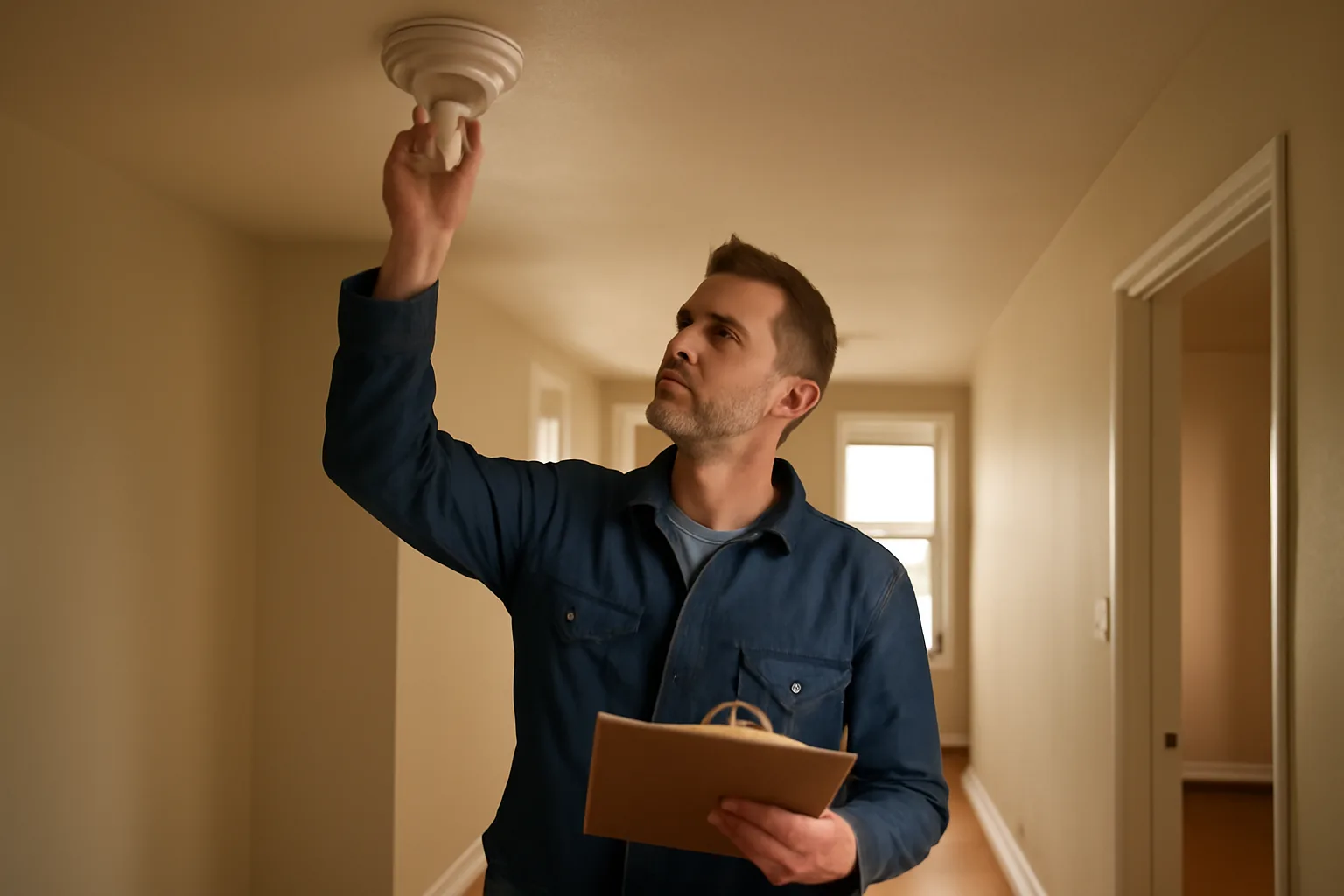
During a routine or move-out inspection, a landlord can look at the general condition and safety of the unit: working smoke and carbon monoxide detectors, plumbing leaks, electrical hazards, HVAC function, signs of pest infestation, mold, structural damage, and cleanliness that could cause damage beyond normal wear and tear. This is about habitability and lease compliance, not a search of personal belongings. What a landlord generally cannot do is treat an inspection as a pretext to go through drawers, closets, or personal items, or to use it as surveillance. Most state laws require inspections to be for a legitimate purpose (repairs, safety checks, showing the unit to prospective tenants or buyers, or a required licensing inspection) and require advance notice, typically 24 to 48 hours depending on the state. For city rental licensing inspections specifically, the inspector is checking against a code checklist: means of egress, smoke/CO detector placement and function, electrical panel condition, water heater strapping or relief valve, handrails and guardrails, window locks, and sometimes minimum square footage per occupant. These are code items, and the inspector isn't there to evaluate your tenant's housekeeping unless it creates a safety hazard.
what rights do tenants have without a lease?
A tenant without a written lease still has real legal rights, because an oral or implied agreement creates what's usually called a month-to-month tenancy at will, governed by the same state landlord-tenant statute that applies to written leases. The lack of paper doesn't erase the law. Tenants without a lease generally still have the right to: habitable housing under the implied warranty of habitability, protection from illegal lockouts or utility shutoffs (self-help eviction is illegal in every state), advance notice before the landlord raises rent or terminates the tenancy (commonly 30 days for month-to-month tenancies, though some states require more), and the return of any security deposit within their state's required timeframe. What they typically don't have is a fixed term. Without a lease specifying an end date, either party can usually end the tenancy with proper notice, subject to any local just-cause eviction ordinance that might still apply. If you're renting without a written lease, you're not in a lawless zone, you're just operating under whatever your state's default landlord-tenant code says, which is often less favorable to you as the landlord than a clear written lease would be.
how much notice does a landlord have to give?
How much notice a landlord must give depends on what's changing: entry, rent increase, or termination, and the answer varies by state. There's no single federal number. For entry, most states require 24 to 48 hours' advance notice for non-emergency access, though a few states don't specify a number and just require "reasonable notice." California requires 24 hours in most circumstances [2]. Florida's landlord-tenant statute requires the landlord to give the tenant reasonable notice of intent to enter, and specifies that 12 hours' notice is presumed reasonable for the purpose of repairs [3]. For rent increases on month-to-month tenancies, 30 days' notice is common, but some states and cities require more for larger increases, especially in rent-stabilized jurisdictions. For lease termination or non-renewal, 30 days is typical for tenancies under a year, with some states requiring 60 or 90 days for longer tenancies or in cities with just-cause eviction protections. Always check your specific state statute; a landlord who gives the wrong notice period can end up restarting the clock on an eviction case, which costs weeks and often hundreds of dollars in refiled court costs.
why do landlords require renters insurance?
Landlords require renters insurance mainly to shift liability risk and personal property risk away from the landlord's own policy. A landlord's dwelling policy covers the structure and the landlord's liability; it generally does not cover a tenant's personal belongings or a tenant's liability if, say, their dog bites a visitor or their unattended candle starts a fire. Renters insurance is inexpensive relative to the protection it buys. The Insurance Information Institute reports that the average renters insurance policy costs roughly $15 to $20 a month for a typical HO-4 policy, according to its 2023 facts and statistics on renters insurance [4]. That's a small ask compared to the cost of an uninsured fire or water damage claim. Requiring it also protects the landlord indirectly: if a tenant's negligence causes damage to the unit or to a neighboring unit, the tenant's liability coverage (rather than the landlord's insurer or the landlord's own pocket) often pays the claim. Many landlords write a renters insurance requirement directly into the lease and ask for proof of a policy naming the landlord as an interested party or additional insured before handing over keys.
what a landlord cannot do in ohio
In Ohio, landlord-tenant relationships are governed by Ohio Revised Code Chapter 5321, and it lays out specific things a landlord cannot do. A landlord cannot shut off utilities, change locks, or remove a tenant's belongings to force them out; Ohio law requires eviction to go through the court process (a forcible entry and detainer action), not self-help [5]. A landlord cannot enter the rental unit without reasonable notice except in an emergency; Ohio Revised Code 5321.04 requires landlords to give "reasonable notice" of intent to enter and to enter only at reasonable times, and most Ohio courts and practitioners treat 24 hours as the safe standard [5]. A landlord also cannot retaliate against a tenant for exercising legal rights, such as reporting a code violation or joining a tenant union; Ohio Revised Code 5321.02 specifically bars retaliatory rent increases, service reductions, or eviction filed within specific timeframes after protected tenant activity [6]. And a landlord cannot ignore the duty to maintain the property in a fit and habitable condition, keep common areas safe, and keep all utilities in good working order per Ohio Revised Code 5321.04's landlord obligations list [5].
does my city require a rental license, registration, or inspection?
A growing list of U.S. cities require landlords to register their rental property, obtain a rental license, or pass a habitability inspection before renting, and the specifics differ wildly from one city to the next. There's no national database that covers every municipality, so this is genuinely a confirm-locally situation. Common program types include: rental registration (just adding your property to a city database, often with a small annual fee), rental licensing (a permit that must be renewed, sometimes tied to an inspection), and proactive rental inspection programs (the city inspects units on a cycle, sometimes triggered by tenant complaints, sometimes universal). Fines for operating an unlicensed rental vary by city and can run from small administrative fees up to hundreds of dollars per violation per day in cities with aggressive enforcement, though exact amounts should be confirmed with your specific city rental licensing office since ordinances change. If you've gotten a notice, a fine, or an inspection deadline letter, don't guess at what's required; check your city's specific ordinance page or call the licensing office directly, because programs range from a simple online registration to a multi-point inspection with a fire marshal walkthrough.
what happens if you skip licensing or ignore an inspection notice?
Ignoring a rental licensing notice or inspection deadline generally leads to escalating consequences: a warning letter, then a fine, then in many cities an order to stop renting the unit until compliance, and in serious or repeated cases the city can pursue court action. Some cities also make an unlicensed rental unenforceable in eviction court. That means if you try to evict a nonpaying tenant while your rental license has lapsed, some courts will dismiss the case until you get the license current, which can cost you months of lost rent while the case sits. The fix is almost always cheaper than the fine. Getting current on registration, scheduling the inspection, and fixing the flagged items is usually far less expensive than accumulated per-day violation fines. If you're staring down a first notice, treat it as a to-do list, not a crisis: confirm the requirement with your city office, gather what you need (proof of ownership, floor plan, smoke detector certification, sometimes a lead paint disclosure for older housing), and get on the schedule.
how to be a landlord without getting blindsided by rules
The landlords who avoid fines and lawsuits aren't the ones with the nicest units, they're the ones who track deadlines and keep records. A few habits make an outsized difference. Keep a renewal calendar for every license, registration, and inspection deadline tied to the property, with a reminder set 60 days out. Cities rarely send more than one renewal notice, and it's easy for it to land in a spam folder. Document the unit's condition at move-in and move-out with dated photos, more than a checklist. This protects you in security deposit disputes and, in California, ties directly into the required move-out inspection process under Civil Code 1950.5 [2]. Put every notice period, deposit rule, and entry rule in writing, in the lease, matching your state's statute exactly. Don't copy a lease template from a different state; deposit limits, notice periods, and required disclosures vary enough that a mismatched lease can cost you a case. If your city requires an inspection, walk through it yourself first using the actual code checklist, not a generic guess. This is the exact gap our City Rental License & Inspection Prep Packet is built to close: a $79 one-time packet with the document checklist and prep steps so you're not discovering a missing smoke detector requirement the day the inspector shows up.
how tenant rights and landlord obligations connect
Landlord obligations and tenant rights are two sides of the same statute, and understanding one without the other leaves gaps. A landlord's duty to maintain habitability exists because the tenant has a right to a livable unit. A landlord's notice requirement before entry exists because the tenant has a right to quiet enjoyment of the space they're renting. If you're building out your lease or your inspection prep, it helps to read the tenant side of the same rules, more than the landlord checklist. See our guides on tenants rights, tenant rights, and renters rights for the tenant-facing version of the same notice, entry, and habitability rules covered above, plus our breakdowns on landlord basics and landlord landlords obligations for the ownership side.
Frequently asked questions
How to become a landlord if I only own one rental unit?
The process is the same regardless of size: confirm zoning allows the rental, register or license it with your city if required, pass any mandatory inspection, get landlord insurance, and use a lease matching your state's landlord-tenant law. One-unit landlords face the same licensing rules as ten-unit owners in most cities that require registration.
Who is responsible for a rental property walk-through inspection in California?
The landlord initiates and conducts the pre-move-out inspection, but the tenant has the right to request it and be present. California Civil Code 1950.5(f) requires landlords to notify tenants of this right and give at least 48 hours' notice of the scheduled inspection date.
What is landlording?
Landlording is the business of owning residential rental property and managing the legal, financial, and maintenance responsibilities that come with renting it out, including rent collection, repairs, licensing compliance, and following tenant-notice and habitability laws.
What is a landlord?
A landlord is the owner or lessor of residential property who rents it to a tenant in exchange for rent under a rental agreement, written or oral. This legal status triggers obligations under state landlord-tenant law, regardless of how many units the person owns.
What rights do tenants have without a lease?
Tenants without a written lease still have rights under their state's landlord-tenant statute: habitable housing, protection from illegal lockouts or utility shutoffs, advance notice before rent increases or termination (often 30 days), and return of any security deposit. The tenancy is usually treated as month-to-month.
How to be a landlord and avoid fines?
Track every licensing, registration, and inspection deadline tied to your property with a 60-day reminder, keep dated photos of unit condition, match your lease exactly to your state's notice and deposit rules, and walk through code inspection checklists yourself before the official inspection.
Why do landlords require renters insurance?
Renters insurance covers a tenant's personal belongings and personal liability, which a landlord's own dwelling policy doesn't cover. The Insurance Information Institute puts the average cost around $15 to $20 a month, and it protects both parties if a tenant's negligence causes fire, water, or liability damage.
How much notice does a landlord have to give before entering?
Most states require 24 to 48 hours' advance notice for non-emergency entry. California requires 24 hours in most cases. Florida's statute treats 12 hours as reasonable notice for repair entry. Always confirm your specific state's statute, since the number isn't federally standardized.
What can a landlord look at during an inspection?
A landlord can inspect for safety and habitability issues: smoke/CO detectors, plumbing leaks, electrical hazards, HVAC function, pests, mold, and structural damage. Inspections should have a legitimate purpose and can't be used to search personal belongings or as pretextual surveillance.
What a landlord cannot do in Ohio?
Under Ohio Revised Code Chapter 5321, a landlord cannot shut off utilities or change locks to force out a tenant, cannot enter without reasonable notice except in emergencies, cannot retaliate against a tenant for reporting code violations, and must keep the unit fit and habitable.
Does every city require a rental license?
No. Rental licensing, registration, and inspection requirements vary city by city and even county by county; there's no nationwide rule. Some cities have no program at all, others require annual registration only, and others require a full habitability inspection before you can rent legally.
What happens if I ignore a rental inspection deadline notice?
Consequences usually escalate: a warning, then a fine, then in many cities an order to stop renting until compliance. Some jurisdictions also won't let you pursue an eviction case while your license is lapsed, which can cost months of lost rent while the case sits.
Do I need a rental license if I only rent to family?
In most cities, yes, if money changes hands for the arrangement, though some ordinances exempt owner-occupied units or certain low-unit-count exemptions. This varies enough by municipality that you should confirm directly with your city rental licensing office rather than assume an exemption applies.
Sources
- HUD, Fair Housing Act protected classes: Federal Fair Housing Act bars discrimination based on race, color, national origin, religion, sex, familial status, or disability
- California Legislative Information, Civil Code Section 1950.5: California landlords must notify tenants of the right to an initial move-out inspection and give 48 hours' notice; general 24-hour entry notice standard
- Florida Legislature, Statute 83.53: Florida landlord entry notice standard treats 12 hours as reasonable notice for repair access
- Ohio Laws, Revised Code 5321.04: Ohio landlord obligations: reasonable notice before entry, habitability duty, and bar on self-help eviction
- Ohio Laws, Revised Code 5321.02: Ohio bars landlord retaliation against tenants for exercising legal rights, such as reporting code violations
- Insurance Information Institute, Facts + Statistics: Renters insurance: Average renters insurance policy costs roughly $15 to $20 a month