Last updated 2026-07-26
TL;DR
Becoming a landlord means more than buying a rental property. Most cities require registration or licensing, periodic inspections, and proper notice before entry. Requirements vary by state and city, but the basics (screening, habitability, notice, insurance) are consistent enough to plan around before you rent out your first unit.
what is landlording and what is a landlord?
A landlord is the owner (or an owner's authorized agent) who rents real property to another person in exchange for payment, usually under a lease or rental agreement. "Landlording" is the informal term for the whole job: screening tenants, collecting rent, handling maintenance, following local law, and dealing with the surprises that come with owning rental property. It's more than a title on a lease. A landlord takes on legal duties that vary by state, but generally include keeping the unit habitable, following fair housing law, handling security deposits correctly, and giving proper notice before entering a unit or ending a tenancy. HUD's Office of Fair Housing enforces the federal Fair Housing Act, which bars discrimination based on race, color, national origin, religion, sex, familial status, and disability in housing transactions [1]. Many new landlords underestimate how much of the job is administrative. Cities with mandatory rental registration or licensing (common in states like California, Ohio, and parts of the Northeast and Midwest) add a layer of paperwork and inspection on top of the basic landlord-tenant relationship. If you're just starting out, treat that paperwork as part of the job, not an afterthought.
how to become a landlord (step by step)
Becoming a landlord is mostly a sequence of legal and financial checkpoints, not a license exam. Here's the realistic order most people go through: 1. Buy or convert a property into a rental, and check zoning to confirm rental use is allowed. 2. Register or license the rental with your city or county if required. This is separate from your property tax bill and is often missed by first-time landlords. 3. Get landlord (more than homeowner's) insurance, sometimes called a dwelling fire policy or DP-3, which covers rental-specific risks like loss of rental income. 4. Set up a compliant lease, security deposit handling process, and screening criteria that follows fair housing law. 5. Schedule any required rental inspection before you can legally rent the unit out, if your city mandates one. 6. Learn your state's notice requirements for entry, rent increases, and lease termination before you need them. Skipping step 2 is the most common expensive mistake. Cities that require rental registration often charge back fees or penalties for unregistered units once they find out, and "I didn't know" is not a defense in most municipal codes. If you own in a city with mandatory licensing, our City Rental License & Inspection Prep Packet walks through the registration and inspection paperwork step by step for a one-time $79 fee, built for landlords with 1 to 10 units.
how to be a landlord day to day (what the job actually involves)
Once you're set up, day-to-day landlording is a mix of a few recurring tasks: rent collection, maintenance requests, occasional turnover between tenants, and staying current on local rule changes. Most independent landlords with a handful of units spend more time on maintenance coordination and paperwork than on anything dramatic. The biggest ongoing responsibilities are habitability (keeping the unit safe and functional), timely repairs, and following your state's specific rules on notice, deposits, and entry. A landlord who ignores maintenance requests risks both tenant complaints to code enforcement and, in many states, a legal defense called "repair and deduct" where the tenant can pay for the repair themselves and deduct it from rent. If you self-manage 1 to 10 units, expect to spend real time on three things: responding to maintenance calls within a reasonable window, tracking security deposit deadlines (many states require return or an itemized deduction list within 14 to 30 days of move-out), and keeping your rental registration or license current if your city requires renewal. Missing a renewal deadline is one of the more common ways landlords end up with an unexpected fine notice.
who is responsible for a rental property walk-through inspection in california?
In California, the landlord is generally responsible for offering an initial move-out inspection, but the process is a shared one. Under California Civil Code Section 1950.5(f), the landlord must, if the tenant requests it, conduct an initial inspection of the unit before the tenant moves out, giving the tenant "a reasonable opportunity to remedy identified deficiencies... prior to the termination of the tenancy" [2]. The statute requires the landlord to give at least 48 hours' written notice of the date and time of the initial inspection, unless the tenant waives that notice [2]. After the inspection, the landlord must provide an itemized statement of proposed deductions, and the tenant then has a chance to fix things themselves or negotiate before move-out. Separately, some California cities with rental inspection ordinances (not the statewide deposit law, but local habitability inspection programs) require the landlord or a city inspector to walk through the unit periodically to check for code violations. Those programs are city-specific, so confirm with your city rental licensing office whether your unit falls under a proactive inspection ordinance rather than just the statewide move-out inspection rule. The move-out inspection is for the tenant's benefit as much as the landlord's. It's a chance to avoid disputes over the security deposit later, and skipping it (when a tenant requests it) can weaken a landlord's position in a deposit dispute.
what can a landlord look at during an inspection?
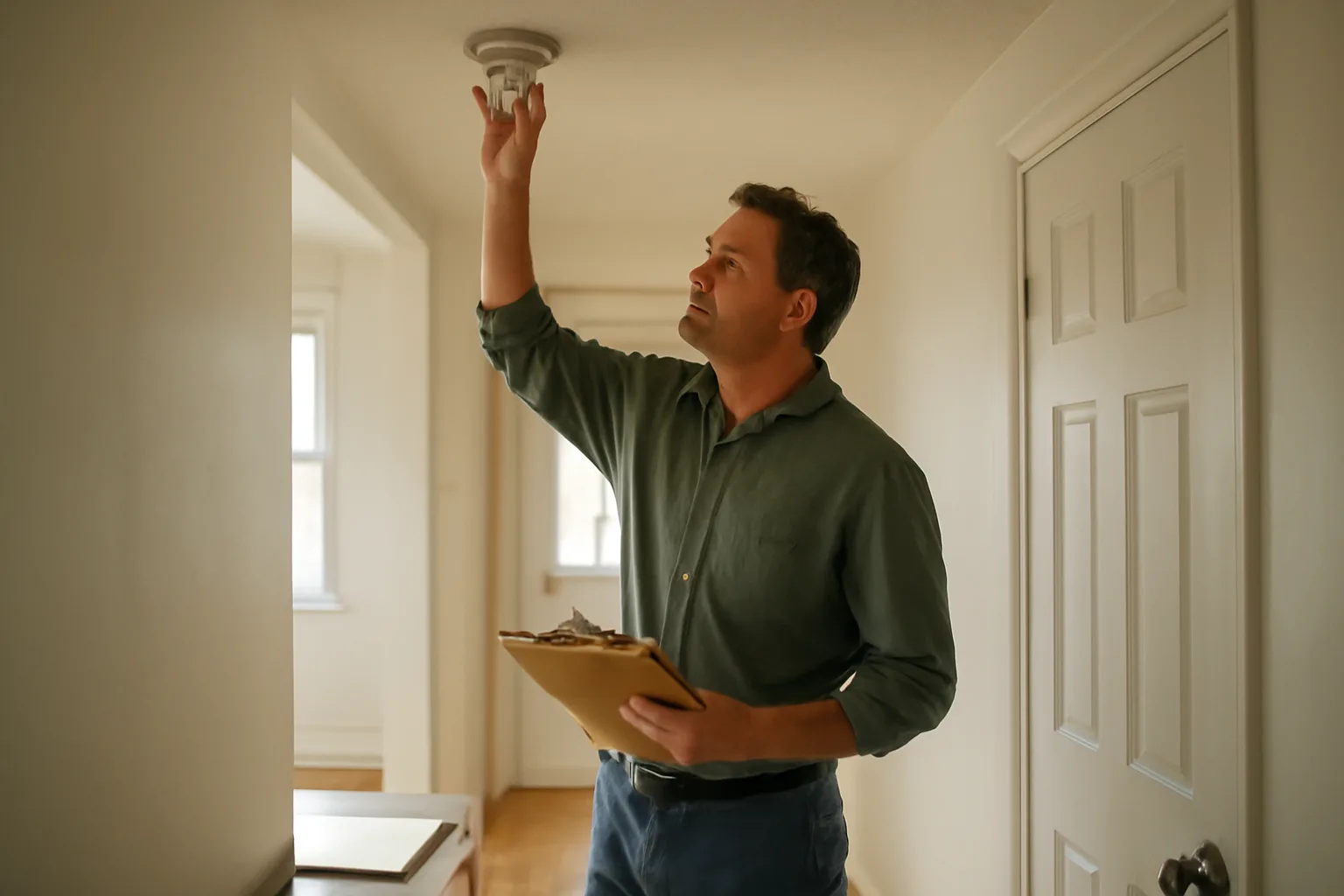
During a routine or move-out inspection, a landlord can generally check for property condition and code compliance: working smoke and carbon monoxide detectors, plumbing and electrical function, signs of pest infestation, structural damage, mold, and cleanliness relative to normal wear and tear. A landlord is not generally allowed to search through a tenant's personal belongings, go through drawers or closets unrelated to a stated maintenance issue, or use an inspection as cover to harass or intimidate a tenant. What's fair game usually maps to what's in the lease and what's required for habitability: HVAC function, water damage, appliance condition, and safety equipment. Some city rental licensing inspections go further and check for things like proper egress from bedrooms, handrail condition, GFCI outlets near water sources, and working locks, because those are common code violation categories. The legal boundary that matters most is notice and purpose. An inspection has to be for a legitimate reason (maintenance, safety compliance, a lease-required periodic check) and has to follow your state's advance notice rule. A landlord who enters without notice "just to look around" is exposing themselves to a real complaint, even in states with fairly landlord-friendly law. If your city has a mandatory rental inspection ordinance, that inspection is usually broader than a private landlord's routine check. City inspectors often look for permit compliance, occupancy limits, and safety code items that go beyond what a private lease would cover.
how much notice does a landlord have to give before entering a rental?
Notice requirements vary by state, and there's no single national rule. California requires at least 24 hours' written notice for most non-emergency entries, under California Civil Code Section 1954, which states that a landlord "may enter the dwelling unit... after giving the tenant reasonable notice... in the absence of an agreement, 24 hours shall be presumed to be reasonable notice" [3]. Other states set different defaults. Some require 48 hours, some require only "reasonable notice" without a specific number, and a few require written notice while others allow verbal notice. This means you have to check your own state's landlord-tenant statute or your city's rental code rather than assume a single national standard applies. Emergencies are the universal exception. Nearly every state allows a landlord to enter without advance notice if there's an emergency, such as a fire, flood, gas leak, or another situation threatening health or safety. Outside of emergencies, entering without proper notice can expose a landlord to a claim for violation of the tenant's right to quiet enjoyment, and in some states it's an explicit statutory violation with its own penalty. Because the exact number of hours differs by state (and sometimes by city ordinance layered on top), confirm your specific state's notice period rather than relying on a general rule of thumb. When in doubt, 24 to 48 hours' written notice covers most jurisdictions and is a reasonable default practice even where the law technically allows less.
why do landlords require renters insurance?
Landlords require renters insurance mainly to shift liability and personal property risk away from the landlord's own policy. A standard landlord insurance policy covers the building and the landlord's liability, but it typically does not cover a tenant's personal belongings or the tenant's liability for incidents they cause inside the unit. If a tenant's negligence causes a fire, water damage, or a guest injury, renters insurance (which commonly includes personal liability coverage, often starting around $100,000 in coverage on basic policies) can cover the tenant's share of the damage instead of that cost falling entirely on the landlord's policy or out of pocket. This is why many leases make renters insurance a lease condition rather than a suggestion. Requiring renters insurance is legal in most states as a lease condition, as long as it's applied consistently to all tenants and doesn't function as a way to discriminate. It's generally cheap for tenants too. Renters insurance policies commonly run in the range of $15 to $30 per month depending on coverage and location, though exact pricing depends on the insurer and the tenant's location and coverage limits. For a landlord with 1 to 10 units, requiring renters insurance is one of the lowest-cost risk management moves available. It doesn't replace your own landlord policy, but it closes a real gap in what your policy is likely to cover.
what rights do tenants have without a lease?
A tenant without a written lease still has real legal rights. Most states treat an unwritten rental arrangement as a month-to-month tenancy-at-will, which means the tenant has the same basic protections as a leased tenant: the right to habitable housing, protection from illegal lockouts or utility shutoffs, the right to proper notice before eviction, and protection under fair housing law. What changes without a lease is mostly the certainty around lease-specific terms (rent amount changes, exact move-out date, specific rules about pets or guests) rather than the tenant's fundamental legal protections. A landlord still can't just change the locks or remove a tenant's belongings without going through the legal eviction process required by the tenant's state, even if there was never a signed lease. Month-to-month tenants (with or without a written agreement) are still entitled to standard notice before the tenancy ends. Many states require 30 days' notice to end a month-to-month tenancy, though some require more for longer-term tenants, so check your specific state statute rather than assuming 30 days applies everywhere. Habitability rights also don't disappear without paperwork. A tenant living under an oral or informal arrangement is still entitled to a livable unit with working utilities, and a landlord who lets conditions slide is exposed to the same code enforcement and legal risk as with a written lease.
what a landlord cannot do in ohio
Ohio landlord-tenant law, codified largely in Ohio Revised Code Chapter 5321, sets specific limits on what a landlord can and cannot do. Under Ohio Revised Code Section 5321.04, a landlord cannot, among other things, retaliate against a tenant for exercising a legal right (like reporting a code violation), and must maintain the premises in a fit and habitable condition [4]. Ohio Revised Code Section 5321.04 requires the landlord to "comply with the requirements of all applicable building, housing, health, and safety codes," keep common areas safe, and maintain electrical, plumbing, and heating systems in good working order [4]. A landlord who fails to do this can be subject to a tenant's legal remedies, including in some cases the tenant's right to deduct repair costs from rent or terminate the lease. On entry, Ohio Revised Code Section 5321.04 also generally requires the landlord to give reasonable notice, commonly interpreted as 24 hours, before entering except in an emergency. A landlord in Ohio also cannot engage in "self-help" eviction: locking out a tenant, shutting off utilities, or removing belongings without a court-ordered eviction is illegal even if the tenant is behind on rent. Ohio Revised Code Section 5321.02 specifically prohibits retaliatory conduct, meaning a landlord cannot raise rent, decrease services, or attempt to end a tenancy specifically because a tenant complained to a health or safety authority or joined a tenants' organization [5]. If you're a landlord in Ohio, it's worth reading Chapter 5321 directly rather than relying on secondhand summaries, because it covers deposit handling, notice, and habitability in one place.
how rental licensing and inspection programs fit into all of this
Everything above is baseline landlord-tenant law, which applies whether or not your city has a rental licensing program. On top of that baseline, a growing number of cities require landlords to register or license rental units and pass a periodic inspection before renting or renewing. These programs vary enormously by city. Some just require an annual registration fee and self-certification. Others require a city inspector to walk through the unit checking for safety code compliance (smoke detectors, egress windows, electrical panel condition, handrails) on a set schedule, often every one to three years. Fees, forms, and inspection cycles are set locally, so confirm the specific fee, inspection interval, and renewal deadline with your city rental licensing office rather than assuming your neighboring city's rules apply. Minneapolis, for example, requires most rental properties to hold a rental license and undergo inspection under its property maintenance code, with inspection frequency tied to the property's prior violation history [6]. Missing a rental license renewal or failing to register a unit at all is one of the more expensive and avoidable mistakes a small landlord can make. Many cities issue escalating fines for unregistered or unlicensed rental units, and some withhold the ability to file an eviction in local court until the property is properly licensed. If you're facing a first-time registration, an inspection deadline, or a violation notice from your city, treating it as routine paperwork (rather than an emergency) usually keeps costs down. Our City Rental License & Inspection Prep Packet is a $79 one-time resource built specifically to help landlords with 1 to 10 units organize the registration and inspection paperwork these city programs require.
Frequently asked questions
How do I become a landlord for the first time?
Buy or convert a property zoned for rental use, register it with your city if required, get landlord insurance, set up a compliant lease and screening process, and schedule any mandatory rental inspection. Check with your city rental licensing office early, since registration requirements are easy to miss and often carry fines if skipped.
What is the difference between landlording and being a landlord?
"Landlord" is the legal role: the person or entity that owns and rents out property. "Landlording" is the everyday work involved in that role, including screening tenants, maintenance, rent collection, and compliance with local licensing and inspection rules.
Who has to be present for a rental walk-through inspection in California?
Under California Civil Code Section 1950.5(f), the landlord must offer the initial move-out inspection if the tenant requests one, giving 48 hours' written notice, and the tenant has the right to be present. City-mandated safety inspections (separate from this deposit-related rule) vary by local ordinance, so confirm attendance rules with your city rental licensing office.
What rights does a tenant have without a signed lease?
A tenant without a written lease is generally still protected as a month-to-month tenant: they're entitled to habitable housing, proper eviction notice, and fair housing protections. What's missing is certainty around lease-specific terms, not the tenant's core legal rights under state law.
Can a landlord require renters insurance as a lease condition?
Yes, in most states a landlord can require renters insurance as a lease condition, as long as it's applied consistently to all tenants. It's a common and low-cost way to cover tenant liability and personal property risk that a landlord's own policy typically doesn't include.
How much notice does a landlord need to give before entering a unit?
It depends on the state. California presumes 24 hours is reasonable notice under Civil Code Section 1954. Other states set different defaults, some requiring 48 hours or just "reasonable notice" without a fixed number. Always check your specific state statute, and expect exceptions for genuine emergencies.
What can a landlord check during a routine inspection?
A landlord can typically check safety equipment, plumbing and electrical function, signs of pests or mold, and general condition relative to normal wear and tear. A landlord generally cannot search personal belongings unrelated to maintenance or use an inspection to harass a tenant.
What can't a landlord do in Ohio?
Under Ohio Revised Code Chapter 5321, a landlord cannot retaliate against a tenant for reporting code violations, cannot perform a self-help eviction (like changing locks or shutting off utilities), and must keep the unit compliant with building, health, and safety codes and in good repair.
Do all cities require rental licenses or registration?
No. Rental licensing and registration requirements are set city by city or county by county, not nationally. Some cities have no program at all, others require simple registration, and some require periodic safety inspections. Always confirm requirements directly with your specific city's rental licensing office.
What happens if a landlord doesn't register a rental unit with the city?
Consequences vary by city, but commonly include fines, back-registration fees, and in some jurisdictions the inability to file an eviction in local court until the unit is properly registered. Confirm your city's specific penalty structure with its rental licensing office rather than assuming a fixed fine amount.
Is a landlord responsible for pest control?
In most states, yes, as part of the general habitability duty, especially for infestations that predate the tenant's occupancy or stem from a building-wide issue. Ohio Revised Code Section 5321.04 specifically requires landlords to maintain units in a fit and habitable condition, which typically includes addressing pest infestations.
How long does a tenant have to fix issues found in a California move-out inspection?
California Civil Code Section 1950.5(f) requires the landlord to give the tenant "a reasonable opportunity to remedy identified deficiencies" before the tenancy ends, but the statute doesn't set an exact number of days; the timeframe depends on how much notice remains before the move-out date.
Can a landlord evict a tenant for complaining about code violations?
No, in most states this is illegal retaliation. Ohio Revised Code Section 5321.02, for example, specifically bars landlords from raising rent, cutting services, or ending a tenancy because a tenant reported a health or safety violation or joined a tenant organization.
Sources
- HUD, Office of Fair Housing and Equal Opportunity: Federal Fair Housing Act bars discrimination based on race, color, national origin, religion, sex, familial status, and disability
- California Legislative Information, Civil Code Section 1950.5: California landlords must offer an initial move-out inspection with 48 hours' notice and a chance to remedy deficiencies
- California Legislative Information, Civil Code Section 1954: California presumes 24 hours is reasonable notice before a landlord enters a rental unit
- Ohio Legislative Service Commission, Ohio Revised Code Section 5321.04: Ohio landlords must maintain the unit in compliance with building, housing, health, and safety codes and keep systems in good working order
- Ohio Legislative Service Commission, Ohio Revised Code Section 5321.02: Ohio law prohibits landlords from retaliating against tenants who report code violations or join tenant organizations
- Minneapolis City Code, Chapter 244 (Maintenance Code: Residential Rental Licenses): Minneapolis requires most rental properties to hold a rental license and undergo inspection, with frequency tied to violation history