Last updated 2026-07-26
TL;DR
There's no national or state-level requirement to hold a general "landlord license." But a growing number of cities and counties require rental registration, a rental license, or a habitability inspection before you can legally rent out a unit. Whether you need one depends entirely on your city or county, not your state.
do landlords have to have a license?
It depends on where the property sits, not on the fact that you're a landlord. No U.S. state issues a blanket "landlord license" the way it issues a driver's license or a contractor's license. What actually triggers a licensing requirement is city or county ordinance, and thousands of municipalities have passed one. Some cities call it a rental license. Others call it rental registration, a certificate of occupancy for rental use, or a residential rental permit. The name changes, the substance is usually similar: you tell the city you're renting out a unit, you pay a fee, and in many programs an inspector checks the unit for basic safety and habitability items before or after you get approved. Cities that run these programs include Baltimore, which requires a rental license renewed every two years, with a base fee for a single-unit license, and Los Angeles, where the Systematic Code Enforcement Program (SCEP) charges an annual per-unit fee to fund proactive inspections [1]. Minneapolis requires a rental license for any property that isn't owner-occupied, with license categories tied to inspection history [2]. If you own in a city with no such ordinance, you may not need any license at all beyond standard business registration your city already requires of any business owner. If you own in Baltimore, Los Angeles, Minneapolis, or hundreds of similarly-sized cities, skipping the license isn't a paperwork inconvenience, it's a code violation with real fines attached.
how do i find out if my city requires a rental license?
Start with your city's department of housing, code enforcement, or building and safety. That's usually where rental licensing programs live administratively, separate from the tax assessor or the county recorder. Search your city name plus "rental registration" or "rental license" on the city's own.gov or.us domain. Skip aggregator sites and real estate blogs for this step; you want the ordinance page or the fee schedule, not a summary someone wrote in 2019. Call the office directly if the website is unclear, which happens more than it should. Ask three things: is a license required for my unit type, what's the current fee, and is there an inspection tied to it. Get the answer in writing or note the date and the name of the person you spoke with. Ordinances change, and "the guy on the phone said it was fine" doesn't hold up against a citation six months later. County-level rules matter too in some states. Certain counties in Maryland, for instance, layer county rental licensing on top of anything the city requires, so a property inside city limits may need both a city license and a county one.
what happens if i rent without a required license?
You get fined, and in some cities you can be blocked from enforcing a lease or collecting rent through the courts until you're licensed. Los Angeles's SCEP ordinance authorizes penalty fees on top of the base per-unit charge for properties that are late to register [1]. Baltimore's rental licensing law makes operating an unlicensed rental a code violation subject to citation, and unlicensed landlords in Baltimore can run into trouble pursuing an eviction because courts may require proof of a valid rental license before hearing a landlord's case. This last point trips people up constantly. You can own the property outright, have a signed lease, and still find your eviction case dismissed or continued because you can't produce a current rental license. It's not a technicality the court waives easily. Fines vary widely by city and by how long you were unlicensed. Some ordinances start around $100 to $300 for a first violation and escalate with each inspection cycle or each day the violation continues. Confirm the exact fine schedule with your city rental licensing office rather than assuming a number from another city applies to you.
what is a landlord?
A landlord is the person or entity that owns residential or commercial property and rents it to someone else, called a tenant, under a lease or rental agreement. The landlord holds legal title (or in some cases a master lease giving them the right to sublease), and in exchange for rent, the landlord gives the tenant exclusive possession of the unit for the lease term. Landlord status comes with legal obligations regardless of whether you think of yourself as a "real" landlord or just someone renting out a spare unit. If you collect rent from someone living in a unit you own, you're legally a landlord under your state's landlord-tenant statute, full stop. That includes people renting out a basement apartment, a duplex unit, an inherited house, or a single room.
what is landlording?
Landlording is the ongoing work of managing rental property: screening tenants, collecting rent, handling repairs, following state and local landlord-tenant law, and managing the lease relationship from move-in to move-out. It's a mix of legal compliance and property management, and most first-time landlords underestimate the legal compliance half. The legal side includes things like handling security deposits according to your state's deposit statute (many states cap the deposit amount and set a strict deadline, often 14 to 30 days, for returning it after move-out), giving proper notice before entry or before ending a tenancy, following fair housing law in advertising and screening, and, in licensing cities, keeping your rental license or registration current. The property management side is what most people picture: fixing the water heater, showing the unit, collecting rent on time. Both halves matter. A landlord who's great at maintenance but ignores licensing deadlines or notice requirements can still end up in housing court or facing city fines.
how to become a landlord
Becoming a landlord legally involves more than buying a rental property and putting up a listing. Here's the realistic sequence. First, check zoning and licensing. Confirm the property is zoned for rental use and find out whether your city or county requires rental registration or a license before you can legally rent it out. This is the step people skip and regret. Second, learn your state's landlord-tenant law. Every state has one, covering security deposit limits and return deadlines, notice periods for entry and termination, habitability requirements, and eviction procedure. Third, get the property inspection-ready if your city requires one. That usually means working smoke and carbon monoxide detectors, no exposed wiring, functioning heat, no active leaks, secure locks, and clear egress from bedrooms. Landlord landlords covers what a typical pre-rental inspection checklist looks like. Fourth, screen tenants consistently and legally. Use the same criteria for every applicant (credit, income, rental history, background check where legal) and document your decisions. The Fair Housing Act prohibits discrimination based on race, color, national origin, religion, sex, familial status, or disability in any housing-related decision [3]. Fifth, get a compliant lease. Fifth, set up separate accounting. Sixth, register or license the rental if your city requires it, and keep that registration current on renewal, because most cities require annual or biennial renewal, not a one-time filing.
how to be a landlord day to day
Day to day, being a landlord means answering maintenance requests promptly, tracking lease renewal and rent due dates, keeping receipts and records for taxes, and staying on top of any local licensing renewal date so it doesn't lapse without you noticing. Most small landlords with one to ten units manage this with a simple system: a shared calendar for renewal and inspection dates, a dedicated bank account for rental income and expenses, and a folder (digital or physical) per property with the lease, inspection reports, and license or registration certificate. The habit that saves the most money over time is treating your city's licensing deadline the same way you'd treat a mortgage payment due date: mark it on the calendar the day you get the license, not the week before it expires. Late renewal fees in some cities double the base fee, and a lapsed license can mean an inspector shows up to find you technically operating illegally even though you meant to renew.
why do landlords require renters insurance?
Landlords require renters insurance mainly to shift liability for the tenant's personal property and for injuries or damage the tenant causes, away from the landlord's own policy. A standard landlord (dwelling) insurance policy covers the building structure, but it typically does not cover a tenant's furniture, electronics, or clothing if there's a fire, burst pipe, or theft. Without renters insurance, a tenant who loses everything in a covered event has no coverage of their own, and some will look to sue the landlord to recover the loss even when the landlord's policy wasn't designed to cover tenant belongings. Renters insurance also usually includes liability coverage, which protects the tenant (and indirectly the landlord) if the tenant's dog bites a visitor or the tenant accidentally causes a kitchen fire that damages a neighboring unit. Many landlords require proof of a policy with a minimum liability limit, commonly $100,000, as a lease condition. This is a lease term you set, not something imposed by rental licensing law in most cities, though a few jurisdictions have started requiring it for certain subsidized or high-density housing programs. Requiring it is legal in nearly every state as a lease condition, similar to requiring a security deposit, as long as it's applied consistently and disclosed in the lease.
how much notice does a landlord have to give?
Notice requirements split into two very different categories: notice to enter the unit, and notice to end a tenancy. Both vary by state, and there's no federal standard for either. For entry, many states require 24 hours advance notice for routine, non-emergency entry (repairs, showings, inspections), though the exact number and the required method of notice (written, posted, verbal) differ by state. California, for example, presumes 24 hours is reasonable notice for entry under Civil Code Section 1954, but that's a presumption, not an absolute rule, and emergencies don't require notice at all [4]. For ending a month-to-month tenancy, notice periods commonly range from 30 days to 60 days depending on the state and sometimes on how long the tenant has lived there. Some states require 60 days notice if the tenant has been there a year or more. For fixed-term leases, in most states no notice is required to end the tenancy on the scheduled end date, though some cities with just-cause eviction ordinances require notice and a stated reason even at lease end. Check your specific state's statute rather than relying on a general number, because getting this wrong can invalidate a termination notice and cost you a full restart of the eviction timeline.
who is responsible for rental property walk-through inspection in california?
In California, the landlord is responsible for offering an initial move-out inspection to the tenant before the tenant vacates, and the tenant decides whether to accept it. California Civil Code Section 1950.5 requires that if the landlord intends to deduct from the security deposit for anything other than unpaid rent tied to the move-out inspection, the landlord must notify the tenant of the right to an initial inspection and, if the tenant requests it, conduct that inspection no earlier than two weeks before the end of the tenancy [5]. At that initial walk-through, the landlord gives the tenant an itemized statement of anything that would be deducted from the deposit based on conditions found, and the tenant gets a reasonable opportunity to fix those items before move-out to avoid the deduction. This is separate from any rental licensing inspection a city might also require; the security deposit walk-through is a state law requirement tied to the tenancy itself, not to rental licensing. For rental licensing inspections specifically (checking smoke detectors, egress, electrical safety, and general habitability), responsibility sits with the city's code enforcement or building department in cities that run such programs, not with the landlord doing a self-inspection, though the landlord is responsible for making the unit accessible and for fixing anything flagged.
what can a landlord look at during an inspection?
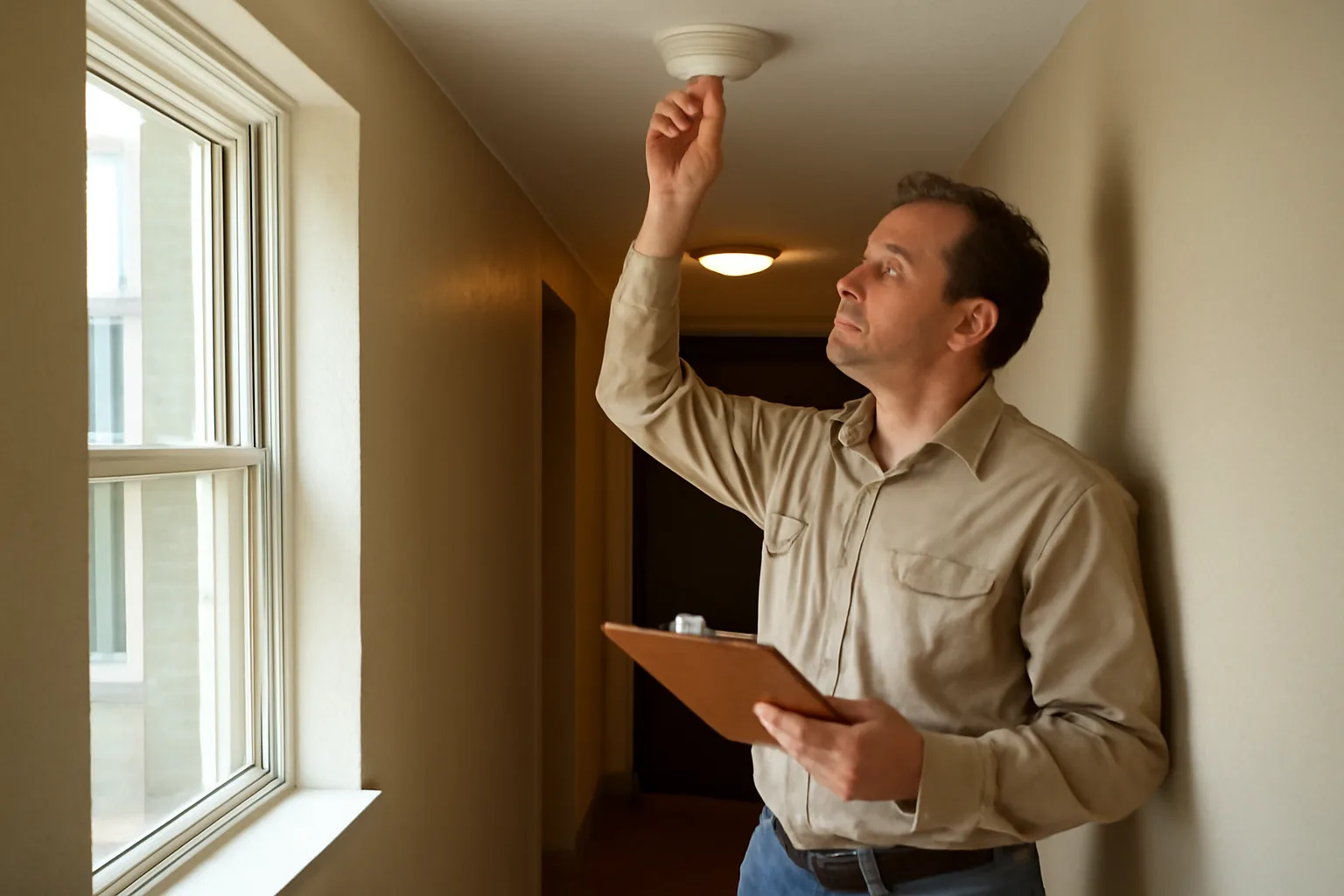
During a rental licensing inspection, the inspector generally checks life-safety and habitability items: working smoke detectors and carbon monoxide detectors, functioning heat, no active plumbing leaks, safe electrical (no exposed wiring, no overloaded circuits), secure exterior doors and windows, adequate egress from bedrooms, and absence of pest infestation or serious mold. Some cities also check for peeling lead paint in pre-1978 housing, tied to federal lead disclosure rules under 40 CFR Part 745 [6]. During a landlord's own periodic inspection of an occupied unit (as opposed to a city licensing inspection), what the landlord can look at is more limited by the tenant's right to quiet enjoyment. A landlord can generally check for maintenance issues, lease compliance (unauthorized occupants, unauthorized pets, property damage), and safety equipment. A landlord generally cannot search personal belongings, go through drawers or closets, or use the inspection as pretext to harass or intimidate a tenant. Most states require the landlord to give advance notice and to conduct the inspection at a reasonable time, and to enter only for a legitimate purpose stated in the notice. At move-out, California's deposit inspection under Civil Code 1950.5 lets the landlord look specifically at conditions that would justify a deposit deduction, itemized in writing [5]. That's narrower than a full home inspection; it's tied to damage beyond normal wear and tear, not general poking around.
what a landlord cannot do in ohio
Ohio's landlord-tenant law is set out in Ohio Revised Code Chapter 5321. Under this chapter, a landlord cannot shut off utilities, change the locks, or remove a tenant's belongings to force them out without going through the formal eviction process in court, sometimes called a "self-help eviction." Ohio law also prohibits retaliatory conduct, meaning a landlord cannot raise rent, decrease services, or start eviction proceedings specifically because a tenant complained to a government agency about a code violation or exercised another legal right under the chapter [7]. Ohio Revised Code 5321.04 requires landlords to keep the premises in a fit and habitable condition, comply with building and housing codes, keep common areas safe, and maintain the electrical, plumbing, and heating systems supplied [7]. A landlord who ignores these duties can face a tenant's right to certain remedies, including in some cases repair-and-deduct or lease termination, though tenants must generally give written notice of the problem and a reasonable time to fix it first. Ohio does not have a statewide rental licensing law; licensing requirements in Ohio come from individual cities, such as Cleveland and Columbus, that have passed their own rental registration ordinances. So an Ohio landlord's obligations are layered: state law (Chapter 5321) sets baseline tenant rights and habitability duties everywhere in the state, while city ordinance determines whether a license or registration is required on top of that.
what rights do tenants have without a lease?
A tenant without a written lease still has full rights under state landlord-tenant law; the absence of a written lease doesn't strip away legal protections. Without a written lease, the tenancy is typically treated as month-to-month (or week-to-week if rent is paid weekly), governed by the state's default statutory rules on notice, habitability, and deposits. That means the landlord still has to maintain the unit in habitable condition, still has to follow the state's notice requirements before ending the tenancy or entering the unit, and still has to follow the state's eviction process rather than removing the tenant informally. Tenant rights and tenants rights generally apply the same way whether or not paper was signed, because in most states an oral agreement to pay rent for occupancy creates a legally recognized tenancy. What a tenant loses without a written lease is mainly evidentiary clarity: the specific rent amount, due date, and any special terms are harder to prove if there's a dispute. That's a real practical risk for both sides, which is part of why a written lease is worth the effort even for a short-term or informal arrangement. See also renters rights for state-specific protections that apply regardless of lease status.
how to check your specific city's licensing requirement before you get fined
The fastest way to avoid a licensing violation is to check before you list the unit, not after code enforcement sends a notice. Pull up your city's housing or code enforcement department page, search the ordinance by name ("rental registration ordinance" or "rental license ordinance"), and read the actual fee schedule and inspection requirements rather than a third-party summary. If you already got a notice, don't ignore the deadline on it. Most cities give a specific window (often 10 to 30 days depending on the ordinance) to register or schedule an inspection before penalties escalate. Confirm the exact deadline and fee with your city rental licensing office directly, since these details change year to year and city to city, and this article can't reliably predict what your specific city charges or requires this year. If you'd rather not spend an afternoon hunting through municipal code and cross-referencing your city's fee page, the City Rental License & Inspection Prep Packet is a $79 one-time tool that walks you through what a typical licensing city expects, so you're not starting the research from zero. It's not a substitute for confirming your city's actual current requirements, but it saves the time of figuring out what questions to even ask your city office.
Frequently asked questions
Do landlords have to have a license to rent out one unit?
It depends on your city, not on how many units you own. Many rental licensing ordinances apply to any rental unit, including a single-family home or one room, with no exemption for small landlords. Some cities exempt owner-occupied duplexes or units rented to family. Confirm with your city rental licensing office rather than assuming a small-scale exemption applies.
Is there a national landlord license?
No. There's no federal landlord license and no state issues one either. Licensing requirements come entirely from individual city or county ordinances, so two landlords in the same state can have completely different obligations depending on which city their property sits in.
How much does a rental license typically cost?
It varies enormously by city. Baltimore charges a base fee for a two-year single-unit license [1], and Los Angeles charges a per-unit annual fee under its SCEP program [2]. Some cities charge flat fees, others charge per unit or per bedroom. Always confirm the current fee with your specific city's office.
What happens if my rental license expires and I forget to renew?
You're typically operating an unlicensed rental from the expiration date forward, which in many cities means fines and, in some cities like Baltimore, difficulty pursuing an eviction in court until the license is reinstated [1]. Renew before expiration; late renewal fees in many cities are higher than the standard fee.
What is a landlord?
A landlord is the property owner (or master lessee) who rents residential or commercial space to a tenant under a lease in exchange for rent, giving the tenant the legal right to exclusive possession of the space for the lease term.
What is landlording?
Landlording is the combined work of legal compliance and property management involved in renting out property: following landlord-tenant law, handling deposits and notices correctly, keeping licensing current, screening tenants fairly, and maintaining the property.
How do I become a landlord for the first time?
Check zoning and city rental licensing rules first, learn your state's landlord-tenant statute on deposits and notice, get the unit inspection-ready, screen tenants consistently under fair housing law [4], use a compliant written lease, and register or license the rental if your city requires it.
Why do landlords require renters insurance?
Mainly to shift liability for the tenant's belongings and for injuries or damage the tenant causes onto the tenant's own policy, since a landlord's dwelling policy typically doesn't cover a tenant's personal property. Many landlords require a minimum liability limit, often $100,000, as a lease condition.
How much notice does a landlord have to give before entering?
It varies by state. California presumes 24 hours is reasonable notice for non-emergency entry under Civil Code Section 1954 [5], and many other states use a similar 24 to 48 hour standard, though the exact rule and required notice method differ. Emergencies generally don't require advance notice in any state.
Who is responsible for the move-out walk-through inspection in California?
The landlord is responsible for offering an initial inspection before move-out under Civil Code Section 1950.5, giving the tenant an itemized list of expected deductions and a chance to fix issues before officially moving out, if the tenant requests that inspection [6].
What can a landlord look at during an inspection?
In a city licensing inspection, the inspector checks life-safety items like smoke detectors, electrical safety, heat, and egress. In a landlord's own periodic inspection, the landlord can check maintenance issues and lease compliance but generally cannot search personal belongings or use the visit as pretext to harass the tenant.
What can't a landlord do in Ohio?
Under Ohio Revised Code Chapter 5321, a landlord cannot perform a self-help eviction (shutting off utilities, changing locks, removing belongings without a court order) and cannot retaliate against a tenant for reporting code violations or exercising legal rights [8].
What rights does a tenant have without a signed lease?
Full rights under state landlord-tenant law still apply. Without a written lease, the tenancy is usually treated as month-to-month by default, and the landlord still must maintain habitability, follow proper notice rules, and use formal eviction procedures rather than removing the tenant informally.
Sources
- Los Angeles Municipal Code Section 151.09, Systematic Code Enforcement Program fee: LA per-unit SCEP annual fee
- Minneapolis Code of Ordinances, Chapter 244, Rental Dwelling Licenses: Minneapolis rental licensing categories tied to inspection history
- U.S. Department of Housing and Urban Development, Fair Housing Act Overview: Fair Housing Act protected classes in housing decisions
- California Civil Code Section 1954: 24-hour notice presumed reasonable for landlord entry in California
- California Civil Code Section 1950.5: Initial move-out inspection and itemized deduction notice requirement
- U.S. EPA, 40 CFR Part 745 Lead-Based Paint Disclosure Rule: Lead paint disclosure requirement for pre-1978 housing
- Ohio Revised Code Chapter 5321: Ohio landlord duties, prohibition on self-help eviction and retaliation