Last updated 2026-07-26
TL;DR
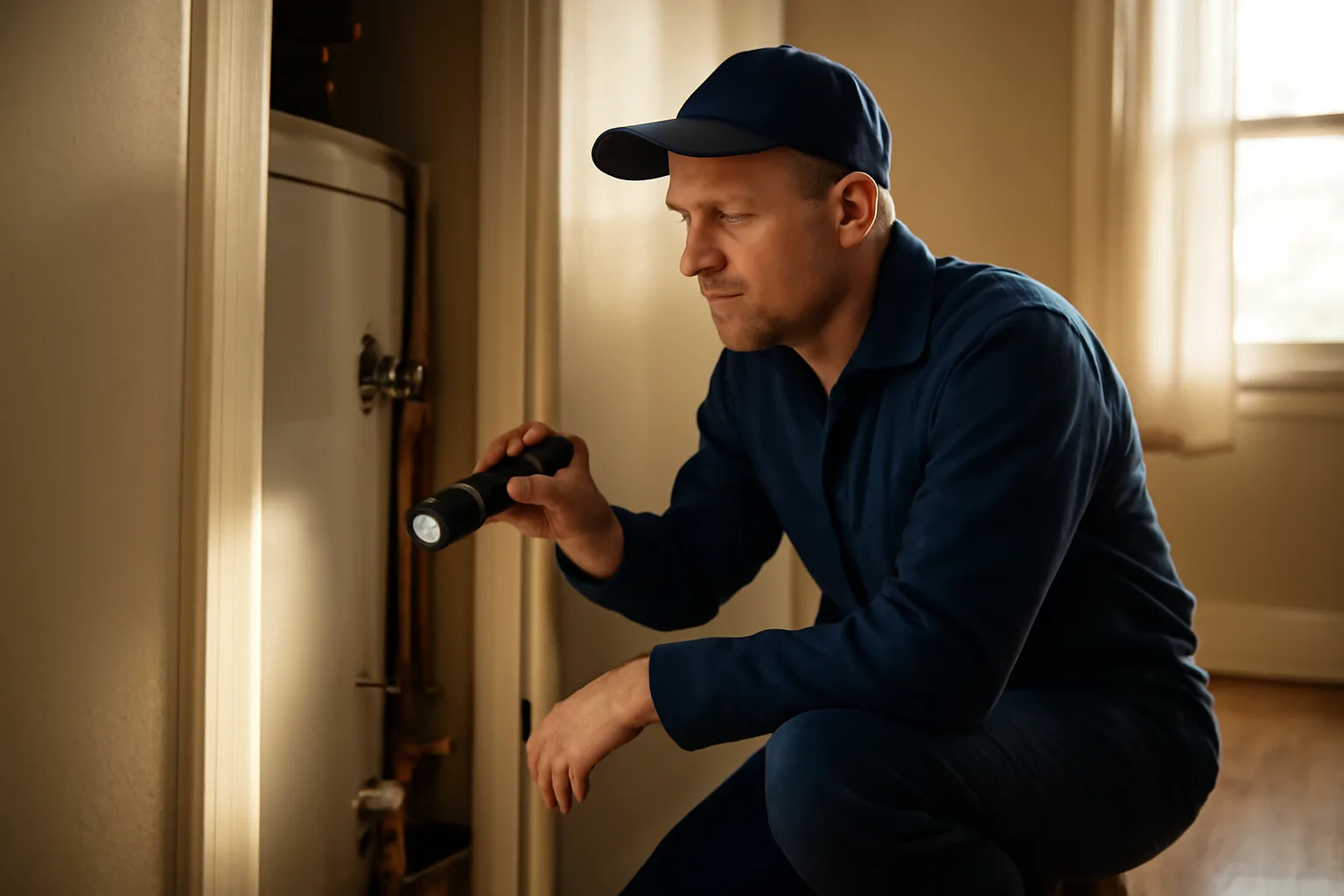
An annual rental property inspection covers smoke and CO detectors, plumbing leaks, electrical hazards, HVAC filters, window and door locks, pest signs, and structural safety items. Landlords must give advance notice (24 to 48 hours in most states), inspect at reasonable times, and stick to safety and lease-compliance issues, not personal belongings.
What should be on an annual rental property inspection checklist?
| Smoke and CO detectors | Test each unit, check battery date, confirm placement per local fire code | |
|---|---|---|
| Fire extinguisher | Check gauge, expiration date, mounting | |
| Plumbing | Under-sink leaks, water heater age and pressure relief valve, toilet seal, visible pipe corrosion | |
| Electrical | Outlet function, GFCI test button in kitchens/baths, exposed wiring, breaker panel labeling | |
| HVAC | Filter condition, thermostat function, visible ductwork damage | |
| Windows and doors | Lock function, weatherstripping, screen condition, egress window clearance in bedrooms | |
| Exterior | Roof shingles, gutter attachment, siding gaps, deck railing stability, exterior stairs | |
| Pest signs | Droppings, nesting material, wood damage, gaps under doors | |
| Structural | Foundation cracks, ceiling stains (water intrusion), floor sag | |
| Appliances | Stove burner function, refrigerator seal, dishwasher hose condition | |
| General condition | Paint condition (especially pre-1978 units, lead paint concerns), flooring wear, mold or mildew | Many cities with mandatory rental licensing require their own inspection checklist as part of the license renewal, and that city checklist usually overlaps with, but doesn't replace, your own. If you're in a city with a licensing inspection coming up, pull the actual checklist your inspector uses before your visit. A lot of cities post theirs as a PDF on the housing department page. Don't guess. The federal lead-based paint disclosure rule under 40 CFR Part 745 also matters here if your property was built before 1978: peeling or chipping paint is a specific item to document at every inspection, more than a general cosmetic note [1]. |
A solid annual inspection checklist covers four zones: life safety, structural systems, plumbing and electrical, and lease compliance. Skip any one of these and you're either missing a fire code violation or missing evidence you'd need in a security deposit dispute. Here's the core list most experienced landlords and property managers actually use, organized by area: | Area | What to check |
What can a landlord look at during an inspection?
A landlord can look at anything connected to habitability, safety, and lease compliance: working smoke detectors, signs of unauthorized pets or occupants, unreported damage, mold, and evidence of lease violations like unauthorized subletting. A landlord generally cannot search through drawers, closets, or personal belongings, or use the inspection as a pretext to harass a tenant. The legal boundary comes from each state's implied warranty of habitability and, separately, the state's entry-notice statute. California's Civil Code Section 1954 lists the specific reasons a landlord may enter, including to make necessary repairs, show the property to prospective tenants or buyers, or when the tenant has abandoned the unit [2]. It does not authorize a landlord to inspect for the tenant's personal conduct unrelated to the property or the lease. In practice, a reasonable inspection walk-through looks at: fixtures, appliances, walls, floors, windows, doors, smoke/CO detectors, visible plumbing and electrical, and general cleanliness as it relates to pest risk or property damage. It does not include opening a tenant's mail, going through their closets, or photographing personal items. If you're documenting damage for a security deposit claim later, photograph the item and the surrounding area only, not personal belongings in the frame. Some landlords ask a contractor or property manager to do the inspection instead of doing it themselves. That's fine and sometimes smarter, since a third party has less incentive to overstep and more credibility if there's ever a dispute.
Who is responsible for a rental property walk-through inspection in California?
In California, the landlord (or their authorized agent, like a property manager) is responsible for scheduling and conducting the routine inspection, and state law requires they give the tenant reasonable written notice, presumed to be 24 hours, before entering for non-emergency purposes [2]. The tenant is not required to be present, but they have a right to be notified in advance and to expect the entry happens at a reasonable time. California Civil Code Section 1954 states landlords may enter to make repairs, show the unit, or in an emergency, and requires the landlord to "give the tenant reasonable notice in writing of his or her intent to enter and enter only during normal business hours," with 24 hours presumed reasonable absent evidence otherwise [2]. Separately, many California cities with rent registries or proactive rental inspection programs (Los Angeles's Systematic Code Enforcement Program is one example) send a city inspector, not the landlord, to do the actual code inspection. In that case the landlord's job is to schedule access, be present or arrange access, and fix anything flagged. The city inspector is responsible for the code compliance check itself; the landlord is responsible for coordinating it and following up on violations. If you're prepping for a city-mandated inspection rather than your own routine one, treat it differently: fix known issues ahead of time, gather any permits for prior work, and know exactly what the inspector's checklist covers so nothing surprises you on inspection day.
How much notice does a landlord have to give before an inspection?
| California | 24 hours (presumed reasonable) | Cal. Civ. Code Section 1954 [2] | |
|---|---|---|---|
| Florida | 12 hours | Fla. Stat. Section 83.53 [3] | |
| Washington | 2 days (48 hours) | Wash. Rev. Code Section 59.18.150 [4] | |
| Texas | No statutory minimum specified | Lease-governed | Emergencies are the one exception nearly every state carves out: a burst pipe, a gas leak, or fire don't require advance notice anywhere. Beyond that, always check your own state's landlord-tenant statute, because the notice period, whether it must be in writing, and what counts as a "reasonable time" (usually normal business hours) all vary. |
Most states require 24 to 48 hours of advance notice before a landlord enters an occupied rental for a non-emergency inspection, though the exact number and whether it must be written varies by state. There's no single national standard, so check your specific state's statute rather than assuming. California presumes 24 hours is reasonable notice under Civil Code Section 1954 [2]. Florida's landlord-tenant statute (Fla. Stat. Section 83.53) requires the landlord to give the tenant "at least 12 hours notice" before entering to inspect, and entry must happen "only at reasonable times" [3]. Texas doesn't set a specific statutory notice period for routine inspections at all, which is unusual, though most Texas leases include a notice clause anyway since it's good practice regardless of the statutory floor. Here's a quick comparison of a few states' minimums: | State | Statutory notice for entry | Source |
What can a landlord not do in Ohio?
In Ohio, a landlord cannot enter a rental unit without giving reasonable notice, cannot shut off utilities or change the locks to force a tenant out (self-help eviction), and cannot retaliate against a tenant for reporting a habitability issue or joining a tenant organization. Ohio Revised Code Section 5321.04 lays out the landlord's specific obligations, and Section 5321.05 covers tenant duties, with the entry and retaliation rules mostly living in Sections 5321.04 and 5321.02 [5]. Ohio's landlord entry rule is in ORC Section 5321.04(A)(8), which requires the landlord to give the tenant "reasonable notice of the landlord's intent to enter" and to enter "only at reasonable times," language nearly identical to California's [5]. Ohio courts and most practitioner guidance treat 24 hours as a reasonable default, though the statute itself doesn't name a specific number of hours the way Florida's does. Ohio Revised Code Section 5321.02 separately bars retaliatory conduct: a landlord can't raise rent, decrease services, or start eviction proceedings specifically because a tenant complained to a housing authority or asserted their rights under the chapter [5]. And Ohio, like most states, doesn't allow landlords to physically remove a tenant's belongings, change locks, or cut off water/electricity/gas as a way to force someone out without going through the actual eviction process in court. What this means for inspections specifically: an Ohio landlord doing an annual walk-through still has to give notice, still has to enter at a reasonable time, and can't use the inspection visit as cover to intimidate a tenant who recently filed a habitability complaint. If a pattern like that shows up in a dispute, it can become the basis for a retaliation claim under Section 5321.02.
Why do landlords require renters insurance?
Landlords require renters insurance mainly to shift liability: if a tenant's negligence causes a fire, water damage, or injury to a guest, renters insurance (specifically the liability portion) covers the claim instead of the landlord's policy or the landlord's own pocket. It also protects the tenant's own belongings, which a landlord's property insurance never covers. A standard landlord (dwelling) insurance policy covers the structure and the landlord's own property, not the tenant's furniture, electronics, or clothing, and it typically doesn't cover a lawsuit arising from something the tenant did inside the unit. Requiring renters insurance with a minimum liability limit, commonly $100,000 in many lease templates, gives the landlord a functional buffer if a tenant's space heater starts a fire or their dog bites a visitor. There's no federal law requiring renters insurance, and most states don't mandate it either, but it's legal for a landlord to require it as a lease condition in the large majority of states, as long as the requirement is disclosed in the lease and applied consistently to all tenants. Some cities and a small number of states have specific rules about how landlords can require it (for instance, some require the landlord to offer a comparable policy option if the tenant can't get one on their own), so check your local rules if you're adding this to a lease for the first time. From a purely practical standpoint: a renters insurance requirement costs the landlord nothing to add to a lease, typically runs the tenant $12 to $30 a month depending on coverage and location, and closes a real liability gap. It's one of the lowest-effort, highest-value additions a small landlord can make to a standard lease.
What is landlording? What is a landlord?
A landlord is the owner (or authorized agent of the owner) of real property who rents that property to another person, called a tenant, in exchange for rent, under a lease or rental agreement. "Landlording" is the informal term for the ongoing work of managing that relationship: collecting rent, maintaining the property, handling repairs, following notice and entry rules, and staying compliant with local licensing and safety codes. Most state landlord-tenant statutes define landlord broadly to include property managers and other agents acting on the owner's behalf, more than the titled owner. Ohio's statute, for example, defines "landlord" as "the owner, lessor, or sublessor of the residential premises, but does not include a manager or assistant of the manager," a phrasing that specifically excludes on-site managers from the legal definitions attached to "landlord" duties while still holding the owner responsible [5]. Being a landlord isn't just collecting a check. It comes with specific legal duties: keeping the unit fit for habitation, keeping common areas safe, complying with building and housing codes, and, in cities with mandatory rental licensing, registering the property and passing periodic inspections. Landlords who treat it as a passive income stream and skip these duties tend to be the ones who show up in local housing court records or get hit with the fines when a rental licensing program finally does its first proactive inspection sweep.
How to become a landlord (and how to actually be a good one)
Becoming a landlord legally requires owning or controlling rental property, complying with your state's landlord-tenant law, and, in many cities, registering or licensing the property with the local housing department before you can legally rent it out. There's no license or certification required nationally, but local requirements vary enormously and skipping them is one of the most common (and expensive) new-landlord mistakes. The practical steps most first-time landlords go through: 1. Confirm the property is zoned and legally permitted for rental use (some cities restrict rentals in certain zones or cap the number of unrelated occupants). 2. Check whether your city requires a rental license, registration, or a pre-rental inspection. Many cities with these programs charge a fee (commonly in the $50 to $300 range per unit, though this varies widely; confirm with your city rental licensing office) and require inspection before the first tenant moves in. 3. Get landlord (dwelling) insurance, distinct from a standard homeowner's policy. 4. Write or adapt a lease that complies with your state's required disclosures (lead paint for pre-1978 units, security deposit handling rules, etc.). 5. Screen tenants consistently and in compliance with the Fair Housing Act, which prohibits discrimination based on race, color, national origin, religion, sex, familial status, or disability [6]. 6. Set up a system for rent collection, maintenance requests, and required entry notices. 7. Renew your license or registration on whatever cycle your city sets (often annual, sometimes every two or three years). Being a good landlord, versus just a legal one, comes down to responsiveness and documentation. Answer repair requests fast, keep records of every inspection and repair, and give tenants more notice than the legal minimum when you can. It costs you nothing and it's the single biggest factor in whether a tenant renews instead of leaving after one lease term. If you're just getting your first rental licensed, our tenant and tenant and landlord landlords guides cover the registration side in more detail city by city.
What rights do tenants have without a lease?
A tenant without a written lease, sometimes called a month-to-month or at-will tenant, still has nearly all the same legal protections as a tenant with a written lease: the right to a habitable unit, the right to advance notice before the landlord enters, protection from illegal lockouts, and protection from retaliation. What they lack is a fixed term and the specific terms a written lease would otherwise spell out. Without a written lease, the relationship is generally governed entirely by state statute and, in some cases, by an oral agreement's implied terms (rent amount, due date). The landlord still can't shut off utilities to force someone out, still has to follow the state's notice period for entry, and still has to give proper notice to terminate the tenancy, typically 30 days for a month-to-month tenancy in most states, though some require more depending on how long the tenant has lived there. California Civil Code Section 1946.1, for instance, requires 60 days' notice to terminate a month-to-month tenancy if the tenant has lived there a year or more, and 30 days if less than a year [7]. Habitability protections, the implied warranty of habitability, apply regardless of whether there's a written lease, because that protection comes from the state's housing code and health and safety statutes, not from lease language. What a no-lease tenant does lose is the certainty of fixed terms: rent can typically be raised with proper notice (subject to any local rent control), and either party can end the tenancy with the statutory notice period instead of waiting out a lease term. If you're a landlord operating without written leases, it's worth changing that. Oral agreements are legal in most states but create exactly the kind of ambiguity that turns a simple dispute into a drawn-out one.
How often should you inspect a rental property, and how do you actually schedule it?
Most experienced landlords inspect occupied units once or twice a year: one routine maintenance inspection, sometimes paired with a seasonal one (HVAC before summer, gutters before winter). Cities with mandatory rental licensing programs often set their own schedule, commonly annual or biennial, tied to license renewal, separate from whatever inspection frequency you'd choose on your own. Twice a year is a reasonable target for most single-family or small multifamily landlords: once at lease renewal time to catch anything before you decide to renew or adjust rent, and once mid-lease to catch small problems (a slow leak, a failing detector battery) before they become expensive ones. If your city requires an inspection as part of license renewal, that one usually satisfies at least one of your two annual visits, as long as you go through and check your own broader checklist too, more than whatever narrower list the city inspector uses. Scheduling well means giving more notice than the legal minimum, offering a couple of time windows so the tenant has some control, and following up in writing (email is fine) even if you gave verbal notice first. That written trail matters if there's ever a dispute about whether proper notice was given. After each inspection, write up what you found, date it, and keep photos. This record does two things: it protects you if a tenant later claims damage was pre-existing, and it gives you a paper trail showing you're maintaining the property, which matters if your city's housing inspector or a court ever asks.
What should you do with the results of an inspection?
Every item you find during an inspection falls into one of three buckets: fix now (safety hazards), fix soon (maintenance issues that could become hazards), and note for the file (cosmetic wear, nothing urgent). Sorting your findings this way keeps you from either panicking over minor wear or ignoring something that turns into a habitability claim. Safety hazards, a dead smoke detector, a GFCI outlet that doesn't trip, a loose stair railing, need same-week attention. In most states, failing to fix a serious habitability issue after being notified opens the door to a tenant withholding rent, repairing and deducting the cost, or filing a complaint with the local housing code office, depending on what the state statute allows. Maintenance issues, a slow drain, a worn weatherstrip, a filter overdue for changing, should go on a fix-soon list with a real date attached, more than "eventually." These are the items that turn into emergency calls (and emergency-rate repair bills) if you let them sit for a year. If you're managing a property in a city with mandatory rental licensing, keep a copy of every inspection report alongside your license file. When renewal time comes, or if a code enforcement officer does a spot check, having a clean paper trail of your own proactive inspections is the difference between a quick renewal and a drawn-out one. A $79 one-time City Rental License & Inspection Prep Packet can help you organize that documentation city by city if you're juggling more than one unit or more than one municipality's rules, though a simple spreadsheet and a labeled folder works fine too if you'd rather build it yourself.
Frequently asked questions
How to become a landlord in a city that requires rental licensing?
Confirm zoning allows rental use, then contact your city's rental licensing or housing office to register the property, pay any required fee, and schedule the pre-rental or annual inspection. Requirements and fees vary by city, so confirm with your city rental licensing office rather than assuming a neighboring city's rules apply.
Who is responsible for a rental property walk-through inspection in California?
The landlord or their agent schedules and coordinates the inspection and must give the tenant reasonable written notice, presumed to be 24 hours, under California Civil Code Section 1954. In cities with proactive rental inspection programs, a city inspector conducts the actual code compliance check, while the landlord arranges access and handles any required fixes.
What is landlording?
Landlording is the ongoing work of owning and managing rental property: collecting rent, handling maintenance, following notice and entry laws, and staying compliant with local licensing and housing codes. It's more operational obligation than passive income, especially in cities with mandatory registration or inspection requirements.
What is a landlord, legally speaking?
A landlord is the owner or authorized agent of rental property who leases it to a tenant in exchange for rent. Most state statutes, including Ohio's, define the term to include property owners and their agents but often exclude on-site managers from the specific legal duties attached to the landlord role.
What rights do tenants have without a lease?
A tenant without a written lease still has habitability protections, the right to advance notice before entry, and protection from illegal lockouts and retaliation, all governed by state statute. What they lack is a fixed lease term; ending the tenancy usually requires the statutory notice period (often 30 to 60 days) instead.
How to be a landlord without constant headaches?
Answer maintenance requests fast, document every inspection with photos and dates, give tenants more entry notice than the legal minimum, and keep your rental license or registration current. Most landlord headaches come from delayed repairs or missed licensing renewals, not from tenants themselves.
Why do landlords require renters insurance?
Renters insurance shifts liability for tenant-caused damage or injuries away from the landlord's own policy and covers the tenant's personal belongings, which landlord insurance never does. It typically costs a tenant $12 to $30 a month and is legal to require in most states if it's written into the lease.
How much notice does a landlord have to give before entering for an inspection?
Most states require 24 to 48 hours notice for non-emergency entry. California presumes 24 hours reasonable (Civil Code Section 1954), Florida requires at least 12 hours (Fla. Stat. Section 83.53), and Washington requires 2 days (RCW Section 59.18.150). Always confirm your specific state's statute.
What can a landlord look at during an inspection?
A landlord can check smoke and CO detectors, plumbing and electrical systems, appliances, structural condition, and evidence of lease violations like unauthorized pets or occupants. A landlord generally cannot search personal belongings, drawers, or closets, or use the inspection as a pretext unrelated to safety or lease compliance.
What can a landlord not do in Ohio?
An Ohio landlord can't enter without reasonable notice, can't shut off utilities or change locks to force a tenant out, and can't retaliate against a tenant for filing a habitability complaint. These rules come from Ohio Revised Code Sections 5321.02 and 5321.04.
Do landlords have to give written notice before an inspection, or is verbal okay?
It depends on the state. Some statutes, like California's, specifically say notice must be in writing. Others allow verbal notice if it's reasonable. Even where verbal notice is legal, following up by text or email creates a record that protects you if there's ever a dispute.
What happens if a tenant refuses to allow an annual inspection?
If you've given legally proper notice and are entering for a legitimate reason (maintenance, safety, code compliance), a tenant generally can't refuse entry, though you still can't force your way in. Persistent refusal can be treated as a lease violation in most states, but the correct response is a written notice and, if needed, court action, not self-help entry.
Sources
- EPA, Lead-Based Paint Disclosure Rule: Federal lead paint disclosure requirement for pre-1978 housing
- California Legislative Information, Civil Code Section 1954: California landlord entry notice requirements (24 hours presumed reasonable)
- Florida Legislature, Statute Section 83.53: Florida requires at least 12 hours notice before landlord entry
- Washington State Legislature, RCW Section 59.18.150: Washington requires 2 days notice before landlord entry
- Ohio Legislature, Ohio Revised Code Section 5321.04: Ohio landlord obligations including reasonable notice before entry and definition of landlord
- HUD, Fair Housing Act Overview: Fair Housing Act prohibited bases for tenant screening discrimination
- California Legislative Information, Civil Code Section 1946.1: California notice periods to terminate month-to-month tenancy (30 or 60 days)