Last updated 2026-07-26
TL;DR
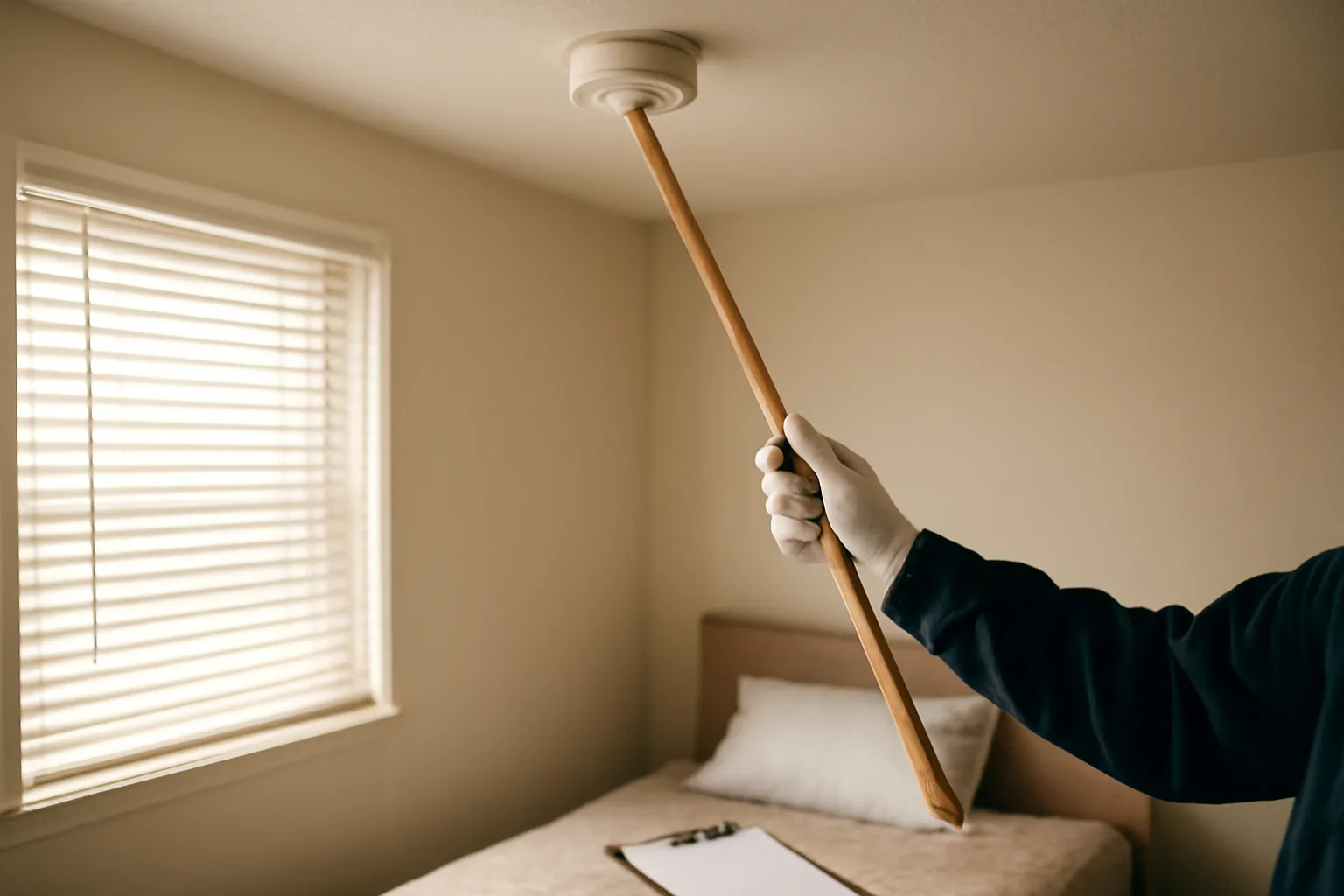
Rental inspectors and leasing agents mainly check life-safety items first: working smoke/CO alarms, secondary means of egress, electrical panel condition, and signs of pests or water damage. Agents doing a leasing walkthrough also document existing condition, test every fixture, and photograph anything that could become a deposit dispute later.
what do agents look for in rental inspections?
There are really two different "agents" here, and landlords often conflate them. A city rental inspector (sometimes literally called a code enforcement officer or housing inspector) is checking your unit against a habitability and safety code, usually tied to your rental license or registration. A leasing or property management agent doing a move-in or move-out walkthrough is documenting condition for the lease file, not code compliance. Both start in the same place: smoke alarms and carbon monoxide detectors. Most state and local codes require a working smoke alarm in each sleeping room, outside sleeping areas, and on every level of the unit, plus CO alarms if there's fuel-burning equipment or an attached garage. The International Property Maintenance Code, which many cities adopt as their base rental code, requires smoke alarms to be installed per NFPA 72 and maintained in working order [1]. After smoke/CO alarms, a city inspector moves to egress (can people get out in a fire), electrical (exposed wiring, overloaded panels, missing GFCI near water), structural issues (foundation cracks, sagging floors, unsafe stairs/railings), and plumbing (leaks, water heater temperature/pressure relief valve, functioning hot water). A leasing agent's walkthrough covers the same physical space but the lens is different: they're testing every switch, faucet, and appliance and writing down existing scuffs, so nobody argues about them at move-out. If you want a structured way to prep for the city inspector specifically, our inspection guides hub breaks down common line items by category.
what can a landlord look at during an inspection?
A landlord (or their inspector/agent) can generally look at anything related to the condition and safety of the unit: walls, ceilings, floors, windows, doors, smoke/CO alarms, electrical outlets and panels, plumbing fixtures, HVAC equipment, and signs of pests, mold, or water damage. What a landlord cannot do is rummage through a tenant's personal belongings, closets full of personal items, or drawers, unless there's a specific safety reason (like checking a suspected gas leak) and even then most leases and state laws limit the scope to what's reasonably necessary. Most states require landlords to give advance notice before entering an occupied unit for inspection, and to enter at reasonable times, not for personal, prolonged, or repeated inspections without cause. California, for example, requires "reasonable notice in writing" which is presumed to be 24 hours absent evidence otherwise, under California Civil Code Section 1954 [2]. During a routine inspection, a reasonable scope looks like this: test every smoke and CO alarm, check under sinks for leaks, open the electrical panel cover to look for double-tapped breakers or scorch marks, check window locks and that windows open (egress in bedrooms), look at the water heater's rating plate and pressure relief valve, and walk the exterior for trip hazards, loose railings, or rot. A landlord doing a licensing prep walkthrough should also photograph anything they fix, in case the actual city inspector questions it later. What's off-limits: opening a tenant's mail, searching bags or containers, showing up unannounced repeatedly "just to check," or using the inspection as cover to harass a tenant over an unrelated dispute. Several state landlord-tenant statutes explicitly list entry for inspection as one of the only lawful reasons to enter, alongside repairs, showing the unit to prospective tenants or buyers, and court order [2].
who is responsible for a rental property walkthrough inspection in california?
In California, the landlord is responsible for scheduling and conducting the initial move-in inspection and, if requested by the tenant, a pre-move-out inspection before the tenant vacates. California Civil Code Section 1950.5 gives tenants the right to request an initial inspection before move-out specifically so they can fix any deficiencies themselves and avoid deposit deductions [3]. The law states landlords must notify tenants in writing of their right to request this inspection, and if the tenant requests it, the landlord must give at least 48 hours' written notice of the date and time before conducting it [3]. The landlord (or their agent, which can be a property manager) does the actual walkthrough, and the tenant has the right to be present. For rental licensing purposes specifically, some California cities (Los Angeles' Rent Escrow Account Program, Oakland's Rent Adjustment Program-linked inspections, and various city-level rental inspection programs) send their own city inspector, separate from the landlord's walkthrough. That inspector answers to the city, not the landlord, and their findings go into a public code enforcement record. Always confirm with your city rental licensing office whether your jurisdiction runs a separate inspection program on top of the state-mandated move-in/move-out process. If you manage property in a city with mandatory licensing, a walkthrough right before the city inspection date is worth doing yourself first. Catching a burnt-out smoke alarm on your own dime beats a failed inspection and a re-inspection fee.
what is landlording, and what is a landlord?
A landlord is the owner (or the owner's authorized agent) who rents real property to a tenant in exchange for payment, under a lease or rental agreement. "Landlording" is the informal industry term for the full set of tasks that come with that role: finding and screening tenants, maintaining the property, handling rent collection, complying with local licensing and inspection rules, and managing the legal relationship day to day. It's not a formal license or credential by itself (though the property you rent out often needs one, depending on your city). Landlording covers everything from writing a lease to responding to a maintenance request at 9pm to keeping a paper trail for security deposit deductions. Cornell's Legal Information Institute defines a landlord simply as the owner of a leasehold estate who grants a tenant the right to possess and use the property [4]. Most landlords with 1 to 10 units are self-managing, meaning they're doing landlording as a side activity alongside a full-time job. That's exactly the group that gets caught off guard by a rental registration notice or inspection deadline, because they didn't budget time for it the way a full-time property manager would.
how to become a landlord (and how to be a landlord day to day)
Becoming a landlord legally starts with owning (or having authority to rent) real property, but the practical steps are what trip people up. Here's the realistic order of operations: 1. Confirm the property is legal to rent. Check your city's zoning and rental registration rules before you list it. Many cities require a rental license or registration before you can legally advertise or collect rent, and renting without one can mean fines even if the unit itself is in fine shape [5]. 2. Get landlord insurance (a landlord/dwelling policy), more than a standard homeowner's policy. Standard homeowner's insurance often doesn't cover a rented property's liability exposure the same way. 3. Set up a compliant lease and screening process: consistent tenant screening criteria, a written lease, and a documented move-in inspection with photos. 4. Register with your city if required. Many mandatory-licensing cities require registration before or shortly after you start renting, with annual renewal and a scheduled inspection. Fees and inspection cycles vary widely by city, so confirm with your city rental licensing office rather than assuming a flat national number. 5. Build a maintenance and inspection routine. Once you're renting, "how to be a landlord" day to day mostly means responding to repair requests quickly, keeping smoke alarms working, and doing your own periodic walkthrough before the city's inspector shows up. Our rental packet builder is built for step 4 specifically: a $79 one-time City Rental License & Inspection Prep Packet that organizes what most cities ask for (proof of ownership, contact info, unit details, and a pre-inspection checklist) so you're not scrambling the week of your inspection.
why do landlords require renters insurance?
Landlords require renters insurance mainly to shift liability and personal property risk off themselves. A landlord's own dwelling/landlord policy covers the building and the landlord's liability, but it does not cover a tenant's personal belongings (furniture, electronics, clothes) if there's a fire, burst pipe, or theft. Without renters insurance, a tenant who loses everything in a fire may try to hold the landlord financially responsible, even when the landlord's policy legally doesn't cover tenant possessions. Renters insurance also usually includes liability coverage, which matters if a tenant's dog bites a visitor or a tenant accidentally starts a kitchen fire that damages a neighboring unit. That liability coverage protects the tenant and, indirectly, reduces the odds the landlord's own policy or reputation takes the hit through a lawsuit. Most renters insurance policies are inexpensive, commonly in the range of a few hundred dollars a year depending on coverage amount and location, though exact pricing varies by state and insurer and isn't something we'll pin to a single national number here. Many landlords require proof of an active policy naming a minimum liability amount (commonly $100,000, sometimes $300,000) as a lease condition, and some states explicitly permit landlords to require it as long as it's disclosed in the lease.
how much notice does a landlord have to give before an inspection?
Notice requirements vary by state, but 24 hours is the most common baseline for routine entry to inspect, repair, or show a unit. California requires "reasonable notice," presumed to be 24 hours in writing, under Civil Code Section 1954 [2]. Many other states set a similar floor, though some require 24 hours specifically and others use looser language like "reasonable notice" without a fixed number. There are two important exceptions almost everywhere: emergencies (a burst pipe, fire, gas leak) allow immediate entry without advance notice, and if a tenant has requested repairs, some states allow shorter notice or none at all for the specific fix requested. Notice generally has to specify the purpose and a reasonable time window, more than "sometime this week." For city rental license inspections specifically, notice rules can be different from the landlord-tenant statute that governs a landlord's own entry. Some cities notify the landlord directly and require the landlord to coordinate tenant access; others send notice straight to the unit. If your city inspection notice doesn't say how much lead time tenants get, confirm with your city rental licensing office before you schedule anything, since giving too little notice can itself become a compliance problem separate from whatever the inspector finds inside.
what rights do tenants have without a lease?
A tenant without a written lease still has real rights. Once someone moves in and pays rent, most states treat that as a month-to-month tenancy at will, governed by the state's landlord-tenant statute even without a signed document. That means the tenant still has a right to habitable housing, a right to notice before the landlord enters, and a right to a legal eviction process (a landlord can't just change the locks or remove belongings). What a no-lease tenant typically loses is the certainty of fixed terms. Without a lease specifying rent amount and duration, either party can usually end a month-to-month tenancy with proper notice (commonly 30 days, though some states or cities require more, especially in areas with just-cause eviction protections). The tenant is also more exposed to rent increases with proper notice, since there's no fixed-term rate locked in. Even without a lease, oral or "month-to-month" tenants are still covered by the state's implied warranty of habitability, meaning the landlord still has to keep the unit safe, weatherproof, and functioning (working plumbing, heat, electrical). This is separate from and doesn't depend on any written agreement. If a landlord is renting month-to-month without a lease in a city with mandatory rental licensing, the licensing and inspection requirements still apply exactly the same as if there were a signed lease. For a broader look at what tenants can expect, see our related coverage on tenants rights and renters rights.
what a landlord cannot do in ohio
Ohio's landlord-tenant law (Ohio Revised Code Chapter 5321) sets specific limits on landlord conduct. A landlord cannot enter the rental unit without giving the tenant "reasonable notice" and entering only at reasonable times, except in an emergency, under ORC 5321.04(A)(8) [6]. A landlord in Ohio also cannot shut off utilities, change locks, or remove a tenant's belongings to force them out (a "self-help" eviction). Ohio law requires landlords to use the formal eviction process through the courts, and retaliatory conduct against a tenant who's exercised a legal right (like reporting a code violation) is restricted under ORC 5321.02 [7]. Ohio landlords also can't refuse to maintain the unit in a habitable condition. ORC 5321.04 requires landlords to keep the premises in a fit and habitable condition, comply with building and housing codes, and keep common areas safe and clean. A landlord who ignores these duties can face a tenant lawsuit for damages or the right to withhold rent under specific procedures set out in the statute. These rules run alongside, not instead of, any city-level rental registration or inspection ordinance. Ohio doesn't have a single statewide rental licensing program, so whether you need a rental license or inspection at all depends entirely on your specific city or township; Columbus, Cincinnati, Cleveland, and several other Ohio cities each run their own separate rental registration programs with their own fees and inspection cycles.
what's the difference between a city code inspection and a leasing agent's walkthrough?
A city rental inspection checks compliance with adopted housing and property maintenance codes, often the International Property Maintenance Code (IPMC) or a locally amended version of it [1]. The inspector has enforcement authority: they can issue a notice of violation, set a re-inspection deadline, and in many cities, fine the owner or withhold/revoke the rental license if violations aren't fixed by the deadline. A leasing agent's walkthrough (move-in or move-out) is a private, contractual process between landlord and tenant. There's no fine or license risk tied to a bad move-in inspection; the consequence is usually a disagreement over the security deposit later. The agent's job is to create an accurate, dated, photographed record of condition so nobody's arguing from memory six months later. Smart landlords run both processes and treat them as separate documents. Do the leasing walkthrough for deposit protection. Do a separate self-inspection modeled on your city's actual checklist before the licensing inspector arrives. Mixing the two into one checklist means you'll likely miss something specific to code compliance, since "looks clean and undamaged" and "meets code" are not the same standard.
what typically fails a rental inspection?
| Smoke/CO alarms | High, code violation, can fail unit | Noted, tested, documented | |
|---|---|---|---|
| Egress windows | High, safety code item | Noted if damaged | |
| Electrical panel | High, fire risk | Rarely opened | |
| Cosmetic wear (paint, carpet) | Low unless health hazard | High, deposit relevant | |
| Pest evidence | High, habitability | Medium, documented | |
| Appliance function | Medium | High, tenant complaint prevention | Most fines and failed inspections come from cheap, fast fixes: a $10 smoke alarm, a $20 GFCI outlet, a $5 pressure relief valve extension. The expensive failures (electrical panel replacement, structural repair) are rarer but obviously cost far more and take longer to resolve before a re-inspection deadline. |
The most common failure points across cities running rental inspection programs cluster around a short list: missing or non-functioning smoke/CO alarms, blocked or painted-shut egress windows in bedrooms, exposed or improperly spliced electrical wiring, missing GFCI protection near water sources, water heater temperature/pressure relief valve issues (missing discharge tube, wrong routing), peeling paint in pre-1978 housing (a lead-based paint concern under federal disclosure rules) [8], and exterior issues like broken steps, missing handrails, or unsecured trash storage attracting pests. The federal Lead-Based Paint Disclosure rule under 42 U.S.C. 4852d requires landlords of pre-1978 housing to disclose known lead hazards and provide an EPA pamphlet to tenants before they sign a lease, and inspectors in some cities check for this disclosure paperwork alongside physical condition [8]. Here's a simple table comparing what each type of inspector typically flags first: | Category | City code inspector priority | Leasing agent priority |
how do landlords prepare for a rental license inspection?
The landlords who breeze through inspections all do the same three things: they get their city's actual checklist ahead of time (most cities publish one, or you can request it from the rental licensing office), they walk the unit themselves with that checklist within a week or two of the scheduled date, and they fix cheap items immediately rather than waiting to see if the inspector flags them. A basic self-inspection walk should hit: test every smoke and CO alarm (press the button, don't just look at the light), open every window in a bedroom to confirm it opens fully for egress, check GFCI outlets within 6 feet of any sink or in bathrooms/kitchens/garages by pressing test/reset, look at the electrical panel for open knockouts or double-tapped breakers, check the water heater's pressure relief valve has a discharge tube routed down and out, and check railings on any stairs with more than a few steps for wobble. Keep dated photos of everything you fix. If a violation notice ever gets disputed or a re-inspection happens, a photo with a timestamp showing the smoke alarm you installed two weeks before the inspection is worth more than your word alone. This is the exact gap our rental packet builder is built to close: a $79 one-time packet that organizes ownership documents, unit details, and a pre-inspection checklist into the format most city rental licensing offices actually ask for, so you walk in with your paperwork done instead of assembling it the night before.
Frequently asked questions
What do rental inspectors check first?
Smoke and carbon monoxide alarms almost always come first, since they're the fastest life-safety check. From there, inspectors typically move to egress (can occupants get out through a bedroom window), electrical panel condition, plumbing leaks, and the water heater's pressure relief valve. Cosmetic issues like paint or flooring wear rarely factor into a code inspection unless they create a health hazard.
Who is responsible for the rental property walkthrough inspection in California?
The landlord is responsible for conducting the move-in inspection and, if the tenant requests one, a pre-move-out inspection with at least 48 hours' written notice under California Civil Code Section 1950.5. Separately, some California cities send their own code inspector for rental licensing purposes, independent of the landlord's own walkthrough.
What is landlording?
Landlording is the informal term for everything involved in renting out property: finding and screening tenants, maintaining the unit, collecting rent, and complying with local licensing, registration, and inspection rules. It's not a license itself; it describes the ongoing role, distinct from the one-time act of owning property.
What is a landlord, legally?
A landlord is the owner of real property, or their authorized agent, who grants a tenant the right to possess and use that property under a lease or rental agreement in exchange for rent. Cornell's Legal Information Institute defines it around this leasehold-granting relationship.
What rights do tenants have without a lease?
Tenants without a written lease are typically treated as month-to-month tenants under state law and keep core protections: habitable housing, notice before entry, and a formal eviction process instead of self-help removal. What they lose is fixed-term certainty; rent and terms can change with proper notice, commonly 30 days.
How do I become a landlord?
Confirm your property is zoned and legally eligible to rent, get a landlord/dwelling insurance policy, set up a written lease and screening process, register with your city if it requires rental licensing, and build a routine for maintenance and inspection prep. Confirm your specific city's registration rules before listing the unit.
Why do landlords require renters insurance?
A landlord's own policy covers the building and their liability, not a tenant's belongings. Requiring renters insurance shifts personal property and liability risk (like guest injuries) onto the tenant's policy, reducing disputes and claims against the landlord after a fire, leak, or accident in the unit.
How much notice does a landlord have to give before entering for an inspection?
Most states use 24 hours as the standard for reasonable notice, though the exact language varies; California presumes 24 hours in writing under Civil Code Section 1954. Emergencies allow immediate entry without notice. City rental license inspections may follow separate notice rules, so check with your city's rental licensing office.
What can a landlord look at during an inspection?
A landlord can inspect the general condition of the unit: alarms, electrical, plumbing, structural elements, appliances, and signs of pests or damage. They generally cannot search a tenant's personal belongings, closets, or containers unless there's a specific, narrow safety reason tied to the inspection's purpose.
What can't a landlord do in Ohio?
Under Ohio Revised Code Chapter 5321, a landlord can't enter without reasonable notice except in emergencies, can't shut off utilities or change locks to force a tenant out, can't retaliate against a tenant for reporting code violations, and can't refuse to maintain the unit in a habitable, code-compliant condition.
What usually fails a rental license inspection?
Missing or dead smoke/CO alarms, blocked bedroom egress windows, exposed wiring, missing GFCI protection near water, and water heater relief valve problems are the most common failures across cities. Most are cheap to fix (under $50 in parts) but still cause a failed inspection if missed.
Does an agent's move-in walkthrough affect my rental license inspection?
No. A leasing agent's move-in or move-out walkthrough is a private lease document for deposit purposes and carries no fine or licensing risk. A city rental license inspection is a separate, code-based process with its own violation notices and re-inspection deadlines, run by the city, not your leasing agent.
Can a landlord fail an inspection over cosmetic issues like old carpet or paint color?
Generally no, unless the cosmetic issue is actually a health or safety hazard, like peeling lead-based paint in pre-1978 housing, which triggers separate federal disclosure requirements under 42 U.S.C. 4852d. Ordinary wear like faded carpet or paint color rarely appears on a code inspector's violation list.
Sources
- International Code Council, International Property Maintenance Code (smoke alarm requirements): Smoke alarms must be installed per NFPA 72 and maintained in working order under the model property maintenance code many cities adopt
- California Legislature, California Civil Code Section 1954: California requires reasonable notice, presumed to be 24 hours in writing, before a landlord enters to inspect
- California Legislature, California Civil Code Section 1950.5: Tenants in California can request a pre-move-out inspection with at least 48 hours written notice from the landlord
- Cornell Law School, Legal Information Institute, Landlord definition: A landlord is the owner of a leasehold estate who grants a tenant the right to possess and use property
- U.S. Department of Housing and Urban Development, Rental Housing overview: Local jurisdictions commonly require rental registration or licensing before a unit can be legally rented
- Ohio Legislature, Ohio Revised Code Section 5321.04: Ohio landlords must give reasonable notice and enter at reasonable times, with an emergency exception, and must keep premises fit and habitable
- Ohio Legislature, Ohio Revised Code Section 5321.02: Ohio law restricts landlord retaliation against tenants who exercise legal rights such as reporting code violations
- U.S. Environmental Protection Agency, Lead Disclosure Rule (42 U.S.C. 4852d): Landlords of pre-1978 housing must disclose known lead-based paint hazards and provide an EPA pamphlet before tenants sign a lease