Last updated 2026-07-26
TL;DR
There's no federal standard. Rental inspection frequency is set city by city, usually every 1 to 3 years under a local rental licensing or registration ordinance, though some cities inspect annually and others only on complaint or tenant turnover. Always confirm the actual interval with your city rental licensing office, since it changes by ordinance amendment.
How often does a rental property need to be inspected?
Most of the time, the answer depends entirely on your city, not on state or federal law. There is no U.S. law that sets a national rental inspection schedule. Instead, individual municipalities that run mandatory rental licensing or registration programs set their own inspection cycles, and those cycles range from every year to once every three or four years, with some cities doing inspections only when a complaint comes in or a tenant moves out. A few patterns show up again and again once you look across cities. Programs built around a license renewal often tie the inspection to that renewal cycle, so if your license renews every two years, your inspection probably happens every two years too. Programs built around a point system or risk tiering will inspect problem properties more often and clean-record properties less often. And a growing number of cities use complaint-based or 'proactive rental inspection' models that only trigger a visit after a tenant reports an issue, rather than inspecting every unit on a fixed clock. Because this varies so much, the only reliable move is to call your city's rental licensing or code enforcement office and ask directly what cycle applies to your property class (single-family, duplex, multi-unit) and your compliance history. Bring your license number when you call. If your city's site lists a specific interval, treat that as authoritative over anything general you read online, including this article. For a $79 one-time way to organize what your specific city inspection actually checks for before the inspector shows up, see the City Rental License & Inspection Prep Packet.
What determines a city's rental inspection frequency?
Three things usually drive the schedule: the type of program (licensing vs. registration vs. complaint-based), the size and condition history of the property, and how the city funds its inspection staff. Licensing programs, where you must hold a valid rental license to legally rent the unit, tend to tie inspection to license renewal. That renewal period is commonly one, two, or three years depending on the city, and it is set in the municipal code, not state law. Registration-only programs, by contrast, sometimes require just an annual filing and fee with inspection happening far less often, maybe only at first registration or after a complaint. Some cities use a tiered or 'good landlord' model, where properties with no violations for a set number of cycles move to a longer inspection interval, while repeat-violation properties get inspected annually or even more often. Detroit's rental ordinance builds in a compliance-based structure where an inspection is required before a rental Certificate of Compliance is issued or renewed, and the city's Buildings, Safety Engineering and Environmental Department administers that certification process for rental property owners [1]. Minneapolis runs a tiered licensing system where the rental license category and violation history change how often a property comes up for inspection [2]. The honest summary: there is no shortcut around checking your specific city's ordinance. If you own units in more than one city, do not assume the interval is the same across all of them. It rarely is.
Is rental inspection frequency set by state law or city ordinance?
City ordinance, almost always. States generally do not mandate a statewide rental inspection schedule; they leave licensing and inspection authority to home-rule cities and municipalities under their own police powers or state enabling statutes. A state may authorize cities to create inspection programs (through general municipal code authority) without specifying how often inspections must happen. That detail lives in the local ordinance, meaning two cities in the same state can have completely different inspection intervals. Ohio, for instance, does not run a statewide rental inspection mandate. Individual Ohio cities that choose to run rental registration or inspection programs write their own frequency rules into their municipal codes. There are exceptions worth flagging. Some states set baseline habitability standards that indirectly affect inspection triggers (for example, requiring a landlord to address a repair within a certain number of days once notified), but that is a habitability rule, not a fixed inspection calendar. Federally, HUD-assisted housing (Section 8 project-based or voucher units) does have its own inspection requirement. HUD's Real Estate Assessment Center historically ran the Uniform Physical Condition Standards (UPCS) inspection protocol for assisted housing, and HUD has since replaced that system with the National Standards for the Physical Inspection of Real Estate (NSPIRE) [3]. Under NSPIRE, HUD sets inspection frequency based on a property's physical condition score rather than a single fixed number applied to every property, with the general framework described in HUD's NSPIRE final rule published in the Federal Register [4]. That federal cycle applies only to HUD-assisted units, not to ordinary market-rate rentals under a city licensing program.
How often do rental properties get inspected under a typical licensing program?
| Standard rental license renewal | Every 1 to 3 years | License expiration date | |
|---|---|---|---|
| Tiered / good-landlord program | Every 1 year (poor record) to every 3-4 years (clean record) | Violation history at renewal | |
| Registration-only (no license) | Often none on a fixed schedule | Complaint or tenant report | |
| New rental registration | Once, at initial registration | First-time licensing | |
| HUD-assisted housing (NSPIRE) | Roughly annually to every 3 years depending on risk score | HUD physical inspection schedule [4] | The biggest mistake landlords make is assuming their city's interval matches what a friend in another city told them, or what a general internet search says. Ordinances get amended. Cities that used to inspect every 3 years sometimes move to annual after a high-profile habitability failure gets media attention, and cities that used to inspect every unit sometimes switch to complaint-based models to save staff time. Confirm the current interval directly with your city, every renewal cycle, more than once. |
Here is a rough range based on how mandatory rental licensing programs are commonly structured. Treat this as a general pattern, not a promise about any specific city; always confirm with your city rental licensing office. | Program type | Typical inspection interval | What triggers it |
What can a landlord look at during an inspection?
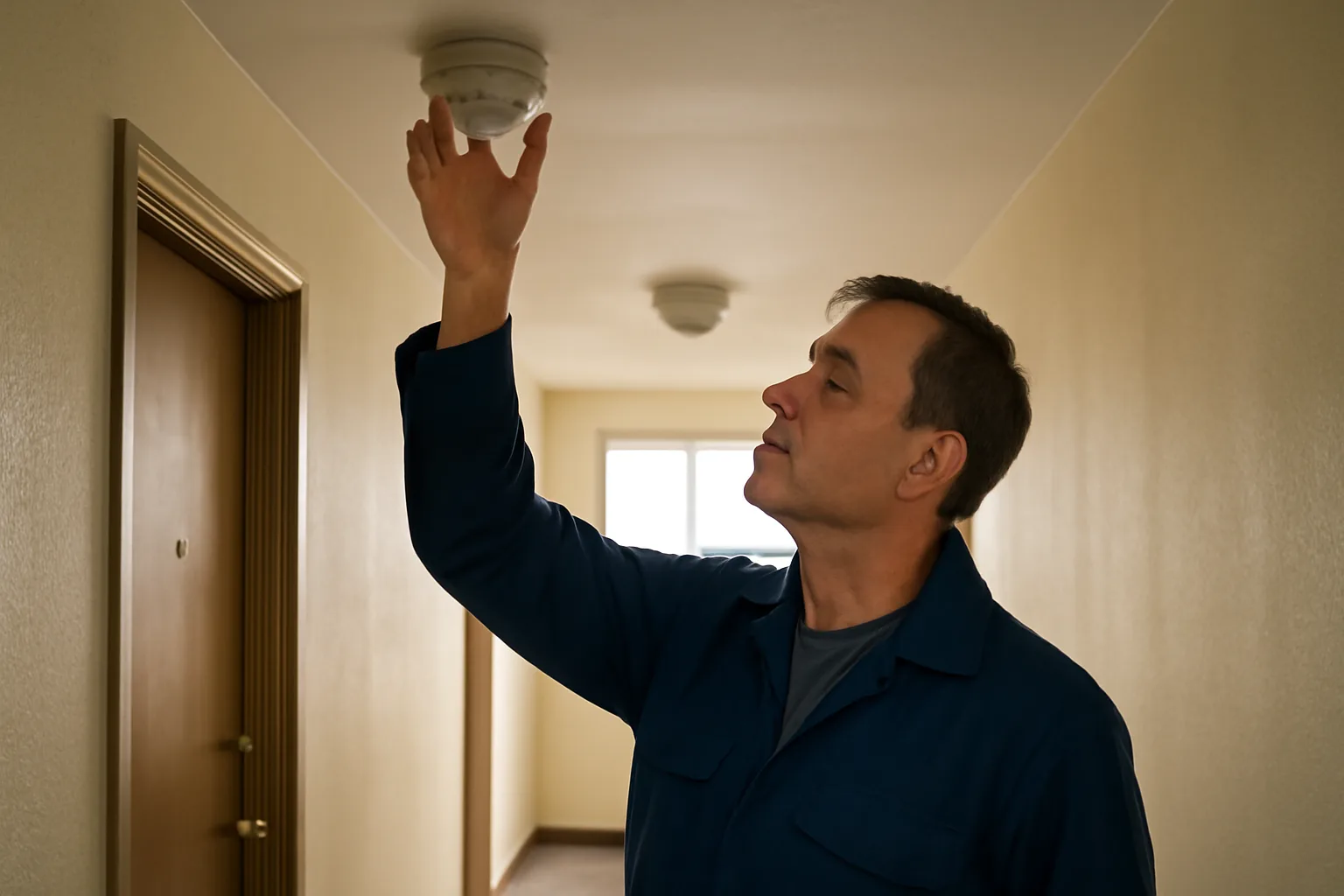
A rental inspection generally checks two categories: life-safety systems and general habitability condition. Inspectors are not there to judge your taste in paint color; they are checking whether the unit meets the minimum standards in your city's housing or property maintenance code. Common inspection items include: working smoke and carbon monoxide detectors in the right locations, functioning heat (and in some climates, minimum temperature standards), safe electrical outlets and no exposed wiring, proper egress from bedrooms (a window or door large enough to escape a fire), handrails on stairs, no active leaks or mold growth, working plumbing fixtures, secure locks on exterior doors, and pest-free conditions. Many cities base these standards on the International Property Maintenance Code (IPMC), which multiple states and cities adopt as their local housing code baseline [5]. Inspectors can generally walk through common areas and the interior of the specific unit being inspected, but they typically need either the tenant's consent, advance notice consistent with your state's entry notice law, or an inspection warrant if consent is refused. This is where landlord-tenant law and inspection ordinance overlap, and it is worth reading your own city's notice requirement rather than assuming a national standard, because there isn't one.
Who is responsible for a rental property walk-through inspection in California?
In California, responsibility splits by inspection type, and this trips up a lot of first-time landlords. For move-in and move-out condition documentation, California Civil Code Section 1950.5 puts the burden on the landlord: the landlord must do (or offer to do) an initial move-out inspection if the tenant requests one, give the tenant a written itemized statement of proposed deductions, and provide a reasonable opportunity for the tenant to fix issues themselves before move-out to avoid deposit deductions [6]. That statute exists specifically to protect security deposit disputes, and it requires the landlord to give at least 48 hours' written notice before the initial inspection unless the tenant waives that notice in writing [6]. For code-based habitability or rental licensing inspections, responsibility sits with the city or county code enforcement or rental housing inspection division, not the landlord personally, though the landlord is required to provide access and correct anything that fails. San Francisco, Los Angeles, Oakland, and other California cities that run proactive rental inspection programs assign the actual inspection to a city inspector; the landlord's job is scheduling access and fixing violations found, not conducting the inspection. So the short answer: for the standard move-in/move-out walkthrough, the landlord is responsible for offering and conducting it under Civil Code 1950.5. For a compliance inspection tied to a city's rental license, the city inspector conducts it, and the landlord's responsibility is access and repair.
How much notice does a landlord have to give before an inspection?
This depends on your state's entry notice statute and, separately, on any inspection-specific notice rule your city ordinance sets, and the two numbers are not always the same. Many states require 24 hours' written or verbal notice before a landlord (or their inspector) enters an occupied unit for a non-emergency reason, though the exact number and required delivery method vary by state. California's Civil Code Section 1954 generally requires "reasonable notice," which the statute presumes to be 24 hours in writing for most non-emergency entries . Some states set 48 hours instead, and some allow verbal notice while others require it in writing. Separately, for the specific move-out inspection under California's deposit law, the notice requirement is explicitly at least 48 hours in writing, distinct from the general 24-hour entry notice rule [6]. If your city runs a licensing inspection, the city's notice to schedule access is a separate communication from either of these, often mailed or emailed to the property owner weeks in advance with a scheduling window, not a same-week entry notice. Bottom line: check three things separately, because they are genuinely different rules stacked on top of each other: your state's general entry notice law, any state-specific move-out inspection notice rule, and your city's rental inspection scheduling notice.
What a landlord cannot do in Ohio
Ohio's landlord-tenant law is set out in Ohio Revised Code Chapter 5321, and it lists specific landlord obligations and prohibited actions. Landlords in Ohio cannot retaliate against a tenant for reporting a code violation or exercising a legal right; Ohio Revised Code 5321.02 prohibits a landlord from raising rent, decreasing services, bringing eviction proceedings, or otherwise retaliating against a tenant who has complained to a government agency about a building, housing, or health code violation . Ohio landlords also cannot enter the unit without reasonable notice for a non-emergency purpose; Ohio Revised Code 5321.04 requires landlords to give reasonable notice of intent to enter and to enter only at reasonable times, except in an emergency . Ohio landlords cannot shut off utilities, change locks, or remove a tenant's belongings to force them out (a "self-help" eviction); Ohio law requires landlords to use the court eviction process instead . And under 5321.04, Ohio landlords must keep the unit in compliance with local building and housing codes and maintain it in a fit and habitable condition, so failing basic maintenance is itself a violation of the statute, separate from any city-level inspection ordinance. None of this is a substitute for reading the actual chapter or talking to a local attorney if you are facing a specific dispute; Ohio Revised Code 5321 is the primary source .
What rights do tenants have without a lease?
A tenant without a written lease, often called a tenant-at-will or month-to-month tenant depending on payment frequency, still has legal rights. The absence of a signed lease does not waive the tenant's habitability rights, notice rights, or protection from illegal eviction; those come from state landlord-tenant statutes and local housing code, not from the lease document itself. Generally, a tenant paying rent without a written lease is treated as a periodic tenancy (commonly month-to-month), which means either party can typically end the tenancy with proper notice, often 30 days, though some states and cities set different minimums, and some cities with just-cause eviction ordinances restrict non-renewal even without a lease. The tenant still has the right to a habitable unit, the right to proper entry notice, the right to the return of any security deposit under the applicable statute, and protection from retaliatory or discriminatory eviction under fair housing law. What a tenant without a lease usually does not have is a fixed-term guarantee; without a written term, the landlord generally has more flexibility to end the tenancy with notice than they would if a one-year lease were in force. If you're a landlord operating without written leases, that is a business risk you're carrying voluntarily, and most attorneys and housing counselors recommend a written lease specifically because it documents both sides' obligations rather than leaving them to be reconstructed from memory in a dispute. For background on tenant protections generally, see tenants rights and renters rights.
Why do landlords require renters insurance?
Landlords require renters insurance mainly to shift liability and property-loss risk away from the landlord's own policy and bank account. A landlord's own insurance (dwelling/fire policy) generally covers the building structure, not the tenant's personal belongings, so if a fire, pipe burst, or theft destroys a tenant's furniture and electronics, the landlord's policy typically will not pay for it. Requiring renters insurance means the tenant, not the landlord, absorbs that loss through their own policy. Renters insurance also typically includes liability coverage, which matters if a tenant's negligence causes damage (a kitchen fire that spreads, an overflowing bathtub that damages a downstairs unit) or if a guest is injured in the tenant's unit. Without renters insurance, that liability claim often lands on the landlord's policy or the landlord personally, driving up the landlord's premiums or exposing them to an uninsured lawsuit. Requiring it is legal in most states as a lease condition, though a handful of jurisdictions regulate how it can be required or capped. It is not a substitute for the landlord's own dwelling and liability coverage; it is a layer that reduces how often the landlord's own policy gets a claim filed against it.
How to become a landlord (and what is landlording, exactly)?
"Landlording" is the ongoing work of owning and managing rental property: screening and selecting tenants, collecting rent, handling maintenance and repairs, complying with local housing code and licensing requirements, managing the lease relationship, and handling turnover between tenants. It is a mix of legal compliance, basic facilities management, and customer service, and it does not stop once a tenant moves in; it is continuous. Becoming a landlord in the practical sense involves a handful of concrete steps: acquire or designate a property for rental use, confirm it is legal to rent under local zoning and any rental licensing ordinance (many cities require a rental license or registration before you can legally lease the unit, and renting without one can trigger fines), get the right insurance (landlord/dwelling policy, more than a standard homeowner policy), understand your state's landlord-tenant statute (security deposit limits and timelines, entry notice rules, habitability duties, eviction procedure), set up a written lease, and build a system for rent collection, maintenance requests, and recordkeeping. A lot of new landlords skip the licensing step because they don't know their city requires one, and that's the single most common source of the fine or notice that sends people looking for an article like this one in the first place. If you got an ordinance notice, inspection deadline, or violation fine and you're trying to figure out what your city actually requires, start by pulling your specific city's rental licensing office page (search "[your city] rental license" plus ".gov") rather than relying on general landlord advice sites, since the fee schedule, inspection interval, and paperwork are all set locally. For a structured way to organize the documents most cities ask for, the City Rental License & Inspection Prep Packet is a $79 one-time packet built for exactly that first-time compliance scramble. For general orientation on landlord obligations, see landlord and landlord landlords.
How to be a landlord day to day: what does the job actually involve?
Beyond the legal setup, day-to-day landlording is mostly maintenance response, communication, and recordkeeping. A landlord who owns 1 to 10 units is usually doing this work personally rather than through a property management company, which means the compliance burden (licensing renewals, inspection scheduling, code violation responses) lands directly on the owner's calendar. Practically, that means: responding to repair requests within whatever timeline your state's habitability law implies (many states expect "reasonable time," some set specific day counts for essential services like heat or water), keeping smoke and CO detectors tested and documented, tracking your rental license or registration renewal date so it doesn't lapse into a fine, keeping a paper trail of all notices given to tenants (entry notices, rent increase notices, lease violation notices), and budgeting for the periodic costs of code compliance, more than mortgage and taxes. Most experienced small landlords keep a simple annual calendar: license renewal date, insurance renewal date, smoke/CO detector battery or unit replacement schedule, and the estimated inspection window if their city runs one. That single calendar prevents most of the late-fee and violation-notice situations that show up as a surprise. For related reading on tenant-facing rights that intersect with your obligations as a landlord, see tenant and tenant and tenant rights.
Frequently asked questions
How often does a rental property need to be inspected in a licensing city?
Most mandatory rental licensing cities inspect every 1 to 3 years, tied to the license renewal cycle, though tiered programs can stretch clean-record properties to 3-4 years and shrink poor-record properties to annual. There is no single national number; confirm the exact interval with your city's rental licensing office, since ordinances change.
Does every city require rental property inspections?
No. Many cities require only registration (a filing and fee) with no fixed inspection schedule, inspecting only after a tenant complaint. Others run full proactive inspection programs on a fixed cycle. Whether your city inspects at all, and how often, depends entirely on that city's own housing or municipal code.
Who is responsible for a rental property walk-through inspection in California?
For move-in/move-out deposit inspections, the landlord is responsible under California Civil Code 1950.5, including offering the initial inspection and giving 48 hours' written notice. For code-compliance inspections under a city rental program, a city inspector conducts the visit; the landlord's job is providing access and fixing violations found.
What is landlording?
Landlording is the ongoing work of owning and operating rental property: tenant screening, rent collection, maintenance, lease management, and compliance with local licensing and housing code. It's continuous, not a one-time setup, and for owner-operators of small portfolios it usually includes handling inspections and violation notices personally rather than through a management company.
What is a landlord, legally speaking?
A landlord is the party who owns or controls a rental property and leases it to a tenant in exchange for rent, taking on legal obligations under state landlord-tenant law and local housing code, including habitability duties, security deposit handling, proper entry notice, and, in many cities, a rental license or registration requirement.
What rights do tenants have without a lease?
A tenant without a written lease still has habitability rights, entry-notice rights, and deposit-return rights under state law; those come from statute, not the lease document. They're generally treated as a periodic (often month-to-month) tenant, meaning either side can typically end the tenancy with standard notice, commonly 30 days, subject to any local just-cause eviction rules.
Why do landlords require renters insurance?
Renters insurance shifts the risk of a tenant's personal property loss and personal liability away from the landlord's own policy. A landlord's dwelling insurance generally doesn't cover a tenant's belongings or a tenant-caused liability claim, so requiring renters insurance protects the landlord from absorbing those costs directly.
How much notice does a landlord have to give before entering or inspecting?
It depends on the state and the purpose. Many states require 24 hours' notice for routine non-emergency entry; California's move-out deposit inspection specifically requires at least 48 hours in writing under Civil Code 1950.5. City rental licensing inspections often use a separate, longer scheduling notice set by local ordinance.
What can a landlord look at during a rental inspection?
Inspectors typically check life-safety and habitability items: smoke and CO detectors, working heat, safe electrical wiring, proper bedroom egress, stair handrails, absence of leaks or mold, functioning plumbing, secure exterior locks, and pest conditions, generally based on a local housing code such as the International Property Maintenance Code.
What a landlord cannot do in Ohio?
Under Ohio Revised Code 5321, a landlord cannot retaliate against a tenant for reporting a code violation (5321.02), cannot enter without reasonable notice except in an emergency (5321.04), cannot use self-help eviction like changing locks or shutting off utilities, and must keep the unit compliant with local housing code.
How to become a landlord?
Confirm the property is legal to rent under local zoning and any rental licensing ordinance, get proper landlord insurance, learn your state's landlord-tenant statute (deposits, notice, habitability, eviction procedure), set up a written lease, and build systems for rent collection and maintenance requests before placing a tenant.
Does a rental inspection interval change if a property has violations?
In many tiered licensing programs, yes. Properties with a clean violation history often move to a longer inspection interval at renewal, while properties with repeat violations get shifted to more frequent, sometimes annual, inspection. The exact tiering rules are set in each city's own rental licensing ordinance.
Can a landlord refuse to let a city inspector in?
A landlord can decline consent, but most cities can then seek an administrative inspection warrant to gain access, and refusing access outright is often itself a violation of the licensing ordinance that can block license renewal. It rarely helps a landlord's compliance standing to refuse; scheduling promptly is the more practical move.
Sources
- HUD, National Standards for the Physical Inspection of Real Estate (NSPIRE) Final Rule, 88 Fed. Reg. 20492 (April 6, 2023): HUD's NSPIRE framework replaced UPCS starting in 2023 and ties inspection frequency to a property's physical condition score
- International Code Council, International Property Maintenance Code: Many local housing codes adopt the IPMC as the baseline standard for habitability and maintenance inspection items
- California Legislative Information, Civil Code Section 1950.5: California law requires landlords to offer an initial move-out inspection and give at least 48 hours' written notice
- California Legislative Information, Civil Code Section 1954: California presumes 24 hours' written notice is reasonable notice for landlord entry into an occupied unit
- Ohio Legislature, Ohio Revised Code Section 5321.02: Ohio law prohibits landlord retaliation against a tenant who reports a code violation
- Ohio Legislature, Ohio Revised Code Section 5321.04: Ohio law requires reasonable entry notice, prohibits self-help eviction, and requires landlords to maintain code-compliant, fit and habitable units