Last updated 2026-07-26
TL;DR
No single Pennsylvania statute requires every rental to have a fire extinguisher. But the state's adopted fire code (based on the International Fire Code) requires extinguishers in many multi-unit and commercial-adjacent buildings, and cities like Philadelphia and Pittsburgh add their own rules through local fire and property codes. Check your local fire marshal or rental licensing office before assuming you're exempt.
are landlords required to provide fire extinguishers in pennsylvania
There's no single line in the Pennsylvania statutes that says "every rental unit must have a fire extinguisher." That surprises a lot of landlords who assume it's baked into the Landlord and Tenant Act. It isn't. The Pennsylvania Landlord and Tenant Act of 1951 covers leases, security deposits, and eviction procedure, but it doesn't set fire safety equipment requirements for individual dwelling units [1]. What does apply is the Pennsylvania Construction Code Act (the Uniform Construction Code, or UCC), which adopts editions of the International Fire Code and International Building Code as the statewide baseline for most municipalities [2]. Those codes require portable fire extinguishers in specific occupancy types, and how they apply to a rental depends heavily on the building's classification, number of units, and age. Then you've got local overlays. Philadelphia has its own fire code enforced by the Philadelphia Fire Department and Department of Licenses and Inspections, and it does require extinguishers in certain rental configurations [3]. Pittsburgh, Allentown, Scranton, and other cities with their own rental licensing programs often fold fire safety checks into the inspection that happens before you get or renew a rental license. So the honest answer is: it depends on your municipality, your building type, and whether you're inside a UCC-opted-out jurisdiction. Don't guess. Call your local fire marshal or code office and ask directly.
does pennsylvania's fire code require extinguishers in rental units
The Pennsylvania UCC incorporates the International Fire Code (IFC), and the IFC does require portable fire extinguishers in a range of occupancies, including most Group R (residential) buildings with common areas, some fuel-fired equipment rooms, and any building with commercial cooking. For a straightforward single-family rental or a duplex with no shared hallways, the IFC's extinguisher mandate is less likely to apply directly to the individual dwelling unit itself, but it can still apply to shared basements, laundry rooms, or mechanical rooms in a multi-unit building [2]. One wrinkle: Pennsylvania law lets municipalities opt out of enforcing the UCC and instead adopt their own code, as long as it's at least as protective. That's part of why Philadelphia and some other cities have their own fire code text instead of just pointing to the state UCC [2][3]. If your rental sits in a municipality that has opted out, the UCC's specific extinguisher language may not be the controlling document; the local fire code is. That's a floor, not a landlord-specific checklist. It's why a call to your local code office beats searching the internet for a definitive number.
what does philadelphia require for fire extinguishers in rentals
Philadelphia is the biggest test case in the state, and it has more explicit rules than most PA cities. The Philadelphia Fire Code, adopted as part of the city's code chapters and enforced alongside the Property Maintenance Code, requires fire extinguishers in specified occupancies, and the city's rental licensing inspection process (through the Department of Licenses and Inspections) checks for basic fire safety items during initial and follow-up inspections tied to the Rental License and the Certificate of Rental Suitability [3]. Philadelphia also requires smoke alarms in every rental unit under the property maintenance code, and carbon monoxide alarms where fuel-burning appliances or attached garages exist, which is a separate but related requirement landlords often lump in with "fire safety" [3]. If you're renting in Philadelphia and haven't confirmed your unit's specific fire extinguisher obligation, that's a call to L&I's rental licensing line, not a guess based on what your last apartment complex had in the hallway. Don't confuse a Philadelphia requirement with a statewide one. What applies in Philadelphia because of its own fire code chapter doesn't automatically apply in Erie or Reading.
do other pennsylvania cities require fire extinguishers for rentals
Pittsburgh, Scranton, Allentown, Reading, Erie, and dozens of smaller boroughs run their own rental registration or licensing programs, and many of them build fire safety checks into the inspection landlords go through before getting a license. But the specifics vary by city and sometimes by building type within the same city. Here's the pattern worth knowing: cities with mandatory rental inspection programs tend to check for things the state's Uniform Construction Code already requires (smoke alarms, CO alarms, safe egress) plus whatever their local fire code adds on top. A three-unit building might trigger different fire code obligations than a single-family rental, because the IFC and many local fire codes scale requirements by occupancy classification and number of units, more than "is this a rental." If you own in a city you haven't fully researched yet, confirm with your city rental licensing office before your next inspection. Fines for missing required fire safety equipment during a licensing inspection tend to be far cheaper to avoid than to argue about after a violation notice arrives.
what type of fire extinguisher should a landlord buy for a rental unit
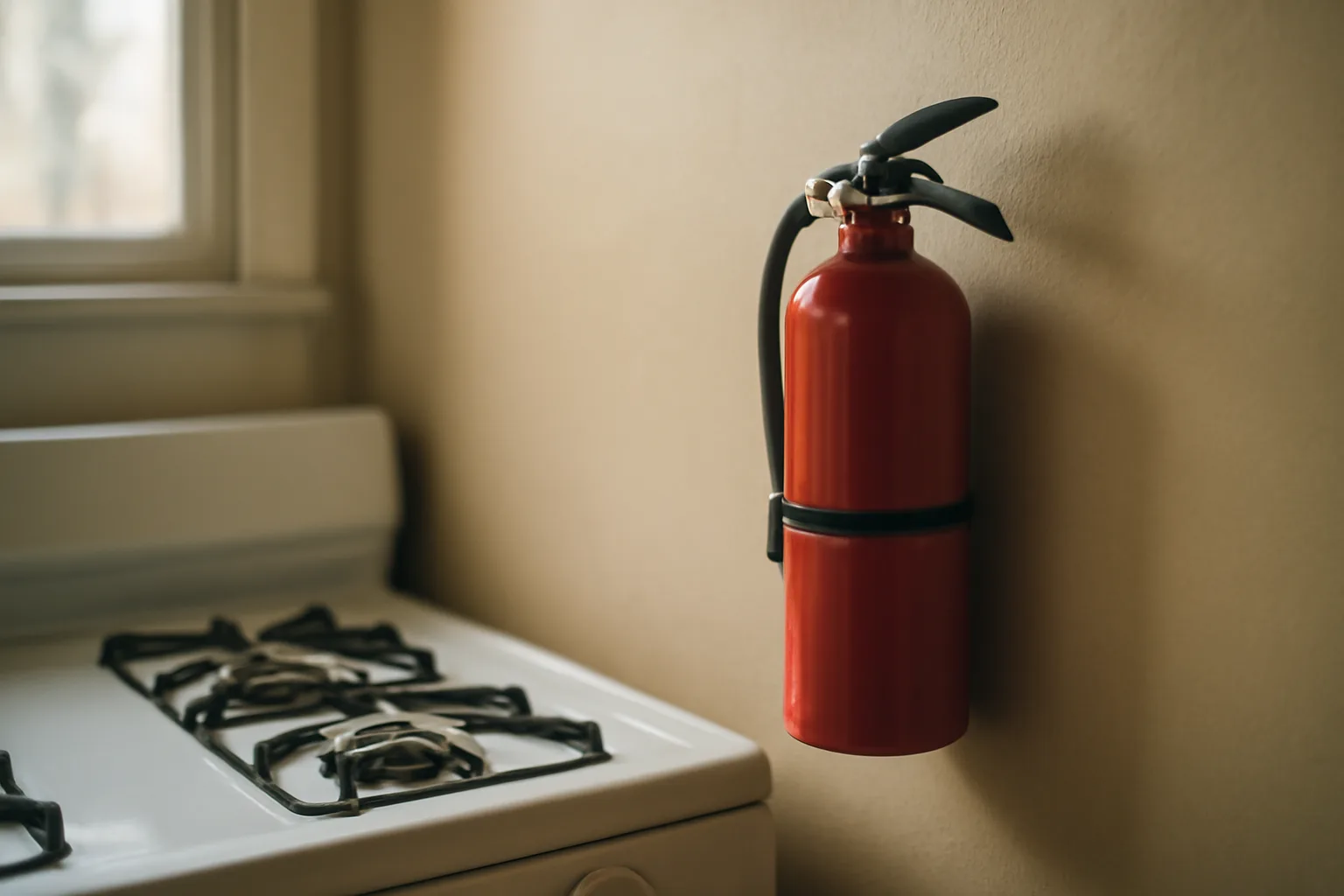
Even where it's not strictly mandated by code for your specific unit, a lot of landlords choose to put a small fire extinguisher in every kitchen anyway. It's cheap insurance against a stovetop grease fire turning into a total loss. The National Fire Protection Association publishes home fire safety guidance recommending a multipurpose extinguisher rated for ordinary combustibles, flammable liquids, and electrical fires (an ABC-rated unit), sized for a residential kitchen, and covers use and placement in its NFPA 10 Standard for Portable Fire Extinguishers [4]. A basic 5-pound ABC extinguisher runs roughly $25 to $50 at most hardware stores as of 2024-2025 pricing, which is a trivial cost compared to a single fire damage claim or a lost tenant. If your unit does fall under a code requirement, the fire code will typically specify placement (near an exit, mounted and visible, within a certain travel distance) and inspection intervals, which for many commercial-style requirements is an annual professional inspection tag. For units where it's not code-mandated, there's no state requirement on brand, rating, or inspection schedule. Landlords who install one anyway usually check it once a year alongside a smoke alarm battery check and note the date somewhere in their maintenance log.
what fire and life safety items does pennsylvania actually require for all rentals
| Smoke alarms | Yes, under Act 121 amendments to fire and panic act [5] | Placement specifics may vary by local code | |
|---|---|---|---|
| Carbon monoxide alarms | Yes, for units with fuel-burning appliances/attached garage [6] | Enforcement mechanism varies | |
| Fire extinguishers | No blanket statewide mandate for individual dwelling units | Yes, common in multi-unit buildings, commercial-adjacent spaces, and cities with their own fire code (Philadelphia, others) | |
| Egress windows/exits | Yes, under UCC building code adoption [2] | Older buildings may have grandfathered conditions | That table is the honest summary: smoke alarms and CO alarms are close to universal, fire extinguishers are situational. |
While the extinguisher question is murky, a few fire and life safety items are much more clearly required statewide. Pennsylvania's Act 121 of 2011 requires smoke detectors in all rental units and amended the state fire and panic act to require working smoke alarms, with landlords responsible for installing and maintaining them and tenants responsible for notifying the landlord if one fails [5]. Carbon monoxide alarm requirements also apply broadly to residential rentals with fuel-burning appliances or attached garages under a separate state law [6]. Here's a quick comparison of what's clearly statewide versus what depends on your municipality: | Safety item | Statewide requirement | Depends on city/county |
what happens if a landlord doesn't have a required fire extinguisher
If your municipality's fire code or rental licensing inspection requires an extinguisher and you don't have one, the consequence is usually a violation notice with a correction period, not an instant fine. Most cities give landlords 10 to 30 days to fix a fire code violation before penalties kick in, though the exact window is set locally, so confirm with your city rental licensing office or fire marshal what your notice actually says. Repeat or unaddressed violations can escalate to citations. In cities with rental licensing programs, an open fire code violation can hold up your license renewal or a certificate of occupancy transfer when you sell or re-rent the unit. That's the part landlords underestimate: it's rarely the extinguisher itself that costs money, it's the delay to your licensing timeline while you sort it out. If you got a notice and you're not sure whether it's a legitimate statewide requirement or a local add-on, don't argue with the inspector before you've read the actual code section cited on the notice. Ask for the code citation, then call the office that issued it. This is exactly the kind of paperwork problem RentalPermitPath's $79 City Rental License & Inspection Prep Packet is built for: it lays out what your specific city checks for, in advance, so a fire safety line item doesn't blindside you the week of an inspection.
how to become a landlord in pennsylvania
Becoming a landlord in Pennsylvania doesn't require a state landlord license, but it does require a handful of practical steps most new owners skip until something goes wrong. Start with confirming the property is properly zoned for rental use, register with your local tax office if required, and check whether your municipality has a rental registration or licensing ordinance, since a growing number of PA cities and boroughs do. You'll also want landlord-specific (not homeowner) insurance, a lease that follows Pennsylvania's Landlord and Tenant Act of 1951 for notice periods and security deposit handling, and a clear plan for habitability items: working smoke alarms, CO alarms where required, functioning heat, and safe electrical and structural conditions [1][5][6]. The practical order most new landlords follow: confirm local licensing requirements, get the property inspected if your city requires it before occupancy, set up compliant lease terms, and get insurance in place before you advertise the unit. Skipping the local licensing step is the single most common first-time landlord mistake in cities that require it, because the fines for renting without a required license often exceed a year's worth of the license fee itself.
what is landlording and what is a landlord
Landlording is the day-to-day work of owning and managing rental property: collecting rent, handling maintenance requests, keeping the unit compliant with local code, screening tenants, and managing the legal relationship defined by the lease and state law. A landlord, legally, is the party who owns or controls a rental property and leases it to a tenant in exchange for rent, taking on specific statutory obligations around habitability, notice, and deposit handling. In Pennsylvania, that relationship is governed primarily by the Landlord and Tenant Act of 1951, which sets out notice periods for lease termination, rules for security deposits (capped at two months' rent for the first year of a lease, one month's rent after that), and the eviction process through the courts [1]. Being a landlord isn't just owning the building; it's the ongoing legal responsibility for keeping it safe and habitable and following the process when things go wrong, rather than trying to force a tenant out yourself. A lot of new owners think of "landlord" as a passive label. In practice it's an active, code-governed role, and that's exactly why cities with rental licensing programs check on landlords periodically rather than trusting a one-time registration.
what rights do tenants have without a lease in pennsylvania
A tenant without a written lease in Pennsylvania still has real legal protections; verbal agreements and month-to-month tenancies are recognized under state law. Under the Landlord and Tenant Act of 1951, a tenancy without a specified term is generally treated as a month-to-month arrangement, and either party typically must give at least 15 days' notice to end it if the tenancy has run less than one year, or 30 days' notice if it's run one year or more, unless local ordinance sets a different standard [1]. Tenants without a lease still get the habitability protections that come from state law and local housing/property maintenance codes: working smoke alarms, safe electrical and plumbing systems, adequate heat, and structurally sound conditions. A landlord can't skip those obligations just because there's no signed lease. What a no-lease tenant does lack is the specific terms a written lease would otherwise lock in, like a fixed rent amount for a defined term or specific rules about pets, subletting, or maintenance responsibilities. Without those in writing, disputes tend to default to whatever the state's general landlord-tenant law says, which favors clearer proof requirements for the party trying to establish a term wasn't month-to-month.
why do landlords require renters insurance
Landlords require renters insurance mainly to shift liability and personal property risk off their own policy. A landlord's insurance covers the building structure and the landlord's own liability, but it generally doesn't cover a tenant's personal belongings if there's a fire, theft, or water damage, and it may not fully cover a tenant's liability if the tenant's negligence causes damage (like an unattended candle or an overflowed bathtub). Requiring renters insurance, commonly with a modest liability minimum like $100,000, pushes that risk onto a policy the tenant carries, which reduces the odds a landlord ends up in a costly dispute over who pays after a covered loss. It's a lease term, not a state-mandated requirement in Pennsylvania; nothing in state law forces landlords to require it, but plenty of landlords choose to make it a lease condition because the cost to tenants (often $10 to $20 a month) is low relative to what it protects against. If you're deciding whether to require it, weigh it against what you'd have to prove in court without it. A tenant without renters insurance who causes a kitchen fire and has no coverage is a tenant you're much more likely to be fighting over damages with directly.
how much notice does a landlord have to give in pennsylvania
Notice requirements in Pennsylvania depend on what the landlord is doing: ending a tenancy, entering the unit, or raising rent. For ending a month-to-month tenancy under the Landlord and Tenant Act of 1951, the standard is 15 days' notice for tenancies under one year and 30 days' notice for tenancies of one year or longer, though some cities add their own notice rules on top [1]. For entering an occupied unit for inspections, repairs, or showings, Pennsylvania's statute doesn't set one specific statewide notice number the way some states do, so the controlling terms are usually whatever the lease specifies, combined with the general legal principle that a landlord can't enter unreasonably or without a legitimate purpose. Many leases specify 24 to 48 hours' notice for non-emergency entry, and that's a reasonable default even where state law is silent. For rent increases, Pennsylvania doesn't cap how much a landlord can raise rent, but does generally require it to happen at lease renewal or with proper notice matching the termination notice period if it's a month-to-month tenancy, since raising rent effectively requires ending the old terms and offering new ones.
what can a landlord look at during a rental inspection
During a routine or licensing inspection, a landlord (or the inspector doing it on the landlord's behalf) is generally checking for habitability and code compliance: working smoke and CO alarms, functioning heat and hot water, safe electrical outlets and panels, no active leaks or mold, secure locks on exterior doors, safe egress from bedrooms, and, depending on the city, fire extinguisher placement in common areas or specified occupancies [2][3][5][6]. What a landlord generally should not do during an inspection is search through a tenant's personal belongings, closets, or drawers beyond what's needed to check a system (like confirming a smoke alarm above a doorway is present and functional). Inspections are about the condition and safety of the unit and its systems, not the tenant's possessions. Cities with mandatory rental licensing programs typically publish an inspection checklist covering these items in advance, which is worth requesting before your inspection date rather than guessing. If you're unsure what your city's inspector will check, that checklist request to your local rental licensing office is the single highest-value phone call you can make before an inspection.
who does a rental property walk-through inspection, and what can't a landlord do (ohio comparison)
In jurisdictions with mandatory rental inspection programs, the walk-through is typically done by a city or county code enforcement officer or fire marshal, not by the landlord alone, though the landlord (or a property manager) is usually required to be present or to have arranged access. This is true across most states with licensing programs, including Pennsylvania's various city ordinances and comparable programs elsewhere. A commonly searched comparison is what a landlord cannot do in Ohio, which is instructive because Ohio's landlord-tenant law (Ohio Revised Code Chapter 5321) sets out similarly clear boundaries: a landlord generally cannot shut off utilities to force a tenant out, cannot change the locks without legal process, cannot enter without reasonable notice (Ohio's statute specifies 24 hours as presumptively reasonable in many cases), and cannot retaliate against a tenant for reporting code violations . Pennsylvania's protections are similar in spirit even though the specific statute numbers differ: no landlord in either state can use self-help eviction methods like lockouts or utility shutoffs instead of going through court. If you're comparing state rules because you own in more than one, don't assume a rule from one state applies in the other. Notice periods, security deposit caps, and entry rules all vary by state statute, and the safest approach is checking your specific state's landlord-tenant act section by section rather than relying on general landlord forums.
Frequently asked questions
Does Pennsylvania law require a fire extinguisher in every rental unit?
No. There's no single statewide statute mandating a fire extinguisher in every individual dwelling unit. Requirements come from the state's adopted fire code (through the Uniform Construction Code) for certain occupancy types, and from local fire codes in cities like Philadelphia. Confirm with your local fire marshal or code office for your specific building type.
Are smoke alarms required in Pennsylvania rentals even if fire extinguishers aren't?
Yes. Act 121 of 2011 amended Pennsylvania's fire and panic act to require working smoke alarms in all rental units, with landlords responsible for installation and maintenance. This is one of the clearest statewide requirements landlords face, unlike the fire extinguisher question, which depends on local code and building type.
What happens if my city cites me for a missing fire extinguisher?
Most cities issue a violation notice with a correction window, commonly 10 to 30 days, rather than an immediate fine. Repeat or unresolved violations can escalate to fines and can hold up rental license renewals. Read the specific code section cited on your notice and call the issuing office to confirm the deadline and fix required.
How to become a landlord in Pennsylvania?
Confirm your property's zoning allows rental use, check if your municipality requires rental registration or licensing, get landlord insurance, prepare a lease consistent with the Landlord and Tenant Act of 1951, and make sure smoke alarms and CO alarms are installed before advertising the unit. No state landlord license exists, but local requirements vary widely.
Who is responsible for a rental property walk-through inspection?
In cities with mandatory inspection programs, a city or county code enforcement officer or fire marshal typically conducts the inspection, with the landlord or property manager responsible for scheduling access. The landlord remains responsible for fixing anything the inspection flags, even though the inspector does the actual walk-through.
What is landlording?
Landlording is the ongoing work of owning and managing rental property: collecting rent, handling repairs, keeping the unit code-compliant, screening tenants, and managing the lease relationship under state landlord-tenant law. It's an active legal role, more than property ownership.
What is a landlord, legally speaking?
A landlord is the party who owns or controls a rental property and leases it to a tenant for rent, taking on statutory duties around habitability, security deposits, notice periods, and eviction procedure. In Pennsylvania, these duties come primarily from the Landlord and Tenant Act of 1951.
What rights does a tenant have without a signed lease in Pennsylvania?
A tenant without a written lease is still protected under Pennsylvania's Landlord and Tenant Act of 1951 and generally holds a month-to-month tenancy, requiring 15 days' notice to end it if under a year, or 30 days if a year or more. Habitability protections like working smoke alarms and safe systems still apply regardless of lease status.
Why do landlords require renters insurance?
Renters insurance shifts liability and personal property risk to the tenant's policy, since a landlord's insurance typically doesn't cover a tenant's belongings or all tenant-caused liability. It's not state-mandated in Pennsylvania, but many landlords require it as a lease condition because it's cheap for tenants and reduces dispute risk after fires, water damage, or theft.
How much notice does a landlord have to give before ending a tenancy in Pennsylvania?
Under the Landlord and Tenant Act of 1951, a month-to-month tenancy under one year generally requires 15 days' notice to terminate, and one of a year or more requires 30 days' notice. Some cities layer additional notice requirements on top, so check local ordinances too.
What can a landlord look at during a rental inspection?
Inspectors generally check smoke and CO alarms, heat and hot water function, electrical safety, signs of leaks or mold, door locks, safe bedroom egress, and, depending on the city, fire extinguisher placement in common areas. Inspections should focus on the unit's systems and safety, not a tenant's personal belongings.
What can't a landlord do in Ohio, and how does that compare to Pennsylvania?
Under Ohio Revised Code Chapter 5321, a landlord cannot shut off utilities to force a move-out, cannot change locks without legal process, must give reasonable entry notice (commonly treated as 24 hours), and cannot retaliate against tenants reporting code violations. Pennsylvania bars similar self-help eviction tactics, though the exact statute sections differ.
Do multi-unit apartment buildings in Pennsylvania have stricter fire extinguisher rules than single-family rentals?
Often yes. The International Fire Code, adopted through Pennsylvania's Uniform Construction Code, tends to apply extinguisher and other fire safety requirements based on occupancy classification and shared spaces like hallways, basements, and mechanical rooms, which single-family rentals typically don't have. Confirm your building's specific classification with your local code office.
Sources
- Pennsylvania General Assembly, Landlord and Tenant Act of 1951, 68 P.S. Section 250.101 et seq.: Pennsylvania's core landlord-tenant law covering leases, notice periods, and security deposits
- 34 Pa. Code Chapter 403, Pennsylvania Uniform Construction Code adoption of the International Fire Code and International Building Code: Pennsylvania's statewide Uniform Construction Code adopts International Fire Code/Building Code provisions as the minimum standard, with municipal opt-out allowed
- City of Philadelphia, Philadelphia Code Chapter 9-3900, Property Maintenance and Rental Licensing: Philadelphia requires a rental license and conducts inspections tied to its own fire and property maintenance code requirements
- Pennsylvania General Assembly, Act 121 of 2011, amending the Fire and Panic Act, 35 P.S. Section 1231.1: Act 121 requires working smoke alarms in Pennsylvania rental units, with landlord responsibility for installation and maintenance
- Pennsylvania General Assembly, Act 13 of 2013, Carbon Monoxide Alarm Standards Act, 35 P.S. Section 7215: Pennsylvania law requires carbon monoxide alarms in residential units with fuel-burning appliances or attached garages
- Ohio Legislature, Ohio Revised Code Section 5321.04, Landlord Obligations: Ohio law prohibits landlord self-help eviction tactics like utility shutoffs and lockouts, and sets entry notice standards
- Occupational Safety and Health Administration (OSHA): Federal OSHA regulation 29 CFR 1910.157 outlines requirements for portable fire extinguishers, often used as a reference standard for extinguisher type and placement.
- Pennsylvania Code: Pennsylvania's Uniform Construction Code chapter 405 sets forth fire and life safety requirements applicable to residential rental properties.