Last updated 2026-07-25
TL;DR
There's no national landlord license. Requirements come from your state's landlord-tenant law plus your city's rental registration or licensing program, if it has one. At minimum you need a legal unit, a habitable property, proper notice practices, and compliance with local registration or inspection rules before you collect rent.
How to become a landlord in the first place
Becoming a landlord isn't a licensed profession like becoming an electrician. Nobody hands you a landlord certificate. What actually makes you a landlord, legally, is renting out real property you own (or sublease legally) to a tenant under some kind of agreement, written or verbal. That said, "legally allowed to rent" and "actually own a house" aren't the same thing. Before you list a unit, you generally need to confirm: the property is zoned for rental use or you have the right permit (many cities restrict short-term or even long-term rentals in certain zones), you're registered with your city if it requires rental registration or licensing, your unit passes any required inspection, and you're carrying appropriate landlord insurance, more than a standard homeowner's policy. A growing number of cities require a rental license or registration before you can legally rent at all. Chicago, for example, requires most residential rental properties to register under its Residential Landlord and Tenant Ordinance framework administered by the Department of Buildings [1]. Los Angeles requires registration under its Systematic Code Enforcement Program (SCEP) with an annual per-unit fee, currently set through the Rent Stabilization Ordinance fee schedule [2]. If your city has one of these programs and you skip it, you're more than risking a fine, you can lose your ability to evict for nonpayment until you're compliant, depending on local ordinance language. The honest starting sequence is: check your city's rental registration or business license page, check your state's landlord-tenant statute for security deposit and notice rules, get a landlord insurance policy, and get your unit inspection-ready before you sign a lease. If you want a structured way to work through the city-specific parts (license applications, inspection prep, required postings), the City Rental License & Inspection Prep Packet walks through that process for a flat $79, but you can absolutely do it yourself using your city's rental licensing office as the source of truth.
What is landlording, exactly?
"Landlording" is the ongoing work of owning and managing rental property, more than the one-time act of signing a lease. It covers screening tenants, collecting rent, handling maintenance requests, keeping the unit habitable, managing security deposits correctly, giving legally sufficient notice for entry or lease changes, and staying current on local registration and inspection requirements. People who own one or two units often think of landlording as passive income. It isn't, not legally. You have ongoing duties under your state's warranty of habitability (a legal doctrine, more than a nice idea, that requires rental units to meet basic health and safety standards throughout the tenancy) and under any local licensing ordinance that requires periodic re-registration or re-inspection. Most states impose some version of an implied warranty of habitability. California's version, for instance, requires landlords to maintain the premises in a condition "fit for human occupation" for the duration of the tenancy, covering things like working plumbing, weatherproofing, heat, and hot water [3]. If you don't understand landlording as an ongoing compliance job, you'll get caught off guard by the first inspection notice or tenant repair request that lands in your mailbox.
What is a landlord, legally?
Legally, a landlord (sometimes called a "lessor") is the party who owns or controls a rental property and grants a tenant the right to occupy it in exchange for rent, under a lease or rental agreement. That's the core definition used across most state landlord-tenant statutes. The definition matters because it triggers legal duties the moment you take on the role, whether or not you call yourself a "landlord" or think of the arrangement as informal. If you accept rent from someone living in your property, you're a landlord under the law, full stop, even if there's no signed lease. This is where a lot of first-time landlords get surprised: renting to a friend or family member "informally" for cash doesn't exempt you from habitability law, security deposit law, or eviction procedure requirements. The label "landlord" attaches based on conduct (accepting rent for occupancy), not based on paperwork.
What rights do tenants have without a lease?
Tenants without a written lease still have real, enforceable rights. In nearly every state, a tenant paying rent without a written agreement is treated as a "tenant at will" or month-to-month tenant, and they're entitled to the same basic protections as any other tenant: habitable conditions, proper notice before entry, and a legal eviction process rather than a lockout. No written lease does not mean no rights and it does not mean the landlord can remove the tenant whenever convenient. Self-help eviction (changing locks, shutting off utilities, removing belongings without a court order) is illegal in essentially every U.S. state, lease or no lease. California's Civil Code Section 1954 restricts landlord entry even without a written lease [3], and most states require formal written notice (commonly 3, 30, or 60 days depending on tenancy length and reason) before ending a month-to-month tenancy. If you're renting without a written lease right now, get one in place. It protects you as much as the tenant, because verbal terms are nearly impossible to enforce if a dispute goes to court.
Who is responsible for a rental property walk-through inspection in California?
In California, the landlord is responsible for initiating the move-out walk-through inspection, but the tenant has to be given the opportunity to participate. California Civil Code Section 1950.5 requires that if a landlord intends to withhold any part of a security deposit for repairs at move-out, the landlord must, upon the tenant's request, conduct an initial inspection before the tenant vacates and give the tenant an itemized list of deficiencies with a chance to fix them [3]. This "pre-move-out inspection" is optional for the tenant to request but if requested, the landlord must offer it within a reasonable time before the lease ends, typically interpreted as within the last two weeks of the tenancy. The landlord (or their agent, like a property manager) does the actual inspection and writes the itemized notice. The tenant has the right to be present. This is separate from any city-mandated rental housing inspection (used for licensing purposes in cities with proactive rental inspection programs), where a city inspector, not the landlord or tenant, does the walk-through to check code compliance for licensing renewal.
What can a landlord look at during an inspection?
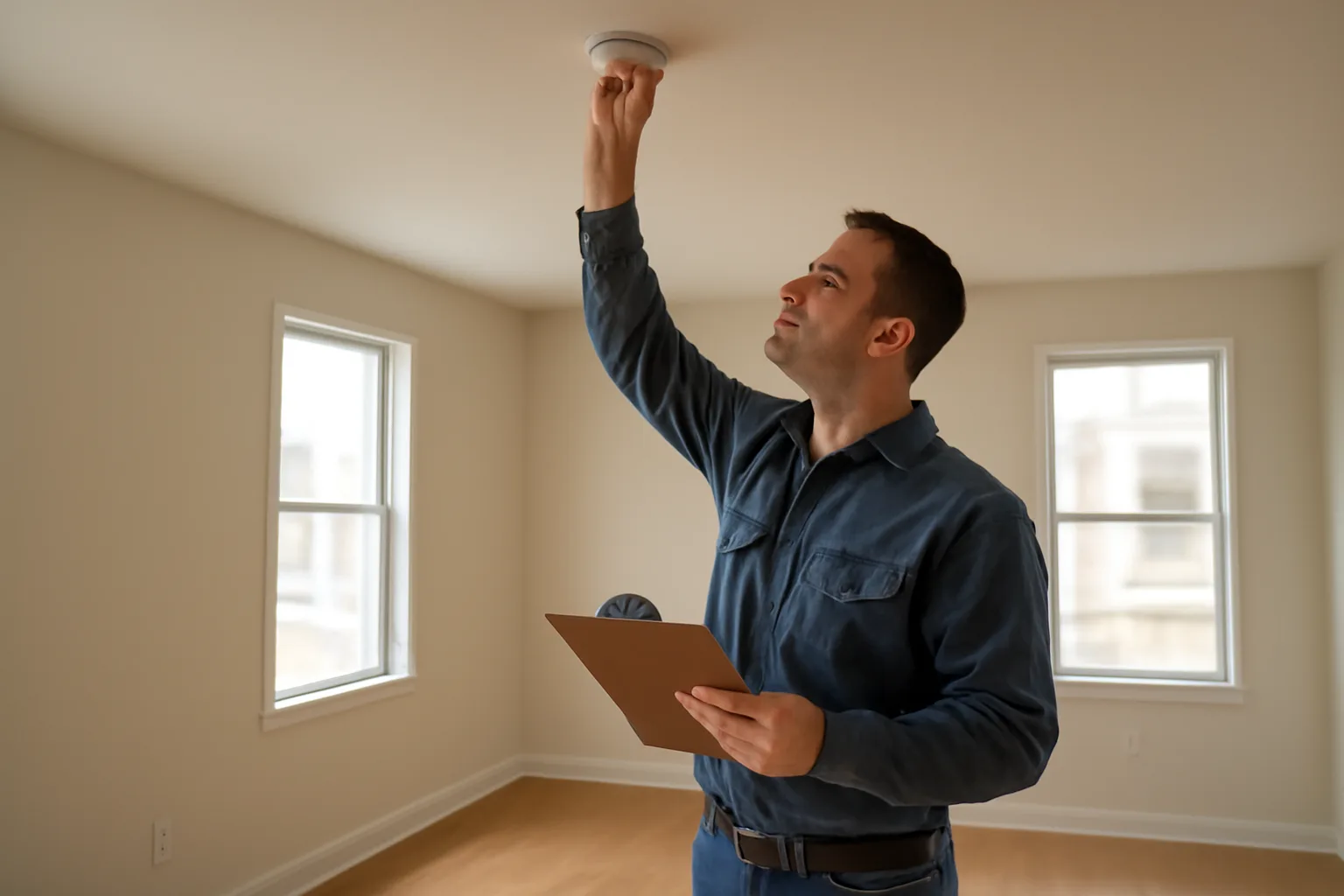
During a routine or move-out inspection, a landlord (or city inspector, for licensing inspections) can generally check the condition of the unit as it relates to habitability and lease compliance: working smoke and carbon monoxide detectors, plumbing and water heater function, electrical outlets and panel condition, heating and cooling systems, structural issues (cracked walls, damaged flooring), pest evidence, and cleanliness relative to normal wear and tear. What a landlord generally cannot do during an inspection is search personal belongings, go through closets or drawers unrelated to habitability checks, or use the inspection as a pretext to harass a tenant or retaliate for a complaint. Many states also cap how often a landlord can inspect absent an emergency or the tenant's consent. For licensing or code-compliance inspections done by the city, the inspector is usually looking at a specific checklist: smoke/CO detector placement and function, egress window sizes in bedrooms, water heater strapping and pressure relief valves, GFCI outlets near water sources, handrails on stairs, and any visible code violations like exposed wiring or missing weatherstripping. Minneapolis publishes its rental license property maintenance requirements, covering smoke alarm placement, egress, and mechanical systems, in its Rental Licensing Property Maintenance Code chapter, so ask your local rental licensing office for the equivalent document before your inspection date rather than guessing [4].
How much notice does a landlord have to give?
| Entry for repairs/showing | 24 to 48 hours | CA presumes 24 hrs reasonable [3] | |
|---|---|---|---|
| End month-to-month tenancy | 30 to 60 days | Longer if tenant tenure exceeds 1 year in some states | |
| Rent increase (standard) | 30 days | Some states scale with increase size | |
| Rent increase (large, CA) | 90 days | CA Civ. Code 827, increases over 10% [3] | |
| Nonpayment of rent notice | 3 to 14 days | Varies heavily by state | Don't treat this table as your legal answer, it's a pattern, not a citation for your specific state. Pull your actual state statute before sending any notice. |
Notice requirements vary by state and by what the notice is for, so there's no single national number. As a rough guide: entry notice is commonly 24 hours (California requires "reasonable notice," which the statute presumes to be 24 hours in normal circumstances) [3]. Lease termination notice for month-to-month tenancies is commonly 30 days, though some states require 60 days if the tenant has lived there a year or more. Rent increase notice often mirrors termination notice: 30 days for a standard increase, sometimes 60 or 90 days for larger increases (California requires 90 days' notice for rent increases over 10% in a 12-month period under Civil Code Section 827) [3]. Notice for nonpayment of rent before starting eviction is typically much shorter, often 3 to 14 days depending on the state. Here's a general comparison, but always confirm exact numbers against your specific state statute, because these vary widely and change: | Notice type | Common range | Example |
Why do landlords require renters insurance?
Landlords require renters insurance mainly to shift liability and personal property risk off their own policy. A standard landlord or dwelling insurance policy covers the building structure and the landlord's own belongings (appliances, fixtures), but it generally does not cover a tenant's personal property if there's a fire, burst pipe, or theft, and it may not adequately cover the landlord if the tenant is found liable for causing damage or an injury inside the unit. Renters insurance typically includes personal liability coverage, meaning if a tenant's negligence causes a fire or a guest gets hurt in their unit, the tenant's policy responds first, protecting the landlord from being the only deep pocket in a lawsuit. Renters insurance is relatively cheap, commonly in the range of $15 to $30 a month depending on coverage amount and location, according to typical insurance industry cost surveys, though exact pricing depends on your market and carrier. Requiring it is legal in most states as a lease condition, though a handful of jurisdictions have specific rules about how landlords can enforce it (for example, some require the landlord to offer a comparable policy if the tenant can't get their own, particularly in subsidized housing contexts). If you require renters insurance, put the requirement and the minimum liability coverage amount directly in the lease, and ask for proof of an active policy before move-in and at each renewal.
What can a landlord not do in Ohio?
Ohio's landlord-tenant law, codified largely in Ohio Revised Code Chapter 5321, restricts landlords from several actions that are common trouble spots. A landlord in Ohio cannot shut off utilities, change the locks, or remove a tenant's belongings to force them out without going through formal eviction (this is illegal "self-help eviction" and Ohio courts treat it seriously) [5]. Ohio Revised Code 5321.04 requires landlords to maintain the premises in a fit and habitable condition, comply with building and housing codes materially affecting health and safety, keep common areas safe, and maintain plumbing, electrical, heating, and appliances supplied by the landlord in good working order [5]. A landlord who fails these duties can face tenant remedies including rent escrow (where the tenant pays rent to the court instead of the landlord until repairs happen) under Ohio Revised Code 5321.07 [6]. Ohio law also prohibits retaliatory conduct, meaning a landlord cannot raise rent, decrease services, or attempt to evict a tenant specifically because the tenant complained to a housing authority or joined a tenant union, under Ohio Revised Code 5321.02 [7]. And landlords cannot enter a rental unit whenever they want. Ohio Revised Code 5321.04 requires reasonable notice, generally interpreted as 24 hours, except in genuine emergencies [5]. This Ohio pattern (habitability duty, no self-help eviction, notice for entry, anti-retaliation protection) is close to what most states require, which is why it's worth reading as a template even if you're not in Ohio.
What do rental registration and licensing programs actually require?
This is the part that trips up new landlords who assume state landlord-tenant law is the whole picture. Many cities layer their own registration, licensing, or inspection requirements on top of state law, and these are separate systems with separate deadlines and separate fines. A typical city rental licensing program requires: an initial registration or license application (often with a per-unit or per-property fee), a physical inspection of the unit before the license issues or at renewal (commonly every 1 to 3 years depending on the city), proof of local business registration or a designated local contact if you don't live in the city, and posting of the license or a placard in a visible location in some jurisdictions. Fees and cycles vary enormously. Confirm exact numbers with your city rental licensing office. Cities also vary on what triggers a mandatory inspection: some inspect every unit before initial licensing, others only inspect on complaint or a percentage-based random sample each year. Missing a required license renewal or ignoring an inspection notice commonly results in fines that escalate the longer you stay noncompliant, and in some cities an active violation can block your ability to legally collect rent or evict until it's resolved. If you're dealing with a specific ordinance notice right now, the fastest path is pulling up your city's actual rental licensing page and reading the fee schedule and inspection checklist directly, rather than relying on general advice like this article, since these programs differ block by block in some metro areas.
What else should new landlords set up before renting?
Beyond registration and inspection compliance, a few things separate landlords who avoid trouble from landlords who end up in housing court. Get a written lease, even for family or friends, covering rent amount, due date, security deposit terms, and maintenance responsibilities. Set up a separate bank account for rental income and security deposits; many states legally require deposits to be held in a separate, sometimes interest-bearing, account, and commingling can create liability even where it's not strictly illegal. Get landlord insurance (more than homeowner's insurance), and consider an umbrella liability policy given how cheap they are relative to a single lawsuit. Document the unit's condition with photos or video before move-in and before move-out; this single habit resolves more security deposit disputes than any lease clause could. And build a simple compliance calendar: your city's license renewal date, your state's required notice periods, and your insurance renewal date, so you're not scrambling when a notice arrives. If you want a structured walkthrough for a specific city's licensing and inspection requirements, rather than piecing it together from scattered municipal pages, the City Rental License & Inspection Prep Packet is a one-time $79 resource built for exactly this. It's not a substitute for reading your city's actual ordinance, but it organizes the process so you're not guessing what an inspector will check.
Where to learn more about tenant and landlord rights
Landlord-tenant law is genuinely local: your state statute sets the floor, and your city ordinance can add registration, licensing, and inspection layers on top. If you want to understand the tenant side of these same rules, since your obligations and their rights are two views of the same law, it's worth reading up on tenants rights and tenant rights as they apply in your state, along with general renters rights resources that cover habitability, notice, and deposit rules from the other side of the lease. For landlords specifically working through licensing questions city by city, start with your municipal rental licensing or code enforcement office's published fee schedule and inspection checklist. These pages change, sometimes yearly, so treat any number you find in a blog post (including this one) as a starting point to verify, not a final answer.
Frequently asked questions
How do I become a landlord with no experience?
Start by confirming your property is legally zoned for rental use, then check your city's rental registration or licensing requirements and your state's landlord-tenant statute for lease, deposit, and notice rules. Get landlord insurance, write a solid lease, and get the unit inspection-ready before advertising it. Many first-time landlords also read their state's official landlord-tenant handbook, often published free by the state attorney general's office.
Do I need a license to rent out my house?
It depends entirely on your city and state. Most states don't require an individual landlord license, but a large and growing number of cities do require rental registration or a rental license, often with inspection and per-unit fees. Check directly with your city's rental licensing or code enforcement office; there's no national requirement.
What is the difference between a landlord and a property manager?
A landlord owns or legally controls the rental property and holds the ultimate legal obligations under the lease and state law. A property manager is typically hired by the landlord to handle day-to-day tasks like rent collection, maintenance, and tenant communication, but the landlord still generally carries the underlying legal responsibility unless the manager holds specific delegated authority.
Can a landlord evict a tenant without a written lease?
No. Even without a written lease, a tenant paying rent has tenancy rights and can only be removed through the legal eviction process in their state, which requires proper written notice and typically a court order. Self-help eviction, like changing locks or removing belongings, is illegal in effectively every U.S. state regardless of whether a lease exists.
How much notice does a landlord have to give before entering the unit?
Most states require some form of "reasonable notice," commonly interpreted as 24 hours, except in genuine emergencies. California's Civil Code presumes 24 hours is reasonable for routine entry [3]. Ohio Revised Code 5321.04 similarly requires reasonable notice, generally treated as 24 hours [5]. Always check your specific state statute since exact language and exceptions vary.
Why do landlords require renters insurance from tenants?
Renters insurance covers the tenant's personal belongings and includes liability coverage if the tenant's negligence causes damage or injury, which protects the landlord from being solely liable. It's inexpensive, commonly $15 to $30 a month, and requiring it is legal in most states as a standard lease condition.
What rights does a tenant have without a signed lease?
A tenant without a written lease is generally treated as a month-to-month or at-will tenant and keeps the same core protections: habitable housing, proper notice before entry, proper notice before termination, and a formal eviction process rather than a lockout. Verbal or informal arrangements don't waive these legal protections in any U.S. state.
Who does the move-out inspection walk-through in California?
The landlord (or their agent) conducts the pre-move-out inspection, but only if the tenant requests one under California Civil Code Section 1950.5. The tenant has the right to be present, and the landlord must provide an itemized list of proposed repair or cleaning deductions with a chance for the tenant to fix issues before move-out [3].
What can a landlord check during a routine inspection?
A landlord can generally check habitability and lease-compliance items: smoke and CO detectors, plumbing, heating, electrical condition, structural issues, pest evidence, and general cleanliness. Landlords generally cannot search personal belongings or use inspections to harass or retaliate against a tenant, and many states cap how frequently non-emergency inspections can happen.
What can't a landlord do in Ohio specifically?
Under Ohio Revised Code Chapter 5321, a landlord cannot use self-help eviction (locks, utility shutoffs, removing belongings), must maintain habitability and code compliance, must give reasonable notice before entry, and cannot retaliate against a tenant for complaints or organizing, per ORC 5321.02, 5321.04, and 5321.07 [5][6][7].
What happens if I don't register my rental with the city?
Consequences vary by city but commonly include escalating fines, and in some jurisdictions the city will block you from filing an eviction for nonpayment of rent until you're registered and compliant. Some cities also charge back-fees for the period you operated unregistered. Check your specific city's rental licensing ordinance for exact penalties.
Is landlording considered a business for tax purposes?
Generally yes, rental income is reported to the IRS, commonly on Schedule E of Form 1040 for individual landlords, and expenses like repairs, mortgage interest, and depreciation are deductible. Whether it rises to a formal "trade or business" for other tax purposes depends on scale and involvement; a tax professional should confirm your specific situation.
Sources
- Municipal Code of Chicago, Chapter 5-12, Residential Landlord and Tenant Ordinance: Chicago requires most residential rental properties to comply with its Residential Landlord and Tenant Ordinance, administered by the Department of Buildings
- Los Angeles Housing Department, Rent Stabilization Ordinance Registration and Fees, LAMC Chapter XV: Los Angeles requires rental property registration under its Rent Stabilization Ordinance framework with an annual per-unit fee
- California Civil Code Section 1950.5 / 1954 / 827: California security deposit, pre-move-out inspection, entry notice, and rent increase notice rules
- Minneapolis Code of Ordinances, Chapter 244, Maintenance Code, Rental Licensing: Cities publish specific property maintenance and inspection requirements for rental licensing programs, such as Minneapolis's maintenance code chapter
- Ohio Revised Code 5321.04, Landlord obligations: Ohio landlord duties: habitability, code compliance, reasonable entry notice
- Ohio Revised Code 5321.07, Tenant remedies including rent escrow: Ohio tenants can use rent escrow if landlord fails habitability duties
- Ohio Revised Code 5321.02, Retaliatory conduct prohibited: Ohio prohibits landlord retaliation against tenants for complaints or organizing