Last updated 2026-07-26
TL;DR
A rental move-in inspection checklist documents the unit's condition, room by room, before a tenant moves in, with photos and tenant sign-off. It protects security deposit deductions later and, in cities with rental licensing, often overlaps with what a code inspector checks. Do it the same day the tenant gets keys, not before.
What should a rental move-in inspection checklist include?
| Entry/exterior doors | Locks work, keys match, weatherstripping, paint/finish condition |
|---|---|
| Living areas | Wall/ceiling condition, flooring, window screens, blinds, outlet covers |
| Kitchen | Appliance function (test each one), cabinet hinges, countertop chips, sink/faucet leaks, garbage disposal |
| Bathrooms | Toilet flush and base seal, tub/shower caulk, exhaust fan, water pressure, under-sink leaks |
| Bedrooms | Closet doors/tracks, window locks, flooring, smoke detector present and tested |
| Utilities | Water heater age/leaks, HVAC filter and thermostat, electrical panel labeled, visible wiring issues |
| Safety | Smoke detectors in every required location, CO detector if fuel-burning appliances present, fire extinguisher if required |
| Exterior/other | Yard condition, fencing, mailbox key, garage door opener, any existing pest evidence |
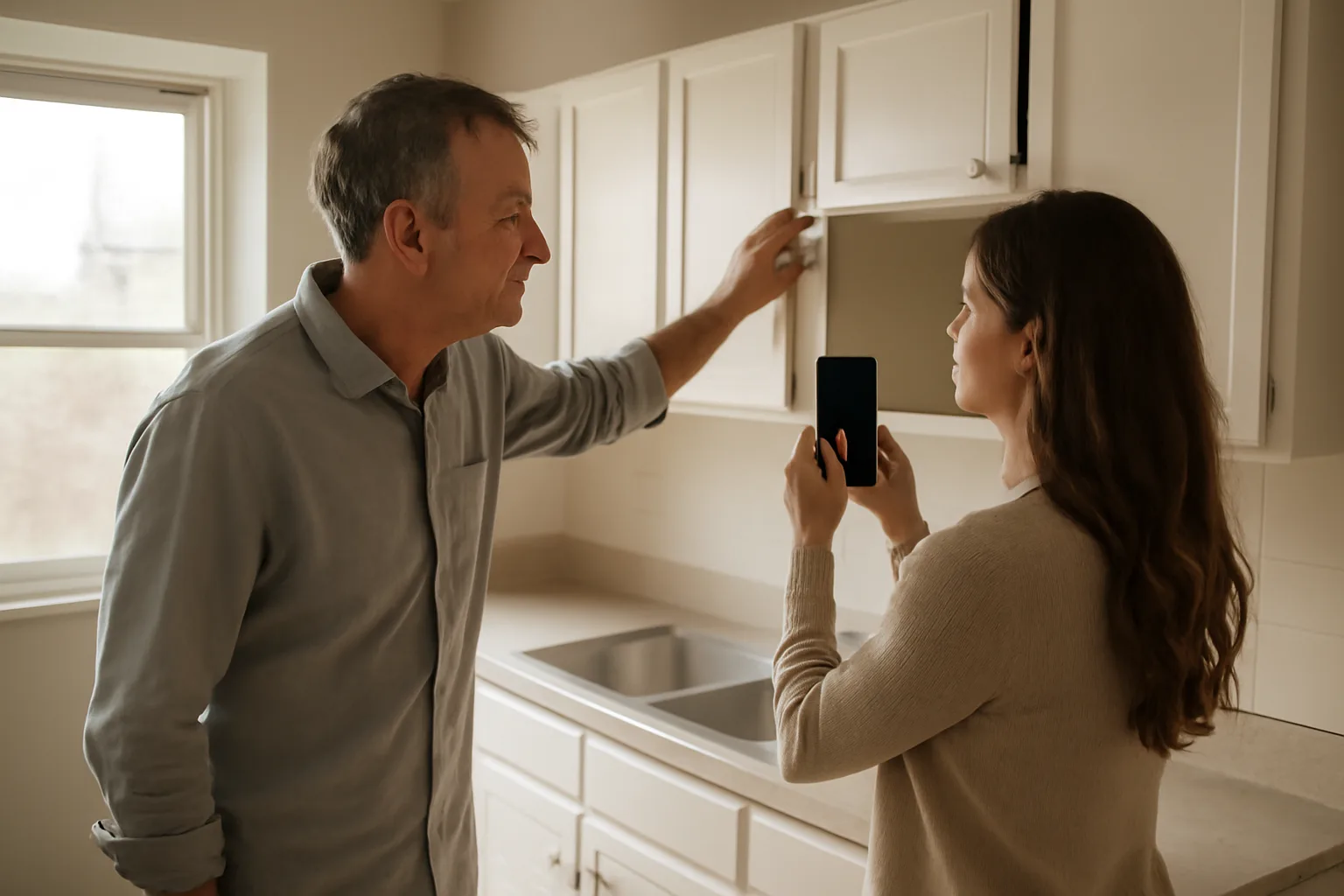
A move-in inspection checklist should cover every room, every major system, and every surface where damage could later become a dispute. That means walls, floors, ceilings, windows, doors, cabinets, countertops, all appliances, plumbing fixtures, light fixtures and switches, smoke and carbon monoxide detectors, and the condition of any furniture you're providing. You want enough detail that a judge or a mediator six months from now could read it and picture the room. Most state deposit statutes don't require a specific form, but they do require you to be able to prove what condition the unit was in at move-in if you want to withhold deposit money at move-out. California's security deposit law, for example, gives tenants the right to request an initial inspection before move-out specifically so disputes over damage can get resolved before the tenant leaves [1]. That only works if you also have a clear move-in record to compare against. Practical structure that works for a 1-10 unit landlord: one line item per fixture or surface, a condition rating (new, good, fair, damaged, needs repair), a note field, and a photo reference number. Walk the unit with the tenant present, not alone beforehand. Have both of you sign and date it, and give the tenant a copy same day, ideally within 24 to 48 hours by mail if you can't do it in person. Don't skip the exterior if the tenant has a private yard, deck, garage, or storage area. Those get forgotten constantly and then become the exact thing someone argues about at move-out. Room-by-room checklist template: | Area | Check for |
Who is responsible for a rental property walk-through inspection in California?
In California, the landlord is responsible for offering the move-out walk-through, but the tenant has to request it. Under California Civil Code Section 1950.5, a landlord must notify the tenant in writing of the right to an initial inspection before the tenant moves out, and the inspection has to happen "no earlier than two weeks before" the termination or vacate date [1]. If the tenant requests it and the landlord conducts it, the landlord must give the tenant an itemized statement of anything that needs fixing to avoid a deduction, along with a reasonable opportunity to fix it themselves. That's the move-out inspection though. For move-in, California law doesn't mandate a specific joint walk-through the way some other states do, but Section 1950.5 does require landlords to document the unit's condition if they want to justify deposit deductions later, and the practical way to do that is a signed move-in checklist with photos [1]. If you skip it, you're relying on your own memory and photos with no tenant sign-off, which is a much weaker position in small claims court. Cities with rental licensing programs sometimes layer their own inspection on top of this. A code compliance inspector checking for a rental license isn't looking at wear and tear the way a landlord-tenant walk-through does. They're checking for code violations: working smoke detectors, proper egress, no illegal wiring, functioning plumbing. Those are two separate processes and two separate checklists, and conflating them is a common mistake first-time landlords make.
What can a landlord look at during an inspection?
A landlord can generally inspect for property condition, safety hazards, lease compliance (unauthorized pets, unauthorized occupants, smoking violations), and maintenance issues. What a landlord cannot do is treat an inspection as a pretext to search through personal belongings, closets, drawers, or private areas that have nothing to do with the stated purpose of the visit. Most state landlord-tenant statutes require the inspection purpose to be legitimate: repairs, showing the unit to prospective tenants or buyers, or verifying the tenant hasn't violated the lease. California's entry statute, Civil Code Section 1954, lists the specific purposes that justify landlord entry, including to make necessary or agreed repairs, show the unit to prospective tenants or buyers, or conduct the move-out inspection described above [2]. A landlord entering repeatedly with no stated purpose, or going through a tenant's things unrelated to a repair, is generally overstepping even where the statute doesn't spell it out room by room. During a licensing-related code inspection, the inspector is typically limited to what's needed to check code compliance: smoke and CO detector placement, egress windows, electrical panel, visible plumbing leaks, evidence of pests or mold, and general habitability items. They are not there to inspect a tenant's belongings or personal areas beyond what's needed to see the fixture behind them.
How much notice does a landlord have to give before an inspection?
Notice requirements vary by state, typically running from 24 hours to 48 hours for routine, non-emergency entry, though a handful of states set no statutory minimum at all. California Civil Code Section 1954 states that "twenty-four hours shall be presumed to be reasonable notice in absence of evidence to the contrary" for landlord entry [2]. Other states like Illinois don't have a general statewide notice statute for private landlords outside of Chicago's municipal ordinance, so local rules matter as much as state ones. For the move-in walk-through itself, notice isn't usually the issue since the tenant is present and expecting it as part of getting keys. Notice rules mostly come up for later inspections during the tenancy, annual city rental inspections, or maintenance visits. If your city requires a rental license, check whether the inspection notice requirement comes from the city ordinance rather than the state landlord-tenant statute. Cities often specify their own notice period for the initial licensing inspection, and it can differ from what state law requires for a routine landlord visit. Always confirm with your city rental licensing office what their specific notice period is before scheduling; it's frequently spelled out on the same page as the license application itself. Emergency entry (fire, flooding, gas leak) generally doesn't require advance notice under any state's law, since the point is immediate safety.
What is landlording, and what does the job actually involve day to day?
Landlording is the ongoing work of owning and operating a rental property: screening and selecting tenants, handling move-in and move-out, collecting rent, maintaining the unit, responding to repair requests, keeping up with local licensing and inspection requirements, and managing the legal side of the tenancy including notices and, when necessary, eviction filings. It's part property management, part bookkeeping, part compliance work. For a 1-10 unit landlord, most of that falls on one person, which is why the paperwork side (leases, inspection checklists, notices, license renewals) tends to be the part that gets neglected first when things get busy. That's also usually the part that costs the most money when it goes wrong: a missed license renewal, an undocumented move-in condition, a notice sent with the wrong number of days. The U.S. Department of Housing and Urban Development and most state housing agencies treat rental housing providers as subject to fair housing law regardless of portfolio size, with limited exemptions (for example, owner-occupied buildings with four or fewer units, under the federal Fair Housing Act's exemptions) [3]. So even a landlord with one unit has legal obligations that look a lot like those of a large property management company, just without the staff to handle them.
What is a landlord, exactly, in legal terms?
A landlord is the party who owns or controls a rental property and leases it to a tenant in exchange for rent, taking on the legal obligations that come with that relationship: maintaining habitability, respecting the tenant's right to quiet enjoyment, following state and local notice rules, and handling the security deposit according to statute. Legally, the landlord-tenant relationship is created by a lease or rental agreement, written or verbal, and both sides get default rights and duties from state law even if the lease is silent on them. The implied warranty of habitability, recognized in the majority of states either by statute or case law, obligates a landlord to keep the unit livable regardless of what the lease says [4]. A landlord can be an individual owner, a couple, an LLC, or a property management company acting as an agent for the owner. For licensing purposes, most cities require the actual owner of record (or the LLC that holds title) to be named on the rental license application, even if a property manager handles day-to-day operations.
How do you become a landlord, step by step?
Becoming a landlord means buying or otherwise acquiring rental property, then meeting your state's and city's requirements to legally rent it out, which usually includes registering the rental with the city, passing any required inspection, screening tenants under fair housing law, and signing a compliant lease. The basic sequence looks like this for a first-time landlord: 1. Acquire the property and confirm zoning allows rental use (some single-family zones restrict rentals or require a special permit). 2. Check whether your city requires rental registration or licensing before you can legally rent the unit; many mandatory-licensing cities require this before the first tenant moves in, not after. 3. Get any required pre-rental inspection scheduled and passed. 4. Set up landlord insurance (different from a standard homeowner's policy) and confirm what your mortgage lender requires if the property is financed. 5. Write or obtain a lease that complies with your state's landlord-tenant statute. 6. Screen tenants consistently and in compliance with the Fair Housing Act's protected classes [3]. 7. Collect the security deposit within your state's legal maximum, if one exists, and provide any required disclosures. 8. Do the move-in walk-through and give the tenant keys. Step 2 is the one people miss most often. If your city already runs a mandatory rental licensing program, renting without the license first can trigger fines before you've even collected your first rent check. This is exactly the gap our $79 City Rental License & Inspection Prep Packet is built to close: a structured way to confirm what your specific city requires before you're staring down a violation notice.
How do you actually be a good landlord once tenants move in?
Being a good landlord day to day comes down to responding to repair requests promptly, following your state's entry and notice rules, keeping the property in compliance with local code, and treating the security deposit process as documentation-heavy rather than discretionary. A few habits separate landlords who avoid disputes from those who end up in small claims court or in front of a code enforcement hearing: Respond to repair requests in writing, even a text, so there's a timestamp. Many state habitability statutes tie a landlord's legal exposure to how quickly a known hazard gets fixed, and "I didn't know" doesn't hold up once there's a text message proving otherwise. Don't skip annual smoke and CO detector checks even where your state doesn't mandate an annual visit; several state fire codes require detectors to be tested and codes increasingly require sealed 10-year lithium battery units in new installations. Keep every move-in and move-out inspection record for at least the length of your state's statute of limitations on written contracts, often 3 to 6 years, since deposit disputes can surface well after the tenant has left. Renew your rental license or registration before it lapses. Cities vary widely on renewal cycles (annual is common, but confirm with your city rental licensing office), and a lapsed license can turn an otherwise fine unit into an unlicensed rental overnight, sometimes with daily fines attached.
Why do landlords require renters insurance?
Landlords require renters insurance mainly to shift liability for a tenant's personal belongings and for tenant-caused incidents (like a kitchen fire or a bathtub overflow that damages the unit below) away from the landlord's own policy. A standard landlord or dwelling policy covers the building and the landlord's liability, not the tenant's furniture, electronics, or personal injury claims arising from the tenant's own negligence. Renters insurance is generally inexpensive, commonly in the range of $15 to $30 a month depending on coverage and location, which is one reason more landlords are requiring it as a lease condition rather than treating it as optional. It's legal in nearly every state for a landlord to require proof of renters insurance as a lease condition, as long as the requirement is applied consistently across all tenants and doesn't function as a way to discriminate against protected classes under the Fair Housing Act [3]. For a small landlord, requiring renters insurance also reduces the odds that a tenant-caused loss turns into a lawsuit against you personally, since the tenant's own liability coverage often responds first.
What rights do tenants have without a signed lease?
Tenants without a signed written lease still have real rights, because most state landlord-tenant law applies to any tenancy, whether it's created by a written lease, a verbal agreement, or simply by the tenant paying rent and the landlord accepting it. This is usually called a month-to-month or periodic tenancy. A tenant without a written lease generally still gets: the implied warranty of habitability, protection from illegal lockouts and self-help eviction, the right to proper notice before the landlord can raise rent or terminate the tenancy, and the standard security deposit protections under state law [4]. What changes without a written lease is mostly the terms: rent amount, due date, and any specific rules default to what's reasonable or what's been established by practice, which makes disputes harder to resolve cleanly. Most states require a landlord to give 30 days' notice to terminate a month-to-month tenancy with no lease, though some require 60 days or tie the notice length to how long the tenant has lived there. Always check the specific notice period in your state's statute, since this is one of the areas where states vary the most and getting it wrong can void an eviction filing.
What can a landlord not do in Ohio specifically?
Under Ohio's landlord-tenant law (Ohio Revised Code Chapter 5321), a landlord cannot enter the rental unit without giving the tenant reasonable notice of the landlord's intent to enter, and entry must happen at reasonable times, except in cases of emergency [5]. Ohio law also prohibits a landlord from retaliating against a tenant for exercising a legal right, such as complaining to a code enforcement agency or joining a tenant organization [5]. A landlord in Ohio also cannot shut off utilities, change the locks, or remove a tenant's belongings to force them out, commonly called "self-help eviction." Ohio Revised Code 5321.15 specifically bars a landlord from using force, threat, or utility shutoff to remove a tenant without going through the court eviction process [6]. This matters because it's a common shortcut landlords attempt when they're frustrated with a nonpaying or difficult tenant, and it can expose the landlord to the tenant's actual damages plus reasonable attorney's fees under that statute. Ohio also requires landlords to maintain the property in a fit and habitable condition, comply with building and housing codes, and keep common areas safe, under Ohio Revised Code 5321.04 [5]. Failing to do so is what typically triggers a tenant's right to repair-and-deduct or to withhold rent through Ohio's specific statutory process, which requires the tenant to deposit rent with the clerk of court rather than simply not paying.
How does the move-in checklist connect to your city's rental license inspection?
In cities with mandatory rental licensing, the code inspection and your own move-in walk-through checklist overlap on safety items but serve different purposes, and treating them as the same document is a mistake that trips up a lot of first-time landlords. Your move-in checklist protects you in a security deposit dispute with your tenant. The city's licensing inspection protects the city's interest in code compliance and habitability across its rental housing stock, and it typically happens on its own schedule, sometimes before a tenant moves in and sometimes on a recurring cycle after (confirm the specific cycle and required items with your city rental licensing office, since these vary enormously city to city and even municipal ordinances get amended). Some cities check smoke detectors, egress windows, and electrical panels but nothing about wear, cosmetic condition, or deposit-related detail. Your own move-in documentation should be more granular than what any code inspector will ever look at, because your inspector isn't trying to settle a dispute about a scratched countertop. The overlap that does matter: several safety items belong on both lists. Working smoke and CO detectors, no visible electrical hazards, functioning locks on doors and windows, and no active leaks are things a code inspector checks and things you should be checking anyway on move-in day, since they're also the items most likely to generate a habitability complaint from a tenant later. If you're prepping for a first licensing inspection and building your move-in documentation at the same time, it's worth building both processes together rather than as an afterthought. That's the exact gap the $79 City Rental License & Inspection Prep Packet is meant to fill: a structured way to walk through both your city's likely inspection items and your own move-in documentation in one pass, so you're not scrambling twice.
Frequently asked questions
Do I need a lawyer to build a move-in inspection checklist?
No. A move-in checklist is a factual record, not a legal document requiring drafting expertise. What matters is thoroughness, photos, and a tenant signature. If you're unsure about deposit deduction rules in your state, that's a better use of a quick consult with a local landlord-tenant attorney than the checklist itself.
What is landlording?
Landlording is the day-to-day work of owning and operating rental property: screening tenants, collecting rent, maintaining the unit, handling notices, and complying with state and local landlord-tenant and licensing law. It's a hands-on role even for a single-unit owner, not a passive investment.
Who is responsible for the move-out walk-through inspection in California?
The landlord must offer it, but the tenant has to request it under California Civil Code Section 1950.5. If requested, the landlord must inspect no earlier than two weeks before the tenant vacates and provide an itemized list of anything that could cause a deposit deduction, with a chance to fix it first.
How much notice does a landlord have to give before entering?
It varies by state, generally 24 to 48 hours for non-emergency entry. California Civil Code Section 1954 presumes 24 hours is reasonable notice. Check your specific state statute and, separately, your city's rental licensing ordinance, since city-required inspection notice can differ from the state's standard entry notice rule.
What can a landlord look at during an inspection?
A landlord can check general condition, safety items like smoke detectors and locks, and lease compliance such as unauthorized occupants or pets. A landlord generally cannot use an inspection as cover to search personal belongings, drawers, or closets unrelated to a stated repair or safety purpose.
What can a landlord not do in Ohio?
Under Ohio Revised Code 5321.15, a landlord cannot use force, threats, or utility shutoffs to remove a tenant instead of filing a court eviction. Ohio Revised Code 5321.04 also requires landlords to keep units in fit and habitable condition and prohibits retaliation against tenants who exercise legal rights.
Why do landlords require renters insurance?
Renters insurance covers the tenant's personal belongings and liability for damage the tenant causes, protecting the landlord from disputes over losses that aren't the landlord's fault. It typically costs $15 to $30 a month, and requiring it as a lease condition is legal as long as it's applied to every tenant equally.
What rights do tenants have without a lease?
Tenants without a written lease still get habitability protections, protection from illegal lockouts, standard security deposit rules, and a required notice period (commonly 30 days) before the landlord can end a month-to-month tenancy. The specific terms default to state law and established practice rather than a written document.
How do you become a landlord?
Acquire a property that's zoned for rental use, check whether your city requires rental registration or licensing before renting, pass any required inspection, get landlord insurance, use a lease compliant with your state's law, screen tenants under fair housing rules, and complete a documented move-in walk-through.
Should I take photos or video during the move-in inspection?
Both, if you can. Photos are easier to reference by room and item; a walkthrough video timestamped the same day adds context that photos alone miss, like functioning of a garbage disposal or a running faucet. Store both with the signed checklist, more than on your phone camera roll.
When should the move-in inspection happen relative to giving the tenant keys?
Same day, ideally right before or right as you hand over keys. Waiting even a few days introduces the possibility that new damage or dirt appears and gets misattributed to pre-existing condition, weakening your documentation if there's ever a deposit dispute.
Does a move-in checklist help with my city's rental license inspection too?
Partly. Safety items overlap (smoke detectors, locks, visible leaks, electrical hazards), so checking those on move-in day helps you stay ahead of code issues. But city licensing inspections follow their own schedule and checklist, which you should confirm directly with your city rental licensing office rather than assume matches your own form.
Sources
- California Legislative Information, Civil Code Section 1950.5: California security deposit and initial move-out inspection requirements, including the two-week inspection window
- U.S. Department of Housing and Urban Development, Fair Housing Act overview: Fair Housing Act protected classes and the owner-occupied small building exemption
- Cornell Law School Legal Information Institute, Implied Warranty of Habitability: Most states recognize an implied warranty of habitability regardless of lease terms
- Ohio Revised Code Section 5321.04, Landlord obligations: Ohio landlord obligations to maintain habitability, comply with code, and not retaliate against tenants
- Ohio Revised Code Section 5321.15, Prohibited acts by landlord: Ohio prohibits landlords from using force, threats, or utility shutoff to remove a tenant instead of filing eviction
- California Legislative Information, Civil Code Section 1954: California landlord entry purposes and the 24-hour presumed reasonable notice standard