Last updated 2026-07-25
TL;DR
Becoming a landlord means more than buying a property and finding a tenant. Most cities require rental registration or licensing, many mandate periodic inspections, and landlord-tenant law sets rules on notice, security deposits, and habitability. Start by checking your city's rental licensing office before you list a unit, not after a violation notice arrives.
what is a landlord and what does landlording actually involve
A landlord is the owner (or authorized agent of the owner) of real property who rents that property to another person, called a tenant, in exchange for payment. That's the legal core of it. Landlording is the ongoing work of managing that relationship: collecting rent, maintaining the property in habitable condition, following state and local notice rules, handling security deposits correctly, and keeping the unit compliant with local codes. Most state landlord-tenant statutes define the relationship around a few duties that show up again and again: the landlord must deliver a habitable unit, the tenant must pay rent and not damage the property, and either party can end the tenancy following specific notice rules. California's Civil Code, for example, spells out that a landlord must maintain the premises so that it's "fit for human occupation" [1], which is the standard phrase used in most implied warranty of habitability statutes across the country. Landlording isn't passive income in the way people picture it. Even a single-unit landlord in a city with rental licensing is running a small compliance operation: annual or biennial registration, inspection scheduling, tenant screening under fair housing law, and recordkeeping on deposits and repairs. Skip a step and you're more than risking a bad tenant, you're risking a city citation or a fine that can run into hundreds of dollars per violation depending on the jurisdiction.
how to become a landlord: the actual steps
Becoming a landlord is a sequence, not a single decision. Here's the order that avoids the most common first-timer mistakes. 1. Confirm the property is zoned and licensed for rental use. Many cities require a rental registration or rental license before you can legally lease a unit, separate from your property tax bill or mortgage paperwork. Confirm with your city rental licensing office before you sign a lease, not after. 2. Check whether your city or county requires a pre-rental inspection. A growing number of municipalities (Los Angeles, Minneapolis, and many mid-size cities among them) require a habitability or life-safety inspection before or shortly after a rental license is issued. 3. Get landlord-specific insurance. A standard homeowner's policy usually excludes rental use; you need a landlord or dwelling-fire policy that covers liability to tenants and guests. 4. Set the lease terms and screen tenants consistently. Federal fair housing law under the Fair Housing Act, 42 U.S.C. § 3601 et seq., bars discrimination based on race, color, national origin, religion, sex, familial status, or disability in any housing decision, including screening criteria [2]. Apply the same income, credit, and background standards to every applicant. 5. Collect the security deposit within your state's legal limit and put it wherever state law requires (many states mandate a separate account or specific handling, with return deadlines commonly between 14 and 30 days after move-out, though the exact number varies by state). 6. Register with your city if required, and calendar the renewal and any recurring inspection dates. This is the step people forget, and it's the one that generates fine notices eighteen months later. If you own in a city with mandatory rental licensing, building your registration and inspection paperwork before you list the unit saves real time. That's the gap a City Rental License & Inspection Prep Packet is built to close: a one-time $79 packet that walks through what most cities ask for at registration and pre-inspection, so you're not guessing the week before your inspector shows up.
how to be a landlord day-to-day once you're licensed
Being a landlord after the paperwork is done is mostly about consistency: rent collection, maintenance response, and documentation. The landlords who avoid disputes tend to do three things reliably. They put everything in writing. Repair requests, notices, and rent receipts should have a paper trail, even if it's just a dated text message or email. If a habitability dispute or an inspection violation ever goes to a hearing, the landlord with documentation wins more often than the one relying on memory. They respond to maintenance requests inside a defined window. Several states set specific timeframes for urgent repairs (no heat, no water, electrical hazards) versus routine repairs, often 24 to 72 hours for emergencies and a longer window for non-emergency items. Check your state's landlord-tenant statute for the exact figure rather than assuming a national standard, because there isn't one. They track every renewal date: business license, rental registration, smoke and carbon monoxide detector certifications, and any recurring inspection cycle. Cities differ wildly here. Some require annual registration renewal, some go three years between inspections, and some only trigger an inspection on a tenant complaint or a change of occupancy. None of that is standardized nationally, so "confirm with your city rental licensing office" isn't a cop-out, it's the actual right answer for almost every city-specific question a new landlord has.
who is responsible for a rental property walk-through inspection in california
In California, the landlord is generally responsible for arranging and conducting the walk-through inspection, but the tenant has a right to request one and to be present for it. California Civil Code Section 1950.5(f) gives the tenant the right to request an initial inspection before the end of the tenancy, specifically so they can fix any deficiencies before move-out and avoid deductions from the security deposit [3]. The landlord must give the tenant at least 48 hours' written notice before the inspection, unless the tenant waives that notice, and must provide an itemized statement of any proposed repairs or cleaning that would otherwise be deducted from the deposit [3]. This pre-move-out inspection is optional for the tenant to request; it's not automatically scheduled by the landlord. A separate matter is routine or code-required inspections tied to a city's rental licensing program (Los Angeles's Systematic Code Enforcement Program is one example) where a city inspector, not the landlord, does the walk-through and checks against local housing code [4]. So the short answer: for the standard move-out walk-through, the landlord runs it, but state law gives the tenant the right to trigger and attend it. For a city rental-inspection-program walk-through, the city's inspector does it, and the landlord's job is to schedule access and fix anything flagged.
what can a landlord look at during an inspection
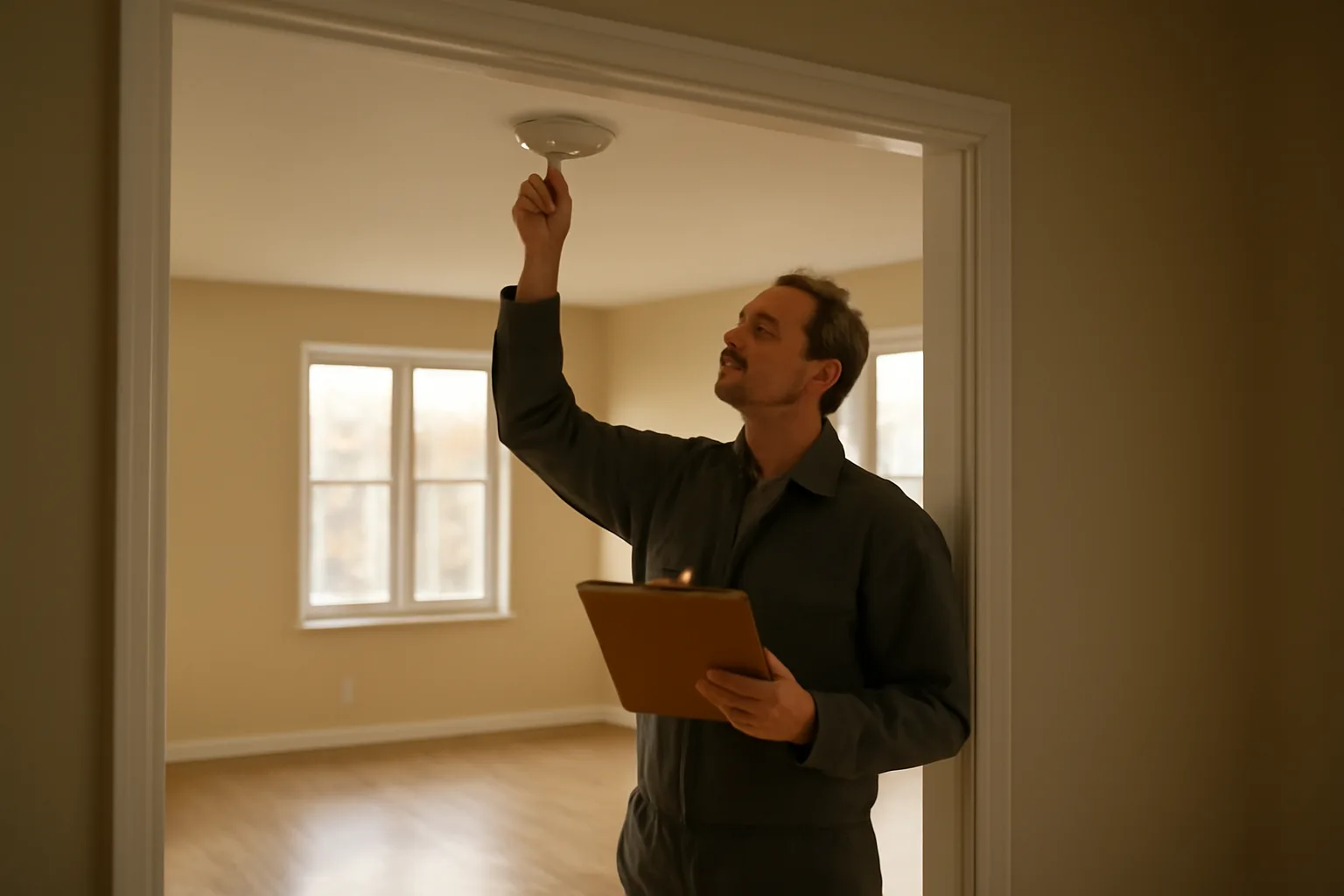
During a routine or move-out inspection, a landlord can generally look at anything related to the condition of the unit and the presence of safety hazards: walls, floors, plumbing fixtures, smoke and carbon monoxide detectors, HVAC function, signs of pest infestation, unauthorized alterations, and unauthorized occupants or pets if the lease restricts them. A landlord cannot use an inspection as a pretext to search personal belongings, read mail, or go through drawers and closets beyond what's needed to check the condition of the space itself. Most state laws require advance notice for any non-emergency entry, commonly 24 hours, and limit entry to reasonable hours. California's Civil Code Section 1954 sets the standard at "reasonable notice," which the statute presumes to be 24 hours in writing unless circumstances make that impractical [5]. For city-run rental inspections tied to licensing, the inspector typically checks a defined list: functioning smoke and CO detectors, secure locks, no exposed wiring, working plumbing, adequate heat, no structural hazards, and compliance with occupancy limits. Some cities also check for unpermitted units or illegal conversions during these visits. The specific checklist differs by city ordinance, so pull your city's inspection checklist directly from its rental licensing office page rather than assuming it matches a neighboring city's list.
what a landlord cannot do in ohio
Ohio's landlord-tenant law, codified at Ohio Revised Code Chapter 5321, sets out specific things a landlord cannot do. A landlord cannot enter the rental unit without giving reasonable notice and entering at a reasonable time, except in an emergency [6]. A landlord cannot shut off utilities, change the locks, or remove a tenant's belongings to force them out; Ohio law requires landlords to use the court eviction process (called forcible entry and detainer) rather than any form of self-help eviction [7]. A landlord in Ohio also cannot retaliate against a tenant for exercising a legal right, such as complaining to a housing authority about a code violation or joining a tenant union; Ohio Revised Code 5321.02 specifically bars retaliatory conduct including raising rent, decreasing services, or threatening eviction in response to such complaints, within a defined look-back period tied to the tenant's protected action [8]. On security deposits, an Ohio landlord cannot withhold a deposit without providing an itemized list of deductions, and must return the deposit or that list within 30 days of the tenancy ending under R.C. 5321.16 [9]. If a landlord fails to comply and a court finds the withholding was made in bad faith, the tenant can recover damages equal to the amount wrongfully withheld plus reasonable attorney's fees. Finally, Ohio law prohibits a landlord from including a lease clause that waives the tenant's right to sue, waives the landlord's duty to maintain the premises, or confesses judgment in advance; R.C. 5321.13 voids any rental agreement provision that waives protections established under the chapter [10].
what rights do tenants have without a lease
A tenant without a written lease, sometimes called a tenant-at-will or a month-to-month tenant by operation of law, still has legal rights. In nearly every state, an oral or implied rental agreement is still a valid tenancy, and the tenant retains the same core protections as someone with a signed lease: the right to a habitable unit, protection from illegal lockouts or utility shutoffs, and the right to proper notice before the tenancy ends. Without a written lease specifying a term, most states default the tenancy to month-to-month, which means either party generally has to give notice to end it, rather than the landlord being able to end things immediately. The specific notice period is state-defined; California requires 30 days' notice for tenancies under one year and 60 days for tenancies of a year or more when the landlord is ending a month-to-month tenancy under Civil Code Section 1946.1 . A tenant without a lease also keeps fair housing protections, security deposit protections (if a deposit was collected), and habitability protections under the state's implied warranty of habitability, since that warranty attaches to the tenancy itself, not to a written document. What a tenant without a lease usually loses is certainty: rent amount, term length, and specific rules can be harder to prove if there's a dispute, since there's no signed document to point to. That's exactly why landlords should always use a written lease, even for a short-term or informal rental.
how much notice does a landlord have to give
| Non-emergency entry | 24-48 hours | State statute, e.g. Cal. Civ. Code 1954 [5] | |
|---|---|---|---|
| Ending month-to-month tenancy | 30-90 days | State statute; length of tenancy can matter | |
| Rent increase (no rent control) | 30-90 days | State or local law | |
| Rent increase (rent-controlled city) | Varies, often longer, may be capped | Local ordinance | |
| Eviction for nonpayment | 3-14 days (varies widely) | State statute | Because these numbers move by state and even by city, the only reliable move is to pull your specific state's landlord-tenant statute or your city's rent ordinance before sending any notice. |
The notice a landlord has to give depends on what's happening: entering the unit, ending a tenancy, or raising the rent. There's no single national number, and this is one of the most jurisdiction-specific parts of landlord-tenant law. For entry to make repairs or show the unit, most states require 24 to 48 hours of advance notice for non-emergency entry. California presumes 24 hours is reasonable under Civil Code 1954 [5]. For ending a month-to-month tenancy, common ranges run from 30 days up to 90 days depending on the state and, in some cases, the length of tenancy; California's 30/60-day rule under Civil Code 1946.1 is one commonly cited example . For rent increases, some states require the same notice period as ending a tenancy, others set a separate rule, and some cities with rent stabilization ordinances require far more notice or cap the increase entirely. Here's a quick comparison of common notice categories. Treat these as typical ranges, not guarantees, since your specific city or state may set a different number. | Notice type | Typical range | Source of variation |
why do landlords require renters insurance
Landlords require renters insurance mainly to shift liability and personal property risk off their own policy. A landlord's dwelling or property insurance covers the building itself, not the tenant's belongings, and typically doesn't cover a lawsuit if the tenant's negligence (an unattended candle, an overflowing bathtub) damages the unit or a neighbor's property. Renters insurance usually covers three things: the tenant's personal property, liability if the tenant causes damage or injury, and additional living expenses if the unit becomes temporarily uninhabitable. Average renters insurance premiums in the U.S. run in the range of roughly $15 to $30 a month depending on coverage limits and location, according to industry rate surveys; a landlord requiring it as a lease condition is a low-cost way to reduce their own exposure to claims that would otherwise land on the property owner's policy or in a lawsuit. Requiring renters insurance is legal in most states as a lease condition, as long as it's applied consistently to all tenants and doesn't function as a disguised way to discriminate under fair housing law [2]. Some cities and a few states have looked at capping how much coverage a landlord can require, so if you're setting a minimum coverage amount in your lease, it's worth confirming there's no local cap before you set the number.
how rental licensing and inspections tie into being a landlord
A meaningful number of U.S. cities now require landlords to register their rental property, obtain a rental license, or pass a periodic inspection before they can legally lease a unit. This is separate from state landlord-tenant law and separate from your mortgage or property tax status; it's a city or county code enforcement requirement, and it exists specifically to catch unsafe housing before a tenant moves in rather than after a complaint. Programs vary a lot in structure. Some cities require registration only (a form and a fee, no inspection). Some require registration plus an inspection at the time of the first rental, then periodically after (every one, two, or three years is common, though exact cycles are set locally). Some only trigger an inspection when a tenant files a complaint or when the property changes ownership. Minneapolis, for example, runs a rental licensing program that requires inspection before initial licensing and on a set renewal cycle set by the city . Los Angeles runs its Systematic Code Enforcement Program, which requires periodic inspection of most rental units in the city, funded through a per-unit fee charged to owners [4]. Because programs vary this much, don't assume your city works like the last one you read about. Confirm with your city rental licensing office what's required, what the fee is, and what the inspection checklist covers before you list a unit or before your renewal date arrives. If you've already gotten a notice, that's usually a sign you missed a registration deadline rather than a sign anything is wrong with the property itself; most first notices are administrative, not punitive, though a missed second notice or a failed inspection is where fines start. If you're staring down a first inspection or a renewal deadline and don't want to reconstruct the requirements from scratch, a City Rental License & Inspection Prep Packet is a one-time $79 resource built around exactly this gap: the paperwork and pre-inspection checklist work that most landlords underestimate until the deadline is close.
what happens if you get a rental licensing violation notice
A rental licensing violation notice usually means one of three things: you didn't register the property at all, your registration lapsed, or an inspection found a code violation that needs correcting. Read the notice closely, because the fix and the deadline differ for each. If it's a registration lapse, the fix is usually just filing the paperwork and paying the fee (and sometimes a late fee) with your city rental licensing office. If it's a failed inspection item, cities typically give a re-inspection window, often 30 to 60 days, though this range varies by city and by the severity of the violation (a life-safety issue like a missing smoke detector usually gets a shorter window than a cosmetic issue). Fines for continued non-compliance can escalate. Some cities charge a flat penalty per violation, others charge daily accruing fines until the issue is fixed, and repeated or willful non-compliance can in some cities lead to a hold on renting the unit at all until it's brought into compliance. Because fine schedules are set locally and change, don't rely on a number you saw for a different city; check the specific fine schedule listed on your city's rental licensing or code enforcement page. The practical move once you get a notice: read the deadline first, call the office listed on the notice if anything is unclear, and fix the underlying issue rather than just paying the fine, since an unresolved violation usually keeps recurring on the next inspection cycle.
Frequently asked questions
How do I become a landlord for the first time?
Confirm the property is zoned and licensed for rental use, check whether your city requires a rental registration or pre-rental inspection, get landlord-specific insurance, screen tenants consistently under fair housing law, and register with your city before you sign a lease. Skipping city registration is the most common first-time mistake and the one that generates violation notices later.
What is landlording, in plain terms?
Landlording is the ongoing management of a rental property: collecting rent, keeping the unit habitable, following notice and deposit rules under state law, and staying compliant with any city rental registration, licensing, or inspection requirement. It's operational work, not passive income, especially in cities with mandatory rental licensing.
What is a landlord, legally?
A landlord is the owner or authorized agent of real property who leases that property to a tenant for payment. State landlord-tenant statutes assign the landlord specific duties, most commonly maintaining a habitable unit and following legal notice and deposit rules, and give the landlord rights like collecting rent and, with proper notice, entering to inspect or repair.
Who is responsible for a rental property walk-through inspection in California?
The landlord generally arranges and conducts it, but California Civil Code Section 1950.5(f) gives the tenant the right to request an initial move-out inspection so they can fix issues before losing deposit money. For city rental-licensing inspections, a city inspector does the walk-through, not the landlord.
What rights do tenants have without a lease?
A tenant without a written lease still has habitability rights, fair housing protections, security deposit protections if a deposit was paid, and notice rights before the tenancy ends, usually defaulting to a month-to-month tenancy under state law. What they lack is a written record of the specific rent and terms, which can matter in a dispute.
How much notice does a landlord have to give before entering the unit?
Most states require 24 to 48 hours of written notice for non-emergency entry. California presumes 24 hours is reasonable under Civil Code Section 1954. Emergencies (fire, flooding, a safety hazard) don't require advance notice in most states.
How much notice does a landlord have to give to end a tenancy?
It depends on the state and sometimes the length of tenancy. California requires 30 days' notice for tenancies under one year and 60 days for tenancies of a year or more under Civil Code Section 1946.1. Other states set different ranges, commonly 30 to 90 days, so check your specific state statute.
Why do landlords require renters insurance?
A landlord's own property insurance doesn't cover a tenant's belongings or most liability claims arising from the tenant's actions. Requiring renters insurance, which typically runs $15 to $30 a month, shifts that risk to a policy the tenant carries, reducing what lands on the landlord's own insurance or in a lawsuit.
What can a landlord look at during an inspection?
A landlord can check the physical condition and safety of the unit: smoke and CO detectors, plumbing, HVAC, signs of pest infestation, unauthorized alterations, and occupancy compliance. A landlord cannot search personal belongings, mail, or private items beyond what's needed to assess the unit's condition.
What can a landlord not do in Ohio?
Under Ohio Revised Code Chapter 5321, a landlord cannot enter without reasonable notice except in an emergency, cannot use self-help eviction (lockouts, utility shutoffs, removing belongings), cannot retaliate against a tenant for reporting code violations, and cannot withhold a security deposit without an itemized statement within 30 days.
Do all cities require a rental license or registration?
No. Requirements are set city by city and sometimes county by county; there's no national rental licensing law. Many mid-size and large cities require registration, and a smaller subset also require periodic inspections. Confirm with your specific city rental licensing office rather than assuming your city has no requirement.
What happens if I miss my city's rental registration deadline?
Most cities send a violation notice first, often with a grace period to file late (sometimes with a late fee). Continued non-compliance can lead to escalating fines, and in some cities a hold on legally renting the unit until registration is complete. Fine amounts and grace periods are set locally, so check the notice for your specific deadline.
How often do rental inspections happen once I'm licensed?
It varies by city. Some require inspection only at initial licensing, others repeat every one to three years, and some only inspect after a tenant complaint. There's no standard cycle nationally, so check your city rental licensing office's published inspection schedule for the exact interval.
Sources
- California Legislative Information, Civil Code Section 1941.1: California's habitability standard requires premises to be fit for human occupation
- U.S. Department of Justice, Fair Housing Act overview: Federal fair housing law bars discrimination in housing decisions based on protected classes
- California Legislative Information, Civil Code Section 1950.5: Tenant's right to request a pre-move-out inspection and landlord's 48-hour notice and itemized statement requirement
- California Legislative Information, Civil Code Section 1954: 24-hour written notice is presumed reasonable for landlord entry in California
- Ohio Laws, Ohio Revised Code Section 5321.04: Ohio landlords must give reasonable notice and enter at reasonable times except in emergencies
- Ohio Laws, Ohio Revised Code Section 5321.15: Ohio law prohibits self-help eviction methods like lockouts or utility shutoffs
- Ohio Laws, Ohio Revised Code Section 5321.02: Ohio bars landlord retaliation against tenants for exercising legal rights
- Ohio Laws, Ohio Revised Code Section 5321.16: Ohio landlords must itemize deductions and return deposits within 30 days
- Ohio Laws, Ohio Revised Code Section 5321.13: Ohio voids lease clauses that waive tenant protections under Chapter 5321
- California Legislative Information, Civil Code Section 1946.1: California requires 30 or 60 days notice to end a month-to-month tenancy depending on tenancy length