Last updated 2026-07-25
TL;DR
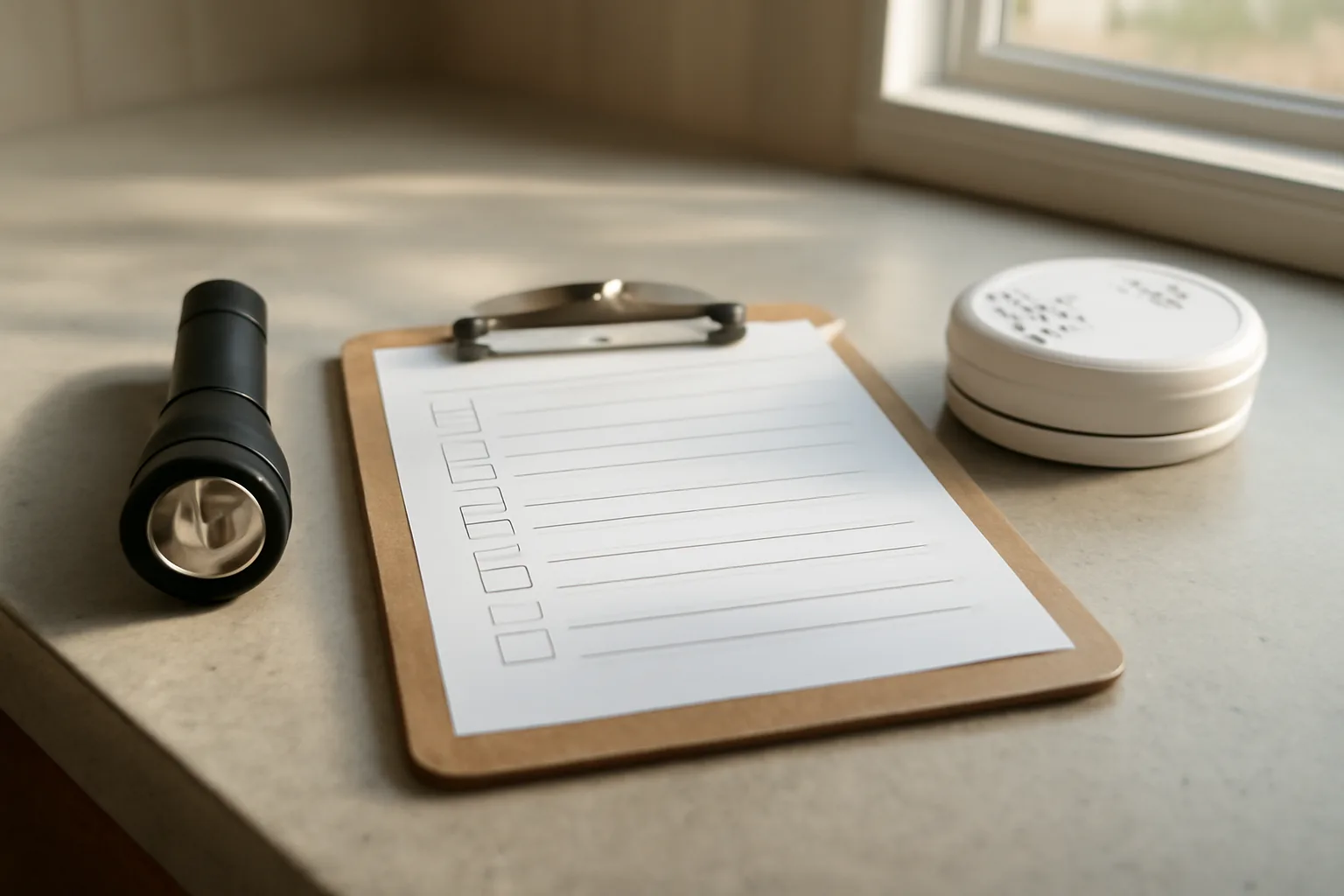
A printable home inspection checklist PDF should cover smoke and CO alarms, egress windows, electrical panels, plumbing leaks, exterior grading, and handrails, since these are the items most city rental inspectors cite most often. Use it before your license inspection, at move-in, and at move-out so nothing catches you off guard on inspection day.
What should a printable home inspection checklist PDF actually cover?
A good checklist for a rental unit covers six areas: life safety devices, electrical, plumbing, structural and exterior, egress, and general maintenance. That's it. Most city rental inspection programs build their checklists around these same categories because they map to the International Property Maintenance Code (IPMC), which most cities adopt with local amendments [1]. Smoke alarms and carbon monoxide alarms come first on almost every city's list, because state and local law usually mandates specific placement (one per sleeping room, one per floor, within a certain distance of bedrooms). Electrical items usually mean checking for exposed wiring, missing outlet covers, and overloaded extension cords used as permanent wiring. Plumbing means active leaks, water heater temperature and pressure relief valves, and functioning shutoff valves. Structural and exterior covers things like handrails on stairs with four or more risers, guardrails on porches over 30 inches high, and peeling exterior paint on pre-1978 buildings (a lead paint issue under federal law) [2]. Egress is the one landlords miss most. Every bedroom needs a way out that doesn't require a key or tool, and in most jurisdictions that means an openable window meeting minimum size and sill height rules, or a second door. If a previous owner converted a den into a 'bedroom' without adding an egress window, that room can fail inspection even if everything else is perfect. Download a checklist that's organized by these categories, not by room. Room-by-room checklists are fine for staging a unit, but inspectors move through a building by system, so a checklist matching that order helps you self-inspect the way they will.
Where can I get a free printable home inspection checklist PDF?
Start with your own city's rental inspection checklist if one exists. Many mandatory-licensing cities publish the actual form or checklist their inspectors use, which is the single most accurate document you can get because it removes guesswork about what that specific inspector will look at. Search '[your city name] rental inspection checklist' or check your city's housing or code enforcement department page; confirm with your city rental licensing office if you can't find one posted. HUD publishes a Housing Quality Standards (HQS) inspection checklist used for Housing Choice Voucher (Section 8) units, which covers a lot of the same ground: smoke detectors, electrical hazards, and structural soundness, and is a solid free baseline even if you don't have voucher tenants [3]. The EPA's lead-based paint disclosure and renovation guidance is useful if your property was built before 1978, since deteriorated paint is a common citation item in older housing stock [2]. If your city doesn't publish anything and you want a checklist built specifically around license and inspection prep rather than a generic home inspection, that's the gap our $79 City Rental License & Inspection Prep Packet is built to fill: a printable, city-adaptable checklist plus the paperwork sequence for registration, licensing, and inspection scheduling in mandatory rental-licensing cities.
What can a landlord look at during an inspection?
A landlord conducting a routine or move-in/move-out inspection can look at the general condition and safety of the unit: walls, floors, ceilings, appliances, plumbing fixtures, smoke and CO alarms, windows, doors, and evidence of damage beyond normal wear and tear. Landlords generally cannot search through a tenant's personal belongings, open closed drawers or containers, or use the inspection as a pretext to harass a tenant. State law usually requires advance notice before a landlord enters an occupied unit for a non-emergency inspection. California requires 24 hours' written notice for entry, with limited exceptions for emergencies [4]. Many other states set 24 or 48 hours as the standard notice window, though a few require different amounts, so check your own state's landlord-tenant statute rather than assuming California's rule applies everywhere. During the inspection itself, a landlord (or the landlord's inspector) can test smoke alarms, check under sinks for leaks, look at the condition of flooring and paint, verify the HVAC system runs, and note any unauthorized alterations like a removed window screen or an added lock. What a landlord cannot do is rifle through drawers, open a tenant's mail, or use the visit to intimidate a tenant into moving out. If a tenant refuses reasonable entry after proper notice, most states allow the landlord to pursue legal remedies, but self-help methods like changing locks or shutting off utilities are illegal almost everywhere.
Who is responsible for a rental property walk-through inspection in California?
In California, the landlord is responsible for conducting move-in and move-out walk-through inspections, and state law gives tenants specific rights around that process. California Civil Code Section 1950.5 requires that if a landlord intends to withhold any part of a security deposit at move-out, the landlord must offer the tenant an initial inspection before the tenancy ends, give at least 48 hours' written notice of that inspection, and provide an itemized statement of anything that needs fixing so the tenant has a chance to remedy it before move-out [5]. The tenant can choose to be present at that initial inspection or waive the right. After the initial walk-through, the landlord must give the tenant an itemized list of deficiencies that could lead to deductions, and reasonable time to fix them if the tenant wants to try. The landlord then does the actual final move-out inspection after the tenant vacates and has 21 calendar days to return the deposit along with an itemized statement of any deductions [5]. This is separate from a city rental license inspection, which is a code enforcement inspector checking the unit against the local housing code, not the landlord checking for damage. Some California cities layer a mandatory rental inspection program (like Los Angeles's Systematic Code Enforcement Program) on top of these tenant-security-deposit rules, so a landlord in those cities is juggling two different inspection processes with two different purposes [6].
How much notice does a landlord have to give before an inspection?
Most states require 24 to 48 hours' written notice before a landlord enters an occupied rental for a non-emergency inspection, but the exact number and required format vary by state, so check your specific state statute. California requires 24 hours' notice in most cases [4]. Some states allow verbal notice, others require it in writing, and a few specify how the notice must be delivered (posted on the door, mailed, or handed directly to the tenant). Emergencies are the universal exception. If there's a burst pipe, a gas leak, or another situation threatening health or safety, a landlord can enter without advance notice in virtually every state. Outside of emergencies, showing up unannounced for a routine inspection, even one required by your city's rental license program, is a good way to create a legal problem for yourself on top of whatever the city inspection turns up. City-mandated rental inspections usually come with their own scheduled-appointment process rather than surprise visits, since the city, not the landlord, typically sets the date and the landlord is expected to notify the tenant. Build tenant notice into your prep timeline: if your city inspection is scheduled for a Tuesday, get written notice to the tenant with enough lead time to satisfy both your state's landlord entry law and any separate notice period the city ordinance requires.
What is landlording, and what does it actually involve day to day?
Landlording is the ongoing work of owning and managing rental property: screening and placing tenants, collecting rent, handling maintenance requests, keeping the property compliant with local housing codes, and managing the legal and financial side of the relationship between owner and tenant. It's less passive than most new landlords expect. Day to day, landlording means responding to a leaking faucet within a reasonable time (most states impose an implied warranty of habitability requiring landlords to keep units livable), tracking lease renewal and rent increase dates, budgeting for a roof or water heater that's aging out, and staying current on any local registration or licensing requirements. In a mandatory-licensing city, landlording also means renewing your rental license on schedule, usually annually or biennially, and passing the periodic inspection tied to that license. A lot of new landlords think of it as collecting a check. The reality is closer to running a small, regulated service business where your two biggest liabilities are a tenant getting hurt because of something you knew about and didn't fix, and a city fining you for an expired license or missed inspection. For a wider look at landlord basics and how they connect to license and inspection cycles by city, see the landlord overview.
What is a landlord?
A landlord is the owner of real property, or that owner's authorized agent, who rents the property to another person (a tenant) in exchange for payment, usually under a lease or rental agreement. The relationship is a legal one governed by state landlord-tenant statutes and, in many cities, additional local ordinances covering registration, licensing, and habitability inspections. Being a landlord comes with obligations that exist whether or not they're spelled out in a lease: keeping the unit habitable, making required repairs, respecting a tenant's right to quiet enjoyment, following proper legal procedures for entry and eviction, and often, registering the rental unit with the city and paying an annual or biennial license fee. Cities that require rental licensing typically define 'landlord' broadly enough to include an LLC, a trust, or an out-of-state owner working through a property manager, more than an individual living down the street. The legal definition matters because it determines who's on the hook for fines. If your city cites the property for a code violation, the citation usually goes to the registered owner of record, which is why keeping your rental registration and license information current with your city's housing department is worth doing even in years when nothing else changes.
What rights do tenants have without a lease?
A tenant without a written lease still has real legal rights. Occupying a unit and paying rent, even informally, typically creates what's called a tenancy at will or a month-to-month tenancy under state law, and that tenant is entitled to the same basic protections as someone with a signed lease: a habitable unit, proper notice before entry, and proper legal notice before the landlord can end the tenancy. Without a written lease, the terms default to whatever the state's landlord-tenant statute says for an unwritten or month-to-month tenancy. That usually means either party can end the arrangement with a set amount of notice, commonly 30 days, though some states require more depending on how long the tenant has lived there. The tenant still can't be locked out, have utilities shut off, or have belongings removed by the landlord as a way to force them out; those 'self-help eviction' tactics are illegal in nearly every state regardless of whether there's a lease. A tenant without a lease also keeps the right to a habitable unit under the implied warranty of habitability that most states recognize by statute or case law, meaning the landlord still has to maintain working heat, water, plumbing, and structural safety even if nothing was ever put in writing. For more on tenant protections generally, see tenant rights and tenants rights.
Why do landlords require renters insurance?
Landlords require renters insurance mainly to shift liability risk away from their own policy. A landlord's own insurance covers the building and the landlord's property, but it typically doesn't cover a tenant's personal belongings or the tenant's liability if, say, a tenant's dog bites a visitor or a candle starts a fire that damages the unit. Requiring renters insurance (often with a minimum liability coverage amount, like $100,000 or $300,000) means the tenant's own policy pays out first if the tenant causes damage or someone is injured in the tenant's unit, instead of the claim flowing straight to the landlord's policy or the landlord's out-of-pocket funds. It's a cheap requirement for the tenant too: renters insurance in the U.S. commonly runs in the range of $15 to $30 a month depending on coverage and location, though actual rates vary by state and insurer. Most states allow landlords to require renters insurance as a lease condition, and some cities and states have weighed in on how landlords can enforce it (for example, some jurisdictions restrict a landlord from force-placing insurance and billing the tenant without proper disclosure). Requiring it doesn't replace the landlord's own dwelling and liability coverage, and it doesn't affect city rental license or inspection requirements at all; those are two separate compliance tracks.
What can a landlord look at during an inspection versus what's off-limits?
| Check smoke/CO alarm function | Search drawers, closets, or personal containers | |
|---|---|---|
| Look at plumbing under sinks for leaks | Read mail or personal documents left out | |
| Photograph condition of walls/floors | Enter without required notice (non-emergency) | |
| Note unauthorized pets or occupants | Enter repeatedly without legitimate purpose | |
| Check HVAC and water heater function | Remove or touch tenant's personal belongings | This applies to landlord-conducted inspections. A city code enforcement inspector operates under different authority (usually tied to the housing code and the rental license ordinance) and may have broader access to common areas and mechanical systems, but still generally can't search personal belongings without separate legal authority like a warrant. |
During a lawful inspection, a landlord can visually check the condition of fixtures, appliances, walls, floors, windows, smoke and CO alarms, and evidence of damage or unauthorized modifications. A landlord cannot open closed drawers, closets used for personal storage, or containers to search through a tenant's belongings, and cannot use the visit as a pretext to look for reasons to evict or to intimidate the tenant. The legal basis for entry itself, more than what's inspected, matters. Entry generally has to be for a legitimate purpose: showing the unit to a prospective tenant or buyer, making repairs, conducting an agreed inspection, or responding to an emergency. An inspection with no stated purpose, done at odd hours, or done far more frequently than reasonable, can itself become a fair housing or harassment issue even if the landlord never touches anything belonging to the tenant. Here's a quick reference for what's typically in bounds versus out of bounds: | Landlord can do | Landlord generally cannot do |
What a landlord cannot do in Ohio
Ohio landlord-tenant law, codified mainly in Ohio Revised Code Chapter 5321, spells out specific things a landlord cannot do. A landlord cannot enter the rental unit without giving the tenant 'reasonable notice' and entering only 'at reasonable times,' except in emergencies [7]. Ohio law doesn't specify an exact number of hours for 'reasonable notice,' which has led courts and practitioners to generally treat 24 hours as a reasonable default, though the statute itself leaves it more open than states with a fixed number. A landlord in Ohio cannot shut off utilities, change locks, or remove a tenant's belongings to force the tenant out, sometimes called 'self-help eviction.' Ohio Revised Code 5321.15 explicitly prohibits a landlord from using these tactics and requires the landlord to go through the court eviction (forcible entry and detainer) process instead [5]. A landlord also cannot retaliate against a tenant for exercising legal rights, like reporting a code violation or joining a tenant organization; ORC 5321.02 protects tenants from retaliatory eviction or rent increases for a defined period after the tenant takes a protected action . Ohio landlords also carry statutory duties they can't skip: keeping the premises in a fit and habitable condition, maintaining common areas, and keeping electrical, plumbing, and heating systems in good working order, all listed under the landlord's ORC 5321.04 obligations . Failing those duties doesn't just risk a tenant complaint; in cities with a rental registration or inspection program layered on top of state law, it risks a separate municipal citation.
How to become a landlord (and how a checklist fits into the process)
Becoming a landlord means buying or converting a property into a rental, then meeting a stack of legal, financial, and local requirements before you can legally rent it out. The order roughly goes: acquire the property, confirm zoning allows rental use, get the unit up to code (this is where a home inspection checklist earns its keep), register or license the rental with your city if required, screen and place a tenant with a compliant lease, and then maintain the property and its compliance status ongoing. Many landlords skip the code-readiness step and go straight to listing the unit, which is backwards in a mandatory-licensing city. If your city requires an inspection before issuing a rental license, a violation found at that inspection can delay your ability to legally rent the unit at all, sometimes by weeks, while you schedule repairs and a re-inspection. Running your own checklist first, using the same categories a city inspector uses (smoke/CO alarms, egress, electrical, plumbing, structural, exterior), catches most of these issues before they cost you a re-inspection fee or a delayed license. Financially, becoming a landlord also means budgeting beyond the mortgage: property tax, insurance, a maintenance reserve (a commonly cited rule of thumb is 1% of the home's value per year, though actual costs vary a lot by property age and system condition), and any city license or registration fees, which range widely by jurisdiction, so confirm the actual number with your city rental licensing office. For a broader walkthrough of what new landlords need to set up before that first tenant moves in, see landlord landlords.
How to be a landlord well, more than legally
Being legally compliant and being a good landlord aren't the same thing, and the difference usually shows up in how few problems you have. Landlords who respond to maintenance requests within a day or two, document unit condition at move-in and move-out with photos, and keep a running checklist of system ages (roof, water heater, HVAC) tend to have fewer disputes, fewer emergency repairs, and fewer surprises at license renewal inspection time. A simple habit that pays off: run your printable inspection checklist twice a year even if your city only requires it every two or three years. Catching a slow leak under a sink or a smoke alarm with a dead battery in month six is a five-minute fix. Catching the same thing during a scheduled city inspection, when you've got an inspector standing there with a clipboard, can mean a re-inspection fee and a delay on your license renewal. Communication matters as much as maintenance. Giving proper notice before every entry, even when your state's minimum is technically less, builds enough goodwill that tenants tend to flag small problems early instead of letting them become code violations. That habit alone prevents a lot of the citations that show up on a first-time city inspection.
Frequently asked questions
Is there a truly free printable home inspection checklist PDF for landlords?
Yes. HUD's Housing Quality Standards checklist is a free, publicly posted PDF covering smoke detectors, electrical hazards, and structural soundness [3]. Many cities also post their own rental inspection checklist for free on their housing or code enforcement department page; search your city's name plus 'rental inspection checklist.'
How to become a landlord if I've never rented out property before?
Confirm zoning allows rental use, get the unit inspection-ready (smoke/CO alarms, egress, working systems), check whether your city requires rental registration or licensing, get proper landlord insurance, and set up a compliant lease and tenant screening process. Then register or license with your city before advertising the unit, since some cities prohibit renting before licensing is complete.
Who is responsible for a rental property walk-through inspection in California?
The landlord is responsible for conducting the walk-through under California Civil Code 1950.5, which requires an optional initial inspection with 48 hours' notice before move-out, followed by an itemized deficiency list, and then a final move-out inspection after the tenant vacates, with 21 days to return the deposit [5].
What is landlording?
Landlording is the ongoing work of owning and operating rental property: screening tenants, collecting rent, handling repairs, keeping the unit habitable, and staying current on any city rental registration, licensing, or inspection requirements. It's an active, recurring responsibility, not a passive income stream.
What is a landlord, legally speaking?
A landlord is the property owner (or authorized agent) who rents real property to a tenant under a lease or rental agreement, governed by state landlord-tenant law and, in many cities, local rental licensing ordinances. The definition usually includes LLCs, trusts, and out-of-state owners acting through a property manager.
What rights do tenants have without a lease?
A tenant without a written lease usually has a month-to-month or at-will tenancy under state law and keeps the same core protections: a habitable unit, proper notice before entry, and proper legal notice before the tenancy can end. Self-help eviction (lockouts, utility shutoffs) is illegal regardless of whether a lease exists.
Why do landlords require renters insurance?
Landlords require renters insurance to shift liability for a tenant's belongings and tenant-caused damage or injury away from the landlord's own policy. It's typically cheap for the tenant, often in the $15 to $30 a month range depending on coverage and location, and most states allow it as a lease requirement.
How much notice does a landlord have to give before entering for an inspection?
Most states require 24 to 48 hours' written notice before non-emergency entry; California specifically requires 24 hours in most situations [4]. Ohio's statute requires 'reasonable notice' without a fixed number of hours, with 24 hours commonly treated as a reasonable default [7]. Always check your specific state statute.
What can a landlord look at during an inspection?
A landlord can look at the general condition of fixtures, appliances, walls, floors, windows, and safety devices like smoke and CO alarms. A landlord cannot search closed drawers, closets, or personal containers, and cannot use an inspection as a pretext to search through a tenant's private belongings.
What a landlord cannot do in Ohio
Ohio landlords cannot enter without reasonable notice except in emergencies, cannot use self-help eviction tactics like shutting off utilities or changing locks (ORC 5321.15), and cannot retaliate against a tenant for exercising legal rights like reporting a code violation (ORC 5321.02) [8][9].
Do I need a different checklist for a city rental license inspection than for a move-in inspection?
Yes, generally. A city license inspection checks code compliance (smoke/CO alarms, egress, electrical, structural safety) against local housing code. A move-in/move-out inspection documents unit condition for security deposit purposes. They overlap on safety items but serve different legal purposes, so keep them as separate documents.
What items get cited most often on rental inspections?
Common citations across cities include missing or non-functional smoke and CO alarms, blocked or undersized bedroom egress windows, exposed electrical wiring or missing outlet covers, active plumbing leaks, missing handrails on stairs, and peeling exterior paint on pre-1978 buildings under federal lead paint rules [1][2].
Can I use a generic home inspection checklist for my rental license inspection?
A generic checklist covers the basics but often misses city-specific ordinance items (like registration posting requirements or specific occupancy limits). Check whether your city publishes its own rental inspection checklist first; if not, a checklist organized around IPMC categories [1] is the closest free substitute.
Sources
- International Code Council, International Property Maintenance Code: Most city rental inspection checklists follow categories drawn from the International Property Maintenance Code
- EPA, Lead-Based Paint Renovation, Repair and Painting Rule: Peeling paint on pre-1978 buildings is regulated under federal lead paint rules
- California Civil Code Section 1954: California requires 24 hours' notice before landlord entry in most non-emergency cases
- California Civil Code Section 1950.5: California requires an optional initial move-out inspection with 48 hours' notice and a 21-day deadline to return the security deposit
- Ohio Revised Code 5321.04: Ohio law requires landlords to give reasonable notice and enter only at reasonable times except in emergencies
- Ohio Revised Code 5321.15: Ohio law prohibits landlords from using self-help eviction tactics like utility shutoffs or lockouts
- Ohio Revised Code 5321.02: Ohio law prohibits retaliatory eviction or rent increases against tenants who exercise legal rights