Last updated 2026-07-25
TL;DR
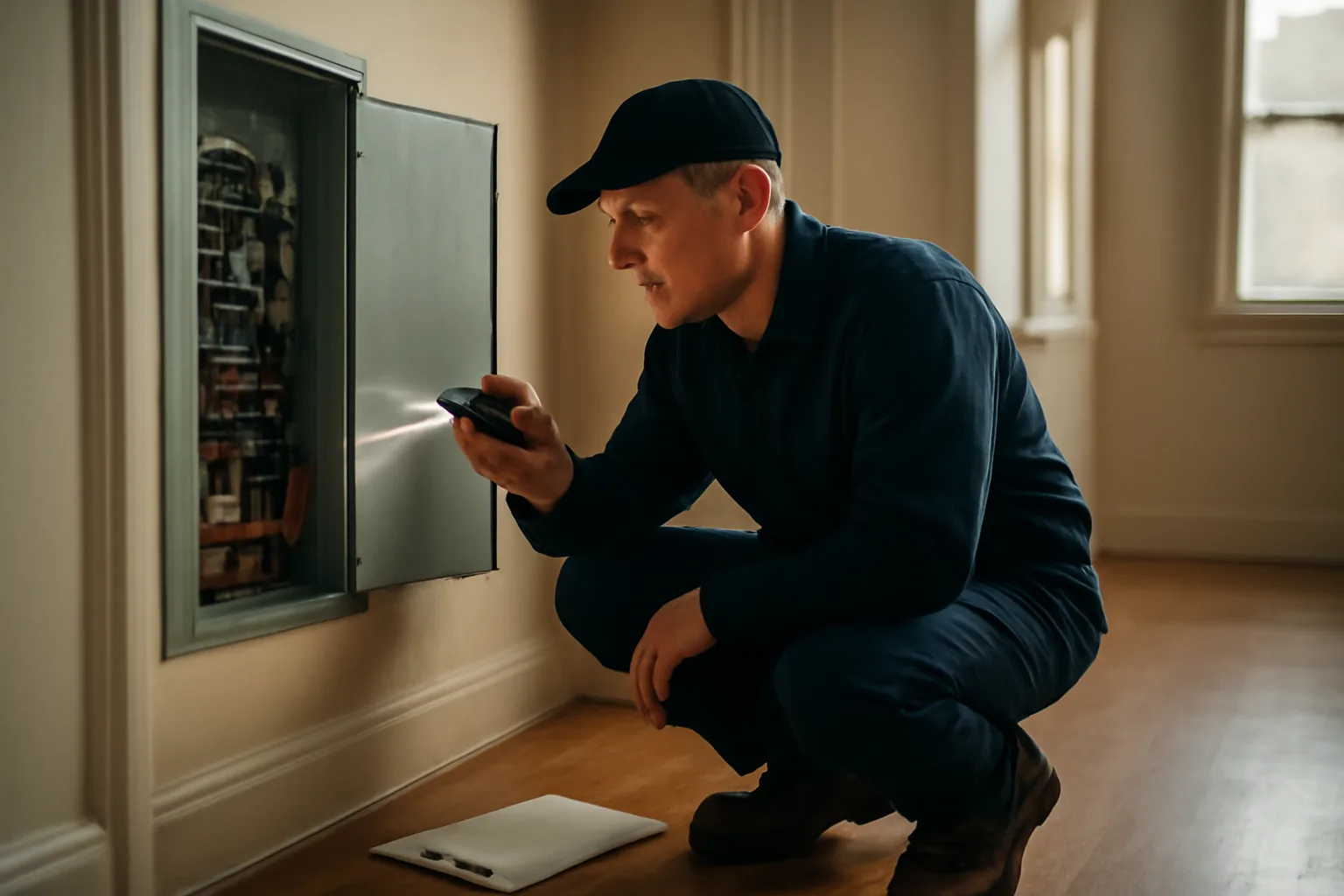
A rental inspection checklist covers smoke and CO detectors, exits, electrical panels, plumbing, pest signs, and structural safety items that most city housing codes require. Most cities require 24 to 48 hours notice before entry. Use this checklist to self-inspect before your official inspection, and confirm your specific city's checklist with your local rental licensing office since items vary by jurisdiction.
What should be on a free rental inspection checklist?
| Smoke alarms | One per bedroom, one per floor, test date under 10 years | IPMC 704, most state fire codes [1] | |
|---|---|---|---|
| CO detectors | Required if gas appliances or attached garage present | State fire marshal rules vary by state | |
| Electrical | No exposed wiring, GFCI in kitchens/baths, working outlets | IPMC 605 | |
| Plumbing | No active leaks, water heater TPR valve, hot water at fixture | IPMC 504-506 | |
| Windows/doors | Locks function, no broken glass, screens present in season | IPMC 304, 703 | |
| Exits | Two means of egress from sleeping rooms, unobstructed hallways | IPMC 702 | |
| Handrails/stairs | Secure railings on stairs with 4+ risers | IPMC 306 | |
| Exterior | No peeling paint (pre-1978 homes), roof intact, gutters draining | IPMC 303-304 | |
| Pest evidence | No active rodent or insect infestation | IPMC 309 | |
| HVAC | Heat source capable of maintaining 68°F (varies by city) | IPMC 602 | Run this list room by room. Kitchen and bathroom first, since that's where GFCI outlets and water heater issues hide. Then bedrooms for smoke alarms and window egress. Then the exterior for paint and structural stuff. It takes about 30 to 45 minutes for a typical unit if you're organized. If you want a version built specifically around your city's actual checklist and fee schedule instead of a generic one, that's exactly what the $79 City Rental License & Inspection Prep Packet is for. It pulls together the checklist, forms, and notice templates for your specific municipality so you're not guessing which code edition your city adopted. |
A solid rental inspection checklist covers five categories: life safety, structural condition, plumbing and electrical, pest and moisture issues, and exits and egress. Most municipal housing codes borrow language from the International Property Maintenance Code (IPMC), which many cities adopt wholesale or with local amendments [1]. That's why checklists in Minneapolis, Rochester, and Pasadena look more similar than different, even though fees and forms vary a lot. Here's a working checklist you can walk through unit by unit before your city's inspector ever shows up. It won't match every local code line for line, but it covers what actually fails inspections most often. | Category | What to check | Common code basis |
How to become a landlord (the licensing side nobody explains)
Becoming a landlord legally means more than buying a property and finding a tenant. In any city with mandatory rental licensing, you need to register the property, often pay an annual or biennial fee, and pass an inspection before you can legally rent it out. Skipping this step is the single most common reason first-time landlords get hit with fines in their first year. The basic sequence looks like this in most licensing cities: register the property with the city's rental licensing office (sometimes called a housing or code enforcement department), pay the registration or license fee, schedule the initial inspection, fix whatever the inspector flags, get your certificate, then repeat on a renewal cycle (usually annual or every two to three years). Some cities also require a local contact person if you don't live in the state, a lead paint disclosure if the building predates 1978 [2], and proof of a certificate of occupancy for the specific number of units. Before you rent your first unit, confirm with your city rental licensing office whether a pre-rental inspection is mandatory or only triggered by complaint. Cities differ enormously here. Some require it before the first tenant moves in. Others only inspect after a tenant complaint or on a rolling multi-year cycle. Don't skip landlord-tenant law basics either. You're taking on legal obligations around habitability, security deposit handling, and notice requirements the moment you sign a lease, regardless of whether your city licenses rentals. If you want the fuller picture on tenant protections you're now responsible for honoring, see tenant rights and renters rights.
What is landlording and what is a landlord, exactly?
A landlord is the legal owner (or an owner's authorized agent) who rents real property to a tenant in exchange for payment, usually under a lease or rental agreement. "Landlording" is the day-to-day work of that role: collecting rent, maintaining the property to code, handling repair requests, managing turnover, and staying compliant with local licensing and inspection rules. Legally, most states define "landlord" or "lessor" in their landlord-tenant statutes, and the definition usually includes anyone who has the right to possession and control of the property, more than the person on the deed. That matters if you're renting out a property you manage for a family member or through an LLC; the LLC or manager can be the landlord of record even if you personally hold title. Day to day, landlording breaks into four buckets: compliance (licensing, inspections, safety code), financial (rent collection, security deposits, taxes), maintenance (repairs, habitability), and legal (leases, notices, evictions if it comes to that). New landlords tend to underestimate the compliance bucket specifically because it's invisible until a notice shows up in the mail. That's usually the moment people start searching for a checklist like this one. If you manage more than a couple of units across different cities, the compliance workload multiplies fast since every city has its own registration fee, inspection cycle, and checklist quirks. Keeping a per-property compliance calendar (license renewal date, inspection due date, fire alarm test date) saves you from the fines that come from simply forgetting a renewal window.
Who is responsible for a rental property walk-through inspection in California?
In California, the responsibility for a rental walk-through inspection depends on which inspection you mean. For a move-in/move-out inspection, California Civil Code Section 1950.5 gives tenants the right to request an initial inspection before move-out specifically tied to the security deposit, and the landlord (or their agent) conducts it and must give the tenant an itemized statement of proposed deductions [3]. "The landlord shall give the tenant reasonable notice of the date and time of the initial inspection... not less than 48 hours prior to the inspection," per California Civil Code 1950.5(f) [3]. The tenant has the right to be present. If repairs are needed to avoid deductions, the landlord must give an itemized list of deficiencies at that walk-through. For city-mandated rental housing inspections (proactive inspection programs like those in Los Angeles's Systematic Code Enforcement Program or similar programs in other California cities), the responsibility sits with a city inspector, not the landlord or tenant. The landlord's job is to schedule access, be present or provide access, and fix violations within the timeline the notice gives. Los Angeles's program, for instance, inspects buildings with two or more units at least once every four years under the Rent Escrow Account Program framework tied to SCEP [4]. So: for security deposit walk-throughs, the landlord runs it under Civil Code 1950.5. For citywide rental housing inspections, the city runs it, and the landlord's obligation is to provide reasonable access. These are two different inspections that people often confuse, and mixing them up is a common mistake in tenant complaint disputes.
How much notice does a landlord have to give before an inspection?
Notice periods vary by state and by the type of entry, but 24 hours is the most common standard for routine inspections or repairs, and some states specify different windows. California requires "reasonable notice," which the statute presumes to be 24 hours for most entries but 48 hours for the initial move-out inspection [3][5]. Other states set their own numbers by statute: for example, many state landlord-tenant statutes require 24 to 48 hours notice for non-emergency entry, though the exact figure and whether it's business days or calendar days differs by state. For city-mandated licensing inspections, notice periods are separate from tenant-entry statutes and set by the municipal code or the inspection department itself, often 7 to 14 days by mail or scheduled appointment, but confirm with your city rental licensing office since this varies widely and some cities allow inspectors to show up with shorter notice for complaint-driven inspections. Emergencies are the one universal exception. If there's a burst pipe, fire, or gas leak, landlords (and often building staff or inspectors) can enter without advance notice because the health and safety exception overrides the standard notice requirement in nearly every state's statute. Practical tip: put your notice policy in writing in the lease and follow it exactly every time, even when you technically could enter faster under an emergency exception. Consistency protects you if a tenant later disputes an entry in a habitability or harassment claim.
What can a landlord look at during an inspection?
A landlord (or city inspector) conducting a routine or code-compliance inspection can look at the condition of fixtures, systems, and structural elements relevant to habitability and code compliance: smoke detectors, electrical outlets and panels, plumbing fixtures, HVAC, windows, doors, walls, ceilings, floors, and evidence of pest or moisture damage. This is the same list that shows up in the checklist table above, because most cities model their inspection forms on the IPMC categories [1]. What a landlord generally cannot do during an inspection is search through personal belongings, closets, drawers, or private storage beyond what's necessary to check for a leak, damage, or a safety hazard. The inspection is about the condition of the unit and the building systems, not an excuse to go through a tenant's stuff. Courts and state statutes generally treat entry beyond the stated purpose as exceeding the landlord's right of access, which can expose the landlord to a claim for violation of the tenant's right to quiet enjoyment. A city code inspector's scope is usually narrower and more specific than a landlord's own routine inspection: they check for code violations only (life safety items, structural issues, sanitation) and don't evaluate cosmetic condition, cleanliness for its own sake, or tenant housekeeping unless it rises to a health hazard like pest infestation or hoarding-related fire risk. Bottom line for the walk-through itself: stick to visible, functional checks (does the smoke alarm test, does the faucet leak, is the outlet GFCI-protected) and don't open drawers, go through closets full of personal items, or linger in a way that feels like a search. That's true whether you're the landlord doing a routine check or the tenant watching a city inspector work.
What rights do tenants have without a lease?
A tenant without a written lease, sometimes called a month-to-month tenant or a tenant-at-will, still has the full protection of state landlord-tenant law, including the right to habitable housing, the right to proper notice before entry, and the right to proper notice before eviction or rent increase. The absence of a written lease does not strip away statutory tenant protections; it just means the terms default to what state law provides for periodic tenancies. Most states require 30 days' written notice to end a month-to-month tenancy without a lease, though some states scale this by tenancy length (California, for instance, requires 60 days' notice if the tenant has lived there a year or more, and 30 days if less than a year, under Civil Code Section 1946.1 [6]). Rent increases on a no-lease, month-to-month tenant typically require the same notice period as termination in many states. Habitability rights don't depend on having a lease at all. The implied warranty of habitability, recognized in some form in nearly every state, requires landlords to maintain basic living conditions (working plumbing, heat, structural safety) regardless of whether there's a signed lease document. A verbal agreement to pay rent in exchange for occupancy is enough to create a legal tenancy. What a no-lease tenant does lose is the certainty of fixed terms: no lease means no fixed end date, no locked-in rent amount, and typically no specific clauses about pets, subletting, or property-specific rules unless something was agreed to verbally and can be proven. For a fuller rundown of what protections carry over regardless of paperwork, see tenants rights and tenant and tenant disputes over verbal agreements.
Why do landlords require renters insurance?
Landlords require renters insurance mainly to shift liability for a tenant's personal property loss and personal liability claims away from the landlord's own policy. A landlord's property insurance covers the building and the landlord's own liability; it does not cover a tenant's furniture, electronics, or personal belongings if there's a fire, burst pipe, or theft, and it typically doesn't cover a tenant's liability if a guest is injured in the unit. Requiring renters insurance is legal in most states as a lease condition, though a handful of jurisdictions have moved to restrict how landlords can enforce it or bundle it into fees. There's no federal law mandating or banning the requirement; it's set state by state and often city by city. Typical minimum liability coverage landlords require runs from $100,000 to $300,000, and premiums for renters insurance nationally average somewhere in the range of $15 to $30 a month depending on coverage and location, though this varies by state insurance market and isn't something we'll pin to a single national figure without a current source. The other reason landlords require it: subrogation. If a tenant's negligence causes damage (say, an unattended stove fire), the landlord's insurer can pursue the tenant's insurer for reimbursement instead of eating the loss or suing the tenant directly, which is faster and less adversarial for everyone involved. If you require it, put the minimum coverage amount and proof-of-insurance timeline directly in the lease, and re-verify coverage at each renewal, more than at move-in. Tenants let policies lapse more often than landlords expect, especially on month-to-month terms.
What can a landlord not do in Ohio?
Ohio landlord-tenant law, codified mainly in Ohio Revised Code Chapter 5321, restricts landlords from several actions that are common triggers for tenant complaints and lawsuits. A landlord in Ohio cannot enter the rental unit without giving reasonable notice, generally interpreted as 24 hours, except in an emergency, per ORC 5321.04 [7]. Ohio landlords also cannot retaliate against a tenant for exercising legal rights, such as reporting a code violation or joining a tenant union; ORC 5321.02 specifically prohibits retaliatory eviction, rent increases, or service reductions taken because a tenant complained to a government agency about a building or housing code violation [8]. "A landlord may not retaliate against a tenant by increasing rent, decreasing services, or bringing or threatening to bring an action for possession" after a tenant makes a good faith complaint, under ORC 5321.02(A) [8]. Ohio landlords cannot shut off utilities, change locks, or remove a tenant's belongings to force them out, a practice generally called a "self-help eviction." Ohio requires landlords to go through the formal eviction process in court (forcible entry and detainer action) instead. They also cannot withhold a security deposit deduction list beyond 30 days after the tenant moves out and demands it in writing, per ORC 5321.16, which requires an itemized list of deductions within that window or the landlord may owe damages . Ohio landlords also cannot ignore their maintenance obligations under ORC 5321.04, which requires landlords to keep the premises in a fit and habitable condition, comply with applicable building and housing codes, keep common areas safe, and maintain electrical, plumbing, and heating systems in good working order [7]. Failing that duty is the basis for most Ohio habitability disputes, separate from any city-level licensing inspection that might also apply.
How do I use a checklist to prep for my city's official inspection?
Walk the unit the same order the inspector likely will: exterior first, then common areas if it's a multi-unit building, then each unit room by room. Take photos of anything you fix so you have a record if the inspector questions whether an item was addressed before or after the notice. Focus your time on the items that cause re-inspection fees, since those cost you money twice: once for the failed inspection, once for the reinspection fee that many cities charge (commonly in the $50 to $150 range depending on the city, though confirm with your city rental licensing office for the actual number). Smoke alarms and GFCI outlets are the two most common first-time failures because they're cheap to fix but easy to overlook, especially in older buildings that predate current code. Don't wait until the notice arrives to start. Cities generally publish their proactive rental inspection cycle publicly (annual, biennial, or every 3-4 years depending on the jurisdiction), so you can self-inspect on your own schedule instead of scrambling in the two-week window after a notice shows up. If you own units in more than one city, build a single master checklist covering the strictest requirement across all your cities, then treat the local code as the floor, not the ceiling. It's simpler to over-comply everywhere than to track ten slightly different rule sets in your head, and it protects you if a city updates its code edition mid-cycle.
What happens if my rental fails inspection?
Most cities issue a notice of violation listing each failed item along with a correction deadline, typically 30 days for most items but shorter (sometimes immediate) for life-safety hazards like an inoperable smoke alarm or exposed electrical wiring. You then fix the items, request a reinspection, and pay any reinspection fee the city charges. Failing to correct violations by the deadline can escalate to daily fines in many cities, sometimes $100 to $500 or more per day per violation depending on the municipality, and in serious cases can lead to the property being deemed unfit for occupancy, which can force tenants out temporarily and cost the landlord far more than the original fix would have. Escalation schedules and per-day fine amounts are set locally, so confirm the exact numbers with your city rental licensing office rather than assuming a rate from another city applies to yours. Repeat or serious violations can also block your rental license renewal entirely, meaning you legally cannot rent the unit again until you're back in compliance and pass reinspection. That's the tool cities use to get compliance instead of just collecting fines forever. The fastest way out of a failed inspection is documentation: fix the item, photograph it, and submit proof to the inspection department the same day if the department allows it, rather than waiting for the formal reinspection appointment. Some cities allow photo-based reinspection for minor items, which saves weeks compared to waiting for another in-person visit.
Frequently asked questions
How to become a landlord if my city requires rental licensing?
Register the property with your city's rental licensing office, pay the registration fee, and schedule (or wait for) the initial inspection before renting it out. You'll also want a lease that meets your state's landlord-tenant law, a plan for security deposit handling, and, in cities that require it, a designated local contact if you live out of state.
Who is responsible for a rental property walk-through inspection in California?
For move-out security deposit inspections, the landlord conducts the walk-through under California Civil Code 1950.5, giving at least 48 hours notice. For city-mandated proactive rental inspections, a city code inspector conducts it; the landlord's job is providing access, not performing the inspection itself.
What is landlording?
Landlording is the ongoing work of owning and managing rental property: collecting rent, maintaining habitability, handling repairs, keeping licenses and inspections current, and following your state's landlord-tenant law. It's more compliance-heavy than most new owners expect, especially in cities with mandatory rental registration.
What is a landlord, legally speaking?
A landlord is the owner or authorized agent who has the legal right to possess and control a rental property and rents it to a tenant under a lease or rental agreement. State landlord-tenant statutes generally define the term broadly enough to include property managers and LLC owners, more than the person on the deed.
What rights do tenants have without a lease?
Tenants without a written lease still have full statutory protection: the right to habitable housing, proper notice before entry, and proper notice before termination or rent increase, usually 30 days under most states' month-to-month rules. Verbal rent-for-occupancy agreements are legally enforceable tenancies in nearly every state.
How to be a landlord without breaking local code?
Register with your city's rental licensing office before renting, keep smoke detectors and electrical systems up to code, respond to repair requests promptly, and track your license renewal and inspection dates on a calendar. Most code violations happen from missed renewal deadlines, not from ignorance of major safety rules.
Why do landlords require renters insurance?
Landlords require renters insurance to protect against a tenant's uncovered personal property loss and liability claims, since the landlord's own policy doesn't cover a tenant's belongings or guest injuries inside the unit. Requiring it is legal in most states as a standard lease condition, typically with a minimum liability coverage of $100,000 to $300,000.
How much notice does a landlord have to give before entering?
Most states require 24 hours notice for routine, non-emergency entry, though the exact figure and whether it's calendar or business days varies by state statute. California requires 48 hours notice specifically for the initial move-out inspection under Civil Code 1950.5. Emergencies allow entry without advance notice everywhere.
What can a landlord look at during an inspection?
A landlord or city inspector can check smoke detectors, electrical outlets and panels, plumbing, HVAC, windows, doors, and signs of pest or moisture damage. What they generally can't do is search through personal belongings, closets, or drawers beyond what's needed to check a specific safety or maintenance issue.
What can a landlord not do in Ohio?
Ohio landlords cannot enter without reasonable notice (generally 24 hours) except in emergencies, cannot retaliate against tenants for reporting code violations under ORC 5321.02, cannot shut off utilities or change locks to force a tenant out, and must return an itemized security deposit deduction list within 30 days under ORC 5321.16.
What's a reasonable reinspection fee if my rental fails the first inspection?
Reinspection fees commonly run $50 to $150 in many cities, but the exact amount is set locally and varies a lot, so confirm with your city rental licensing office. Some cities allow photo-based proof of correction for minor items instead of a full in-person reinspection, which can save you the fee entirely.
Do I need a rental license if I only rent out one unit?
Many cities with mandatory rental licensing require registration and inspection regardless of unit count, including single-family homes and single condo units rented out. A few exempt owner-occupied duplexes or short-term family arrangements, but that exemption isn't universal, so confirm directly with your city rental licensing office before assuming you're exempt.
Sources
- International Code Council, 2021 International Property Maintenance Code: Most municipal rental housing checklists are based on IPMC categories for smoke alarms, electrical, plumbing, egress, and exterior maintenance
- HUD/EPA, Lead Disclosure Rule (24 CFR Part 35, Subpart A): Pre-1978 rental properties require a lead paint disclosure to tenants
- California Civil Code Section 1950.5: Landlords must give at least 48 hours notice before the initial move-out inspection and provide an itemized deduction list
- California Civil Code Section 1954: California requires 24 hours reasonable notice for landlord entry in most non-emergency situations
- California Civil Code Section 1946.1: California requires 60 days notice to terminate a tenancy of one year or more, 30 days if less than a year
- Ohio Revised Code Section 5321.04: Ohio landlords must give reasonable notice (generally 24 hours) before entry except in emergencies, and must maintain the unit in fit and habitable condition
- Ohio Revised Code Section 5321.02: Ohio law prohibits landlords from retaliating against tenants who report code violations
- Ohio Revised Code Section 5321.16: Ohio landlords must provide an itemized list of security deposit deductions within 30 days of move-out