Last updated 2026-07-26
TL;DR
Des Moines requires most rental properties to hold a Certificate of Rental Occupancy or Structure and Site Improvement Permit, renewed on a cycle set by the city (commonly every 1 to 4 years depending on compliance history). Inspections check life-safety items like smoke alarms, egress windows, electrical panels, and exterior conditions. Confirm current fees and cycle length with the Des Moines Permit and Development Center before your renewal date.
Does Des Moines require a rental license or inspection?
Yes. Des Moines requires rental properties to be registered and inspected under its rental housing code, administered through the city's Permit and Development Center. The program applies to most non-owner-occupied residential rentals, including single-family houses, duplexes, and apartment buildings, though the exact scope and any owner-occupied exemptions should be confirmed directly with the city since municipal codes get amended [1]. The underlying legal authority for cities to require this kind of registration and inspection comes from Iowa's minimum housing and building code enabling statutes, which let municipalities adopt and enforce housing maintenance codes for health and safety [2]. Des Moines has built its own local ordinance on top of that state authority, which is why the specific inspection interval, fee schedule, and violation process are set at the city level, not the state level. If you own a rental in Des Moines and haven't registered it, don't assume you're grandfathered in. Cities that run inspection programs cross-reference county assessor and treasurer records against their permit database, and non-owner-occupied parcels that never got a rental permit application tend to surface eventually, usually after a tenant complaint or a utility company referral. At that point you're more than paying the normal fee, you're often dealing with a compressed timeline and possibly a penalty.
How much does the Des Moines rental permit cost?
Fees vary by number of units and whether the inspection is a first-time application, a renewal, or a re-inspection after a failed visit. Because Des Moines periodically updates its fee schedule through city council action, the exact current dollar amounts should be confirmed with the Permit and Development Center or the current fee schedule on the city's website before you budget for it [1]. As a general rule across Iowa cities with similar programs, expect a per-unit or per-building base fee, plus an additional charge if a re-inspection is required because the first visit found violations that weren't fixed by the deadline given. Some cities also charge a separate late fee if you register after the required date, and a handful escalate to a municipal infraction citation if the property is not registered at all, which comes with its own civil penalty range set by the local ordinance and backed by state code on municipal infractions [3]. Budget for the possibility of a second visit. If your properties are older or you haven't done a walkthrough with a level-8 or level-4 flashlight-and-checklist mentality before the inspector arrives, a first-pass failure on something minor (a missing GFCI outlet, a smoke alarm battery, a torn screen) is common enough that smart landlords plan for it rather than get surprised by it.
What does a Des Moines rental inspector actually check?
| Life safety | Smoke alarms, CO alarms, egress windows | Dead battery, no CO alarm on bedroom level | |
|---|---|---|---|
| Electrical | Panel labeling, no exposed wiring, GFCI in wet areas | Missing GFCI in bathroom/kitchen | |
| Structural/exterior | Siding, roof, foundation, handrails | Loose or missing handrail | |
| Plumbing | Leaks, water heater TPR valve, venting | TPR valve discharge pipe missing | |
| Interior | Flooring, walls, ceiling condition, pest evidence | Minor cosmetic damage flagged for repair timeline | If you want a structured way to walk your own units before the city shows up, our $79 City Rental License & Inspection Prep Packet gives you a printable pre-inspection checklist built around this kind of life-safety-first logic, so you can fix the cheap stuff before an inspector charges you a re-inspection fee for it. |
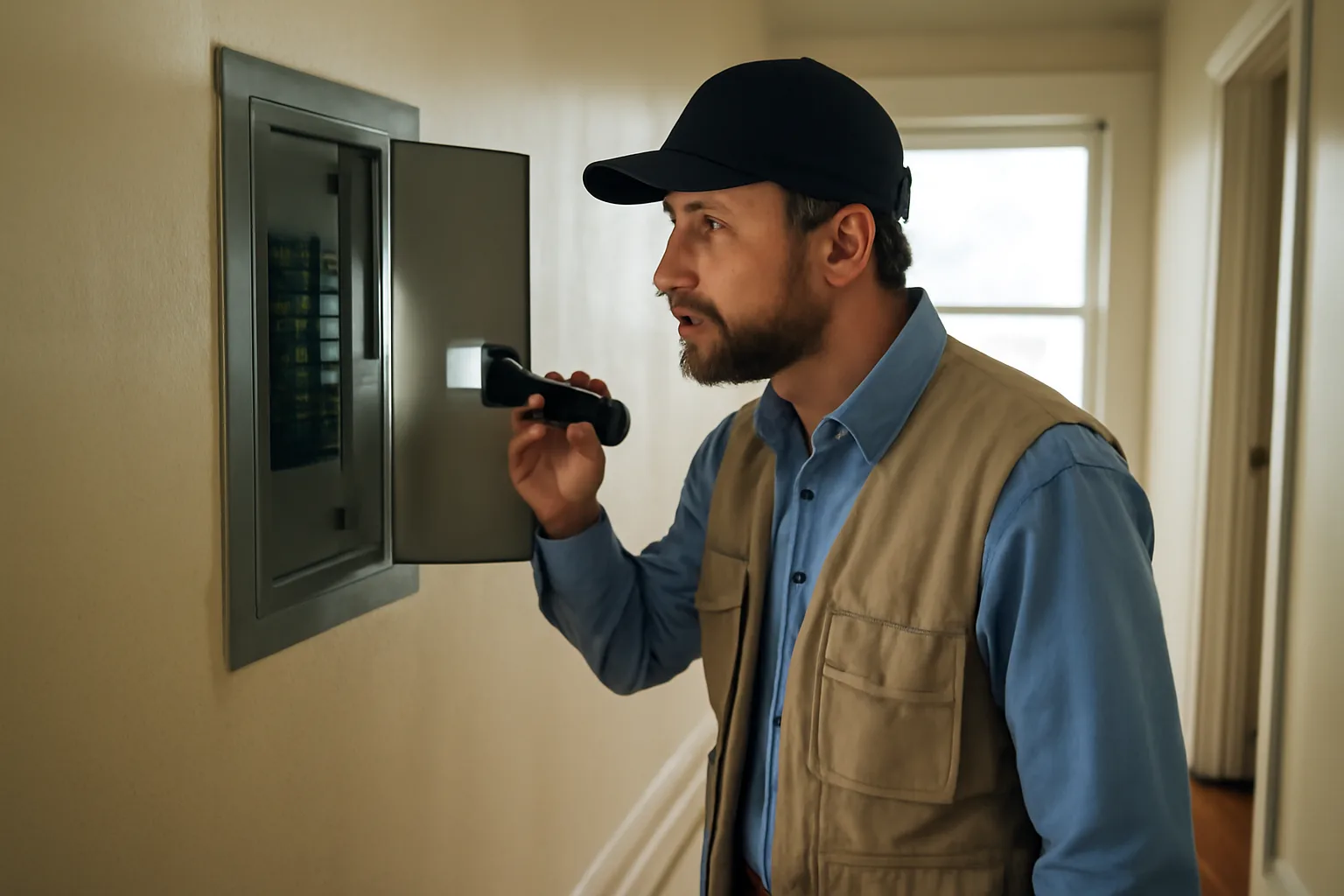
Inspectors are looking at life-safety and habitability items first, cosmetic issues second. Expect them to check smoke alarms and carbon monoxide alarms (placement and function), secondary means of egress from bedrooms (window size and operability), electrical panel condition and any exposed wiring, plumbing leaks, water heater venting and temperature-pressure relief valve, handrails and guardrails on stairs, and exterior conditions like peeling paint, damaged siding, and roof condition [3]. This general checklist mirrors what most Midwest cities with housing codes look for, since most municipal housing codes trace back to the same lineage of model codes (the International Property Maintenance Code is a common base that many Iowa cities adopt with local amendments) [4]. Des Moines' specific checklist, including any items unique to the local ordinance, is worth requesting in advance from the Permit and Development Center so you're not guessing. What can a landlord look at during an inspection is actually two different questions depending on who's inspecting. A city rental inspector is checking code compliance items tied to the ordinance: smoke alarms, egress, electrical, structural, and sanitation. A landlord doing their own periodic unit walkthrough (separate from the city inspection) can look at general condition, lease compliance, and maintenance needs, but generally cannot search personal belongings, and must still give proper notice before entering an occupied unit outside of an emergency. A reasonably organized way to think about likely inspection items: | Category | Typical items checked | Common first-visit fail |
How much notice does a landlord have to give before an inspection?
For a city-run rental inspection, the Permit and Development Center typically schedules a specific appointment window and notifies the property owner directly, so notice is baked into the scheduling process itself rather than governed by landlord-tenant entry rules. Confirm the specific scheduling and notice practice with the Des Moines Permit and Development Center [1]. For a landlord's own entry into an occupied unit for a walkthrough, repair, or showing (separate from the city's inspection), Iowa's Uniform Residential Landlord and Tenant Act sets the baseline. Iowa Code section 562A.19 requires a landlord to give tenants reasonable notice, defined in the statute as at least 24 hours, before entering to inspect the premises, and entry must happen at reasonable times [5]. The statute also allows entry without notice in an emergency, and entry rules can be modified somewhat by written agreement, though a landlord can't use that to make routine entry unreasonably intrusive. So if a tenant asks how much notice does a landlord have to give, the honest Iowa-specific answer is: at least 24 hours for a non-emergency entry to inspect, repair, or show the unit, under Iowa Code 562A.19, unless it's a true emergency. That's a state law floor. Some leases specify more, and that's enforceable too.
What happens if a Des Moines rental property fails inspection?
You get a written list of violations and a compliance deadline, usually somewhere in the range of 30 to 60 days depending on severity, though the exact timeline is set case by case and should be confirmed with the inspector directly. Life-safety items (no smoke alarm, blocked egress, exposed live wiring) generally get shorter deadlines than cosmetic items (paint, minor drywall damage). If you don't fix the violations by the deadline, the property doesn't get its certificate, which means you're technically operating an unpermitted rental, and Des Moines can escalate through its municipal infraction process. Iowa Code chapter 364.22 gives cities authority to enforce ordinance violations as municipal infractions, with civil penalties the city council sets by ordinance, and repeat violations can carry a higher penalty ceiling than first violations under state law [3]. Some cities also have a schedule of accelerating fines for rentals that stay unpermitted month over month. Re-inspection almost always costs money. Budget for it as a real line item, not a surprise, whenever you're going into an older property's first inspection cycle.
How to become a landlord in Des Moines (or anywhere)
Becoming a landlord isn't a license you apply for as a person, it's a role you step into by owning rental property and choosing to lease it out. What actually creates legal and administrative obligations is the property itself: once you rent a unit to someone else, most cities with rental registration programs, Des Moines included, require you to register that specific property, not yourself personally. Practically, the steps look like this: buy or already own a property you intend to rent, check whether your city requires rental registration or licensing (Des Moines does), get the property inspected if required, set up a lease that complies with your state's landlord-tenant law (Iowa Code chapter 562A for residential tenancies) [5], collect and handle the security deposit within state limits, and get landlord liability insurance in place before your first tenant moves in. What is landlording, in plain terms, is running a small housing business: you're responsible for habitability, repairs, following notice and entry rules, handling deposits correctly, and complying with local registration and inspection requirements. It sounds simple until you're the one fielding a 2 a.m. call about a frozen pipe. What is a landlord, legally, is the owner or lessor of real property who has entered a rental agreement with a tenant, and under Iowa Code 562A, that status comes with defined statutory duties, including maintaining the premises in a fit and habitable condition (562A.15) [5].
What rights do tenants have without a lease?
A tenant without a written lease still has legal rights. In most states, including Iowa, an oral or implied rental agreement creates a month-to-month tenancy, and the tenant retains the protections built into the state's landlord-tenant statute regardless of whether anything was signed. Iowa Code 562A applies to rental agreements broadly, and the statute defines a rental agreement to include both written and oral or implied agreements [5]. That means a tenant without a lease still generally has the right to a habitable unit, the right to proper notice before entry (that same 24-hour standard under 562A.19), the right to proper notice before termination of a month-to-month tenancy, and the right to the return of any security deposit under the state's deposit rules and timelines. What a landlord cannot do, lease or no lease, is enter without proper notice outside an emergency, retaliate against a tenant for reporting a code violation, or shut off utilities to force someone out. Landlords sometimes think no written lease means no rules apply. It's the opposite: no written lease usually means the state's default statute controls everything, and defaults tend to favor the tenant on ambiguous points.
What can a landlord look at during an inspection?
During a routine landlord-initiated walkthrough (not the city's code inspection), a landlord can generally look at the general condition of the unit, whether the lease terms are being followed (occupancy limits, unauthorized pets, property damage), and whether maintenance issues need addressing. A landlord typically cannot search through a tenant's personal belongings, closets, or private papers unless there's a specific lease provision or genuine safety concern, and even then, the scope should stay tied to the stated purpose of the visit. For a city rental inspection like the one Des Moines runs, the inspector's scope is narrower and code-specific: life safety systems, structural and mechanical condition, and general sanitation, not personal property or how tenants are living day to day. Tenants sometimes worry a code inspector is going to judge their housekeeping. Mostly they're not. They're checking whether the smoke alarm works and the wiring is safe. Who is responsible for a rental property walkthrough inspection in California is a different regulatory landscape entirely; California doesn't have a single statewide mandatory rental inspection program like Des Moines' municipal one, but many California cities (Los Angeles' Systematic Code Enforcement Program is the best-known example) run their own local rental inspection ordinances, and the responsibility for scheduling and passing those typically sits with the property owner, same as in Des Moines, just under different local rules entirely. If you own in both states, don't assume the checklist or cycle transfers over. It won't.
Why do landlords require renters insurance?
Landlords require renters insurance mainly to shift liability and personal-property risk off their own policy. A landlord's dwelling policy typically covers the structure and the landlord's own property, not the tenant's belongings, and it often doesn't adequately cover a tenant's liability if the tenant causes damage (a kitchen fire, an overflowing tub) that spreads to other units or hurts a guest. Requiring renters insurance, often in the range of a $100,000 liability minimum, means the tenant's own policy responds first for tenant-caused liability and personal property loss, instead of the landlord's insurer (or the landlord directly) eating that cost or fighting over it. It also tends to reduce disputes after a loss, since the tenant has a claims process to use instead of demanding the landlord replace their belongings. This isn't a Des Moines-specific rule, it's a lease-term landlords choose to add, and it's legal in Iowa and most states as long as it's disclosed in the lease and applied consistently to all tenants.
What can't a landlord do (Ohio and generally)?
The question of what a landlord cannot do in Ohio comes up a lot because Ohio's landlord-tenant law, Ohio Revised Code chapter 5321, spells out specific prohibited actions, and the pattern is similar in most states even though the exact statute numbers differ. Under Ohio law, a landlord cannot retaliate against a tenant for exercising a legal right, such as complaining to a housing authority (ORC 5321.02) [6], cannot enter the unit without reasonable notice, generally required to be at least 24 hours except in an emergency (ORC 5321.04 and 5321.05) , and cannot use "self-help" eviction methods like changing the locks, shutting off utilities, or removing the tenant's belongings to force them out without going through the court eviction process. Iowa's equivalent protections live in Iowa Code chapter 562A: 562A.19 covers notice and entry, 562A.36 addresses retaliatory conduct, and Iowa law similarly requires landlords to use the formal eviction (forcible entry and detainer) process rather than self-help remedies [5]. The throughline across states is consistent even when the code sections differ: no retaliation, no entry without proper notice barring emergencies, and no self-help lockouts or utility shutoffs. If you're a landlord operating in more than one state, don't assume rules transfer; read the specific statute for each state you own property in.
How does Des Moines' rental inspection compare to nearby Iowa cities?
Iowa doesn't have a single statewide rental licensing mandate, so every city sets its own program under its home-rule authority. That means Des Moines, Cedar Rapids, Davenport, and Iowa City can each have different inspection cycles, fee amounts, and scope, even though they're all operating under the same state enabling statutes for housing codes and municipal infractions [2] [3]. If you own rentals in more than one Iowa city, don't assume a passed inspection in one transfers to another, and don't assume the renewal cycle is identical. Confirm each city's specific rental registration ordinance separately, ideally by pulling the current municipal code section for rental housing from each city's own website or municode listing before you plan your compliance calendar for the year.
How to be a landlord without getting blindsided by inspection deadlines
The landlords who get burned by Des Moines rental inspections almost always get burned the same way: they miss the renewal notice, or they wait until the inspector is standing on the porch to notice the smoke alarm battery is dead. Neither is a compliance failure of character, it's a calendar failure. The fix is boring but it works: put your renewal date on a calendar the day you get your certificate, walk the unit yourself 30 to 60 days before the scheduled inspection using the same life-safety-first logic the city uses (alarms, egress, electrical, exterior), and fix what you find before anyone official shows up. If you manage more than one or two units, a repeatable checklist beats a memory every time. That's the whole idea behind our $79 City Rental License & Inspection Prep Packet: a printable, city-agnostic pre-inspection checklist and document tracker you can use before every renewal cycle, so the fee you pay the city is for a pass, not a re-inspection. For more on tenant-facing rights and notice rules that intersect with your inspection obligations, see our guides on tenants rights, tenant rights, and renters rights, plus our broader landlord and landlord landlords guides if you're setting up your first rental business from scratch.
Frequently asked questions
Does Des Moines require a rental permit for a single-family rental home?
Generally yes, most non-owner-occupied residential rentals in Des Moines, including single-family homes, fall under the city's rental registration and inspection requirements. Owner-occupied duplexes or specific exemptions may apply. Confirm your property's exact status with the Des Moines Permit and Development Center before assuming you're exempt.
How often does Des Moines re-inspect a rental property?
Inspection cycles vary by property compliance history and unit type in most Iowa rental inspection programs, commonly ranging from every 1 to 4 years. Des Moines sets its specific interval by ordinance, and it may extend for properties with a clean inspection history. Confirm your property's specific cycle with the city's Permit and Development Center.
How to become a landlord in Iowa?
Own or acquire rental property, check your city's rental registration and inspection requirements (mandatory in Des Moines), draft a lease compliant with Iowa Code chapter 562A, handle security deposits within state limits, and secure landlord liability insurance. There's no personal landlord license in Iowa; obligations attach to the property itself once you rent it out.
What rights do tenants have without a signed lease in Iowa?
An oral or implied rental agreement still creates a legally recognized tenancy under Iowa Code chapter 562A, typically month-to-month. The tenant keeps rights to habitability, proper notice before entry (at least 24 hours under Iowa Code 562A.19), proper termination notice, and return of any security deposit under state deposit rules.
What can a landlord look at during a routine inspection?
A landlord doing their own unit walkthrough can check general condition, lease compliance (occupancy, pets, damage), and maintenance needs, but generally cannot search personal belongings without cause. A city code inspector, like in Des Moines, checks life-safety items: smoke alarms, egress, electrical, structural condition, not personal property.
Why do landlords require renters insurance?
Renters insurance shifts liability for tenant-caused damage and loss of the tenant's personal property off the landlord's own policy and onto the tenant's insurer. It typically includes liability coverage (often $100,000 minimum) that responds first if the tenant's negligence causes damage or injury, reducing disputes and out-of-pocket exposure for the landlord.
How much notice does a landlord have to give before entering a rental unit?
Under Iowa Code 562A.19, a landlord must give tenants reasonable notice, defined as at least 24 hours, before entering to inspect, repair, or show the unit, except in a genuine emergency. Many other states use a similar 24-hour standard, though the specific statute number varies by state.
What can't a landlord do in Ohio?
Under Ohio Revised Code chapter 5321, a landlord cannot retaliate against a tenant for reporting code violations (5321.02), cannot enter without reasonable notice, generally at least 24 hours except in emergencies (5321.04, 5321.05), and cannot use self-help eviction tactics like lockouts or utility shutoffs instead of the formal court eviction process.
Who is responsible for a rental property walkthrough inspection in California?
The property owner or landlord is responsible for scheduling and passing local rental inspections in California cities that run them, such as Los Angeles' Systematic Code Enforcement Program. California has no single statewide mandatory inspection law; each city with an ordinance sets its own rules, so requirements vary significantly by city.
What happens if my Des Moines rental fails inspection?
You'll get a written violation list and a compliance deadline, often 30 to 60 days depending on severity, with life-safety items given shorter windows. Missing the deadline can mean re-inspection fees, a denied or delayed certificate, and potential municipal infraction penalties under Iowa Code chapter 364.22 if the property operates unpermitted.
Is there a fee to register a rental property in Des Moines?
Yes, Des Moines charges a fee for rental registration and inspection, typically structured per unit or per building with separate charges for renewals and re-inspections. The current fee schedule changes periodically by city council action, so confirm exact current amounts with the Permit and Development Center.
What is landlording, in simple terms?
Landlording means owning rental property and taking on the responsibilities of leasing it out: maintaining habitability, following notice and entry laws, handling security deposits correctly, complying with local registration or inspection rules, and managing the landlord-tenant relationship day to day. It's a small business role, not a formal title or license.
Sources
- Iowa Code chapter 364, Municipal Home Rule Powers: Iowa cities have home rule authority to adopt housing and building codes, including rental inspection ordinances
- Iowa Code chapter 364.22, Municipal Infractions: Cities can enforce ordinance violations, including unpermitted rentals, as municipal infractions with civil penalties
- International Code Council, International Property Maintenance Code overview: Typical rental inspection checklists focus on smoke alarms, egress, electrical safety, and structural/exterior condition
- Iowa Code chapter 562A, Uniform Residential Landlord and Tenant Law: Iowa's landlord-tenant statute governs notice for entry, habitability duties, deposits, and applies to oral and implied rental agreements
- Ohio Revised Code 5321.02, Retaliatory Conduct Prohibited: Ohio law prohibits landlords from retaliating against tenants for exercising legal rights such as reporting code violations
- Ohio Revised Code 5321.04 and 5321.05, Landlord and Tenant Obligations: Ohio law requires landlords to give reasonable notice, generally at least 24 hours, before entering a rental unit except in emergencies