Last updated 2026-07-25
TL;DR
A city rental inspection is a code compliance check, usually tied to your rental license or registration, covering smoke/CO alarms, electrical, plumbing, structural safety, and egress. Most cities give 24 to 48 hours notice, inspect every 1 to 3 years, and charge $50 to $300 per inspection or re-inspection. Refusing entry can trigger a warrant or license denial in many jurisdictions.
What is a city rental inspection, exactly?
A city rental inspection is a visit from a code enforcement officer, fire marshal, or housing inspector to confirm your rental unit meets the local housing or property maintenance code. It's separate from a walk-through you'd do with a new tenant. This one is about the city checking whether the building itself is safe to live in. Most mandatory-licensing cities tie the inspection to your rental registration or license renewal. Miss the inspection, fail it without fixing violations, or skip the license entirely, and you can lose the right to collect rent or face daily fines in some jurisdictions. Minneapolis, for example, inspects licensed rental properties on a cycle tied to a point system based on prior violations, with licenses renewed every one to three years depending on that history [1]. The legal basis is almost always the International Property Maintenance Code (IPMC) or a locally adopted version of it, which most U.S. cities use as their baseline for minimum conditions in existing residential structures [2]. Your city may have amended sections, so the IPMC is a starting point, not the final word. Always confirm the current local ordinance with your city rental licensing office.
Why do cities require rental inspections in the first place?
Cities inspect rentals because tenants, unlike owner-occupants, often have less power to force repairs and less information about a building's condition before signing a lease. Mandatory inspection programs shift that burden from an individual complaint process to a systematic check. The policy logic traces back to housing code enforcement research showing that complaint-based systems catch a small fraction of problem units, because tenants fear retaliation or eviction if they report conditions themselves. Proactive rental inspection programs, sometimes called PRIPs, are the city's answer: inspect every licensed unit on a cycle instead of waiting for someone to call 311. This is also why the fee funds the inspector's salary and the program's overhead, not general city revenue in most cases. If your city's per-unit inspection fee feels steep, that's usually the reason. Confirm the fee structure and legal basis for it with your city rental licensing office, since programs are funded differently city to city.
What can a landlord look at during an inspection?
| Life safety | Smoke alarms, CO detectors, fire extinguishers in common areas | |
|---|---|---|
| Egress | Bedroom window size, unobstructed exits, working locks | |
| Electrical | GFCI outlets near water, no exposed wiring, working outlets | |
| Plumbing | No active leaks, functioning fixtures, water heater TPR valve | |
| Structural | Handrails, stable stairs, no visible foundation cracks | |
| Exterior | Peeling exterior paint (lead risk pre-1978), roof condition, pest entry points | |
| Occupancy | Overcrowding limits, unauthorized units | A separate but related question landlords often ask is who is responsible for rental property walk-through inspection in California specifically. Under California Civil Code Section 1950.5, landlords must offer tenants an initial inspection before move-out if the landlord intends to withhold any part of the security deposit for repairs or cleaning, and the tenant has the right to be present [3]. That move-out inspection is a landlord-tenant financial matter, distinct from a city code compliance inspection, but both can happen around the same time if a unit turns over. |
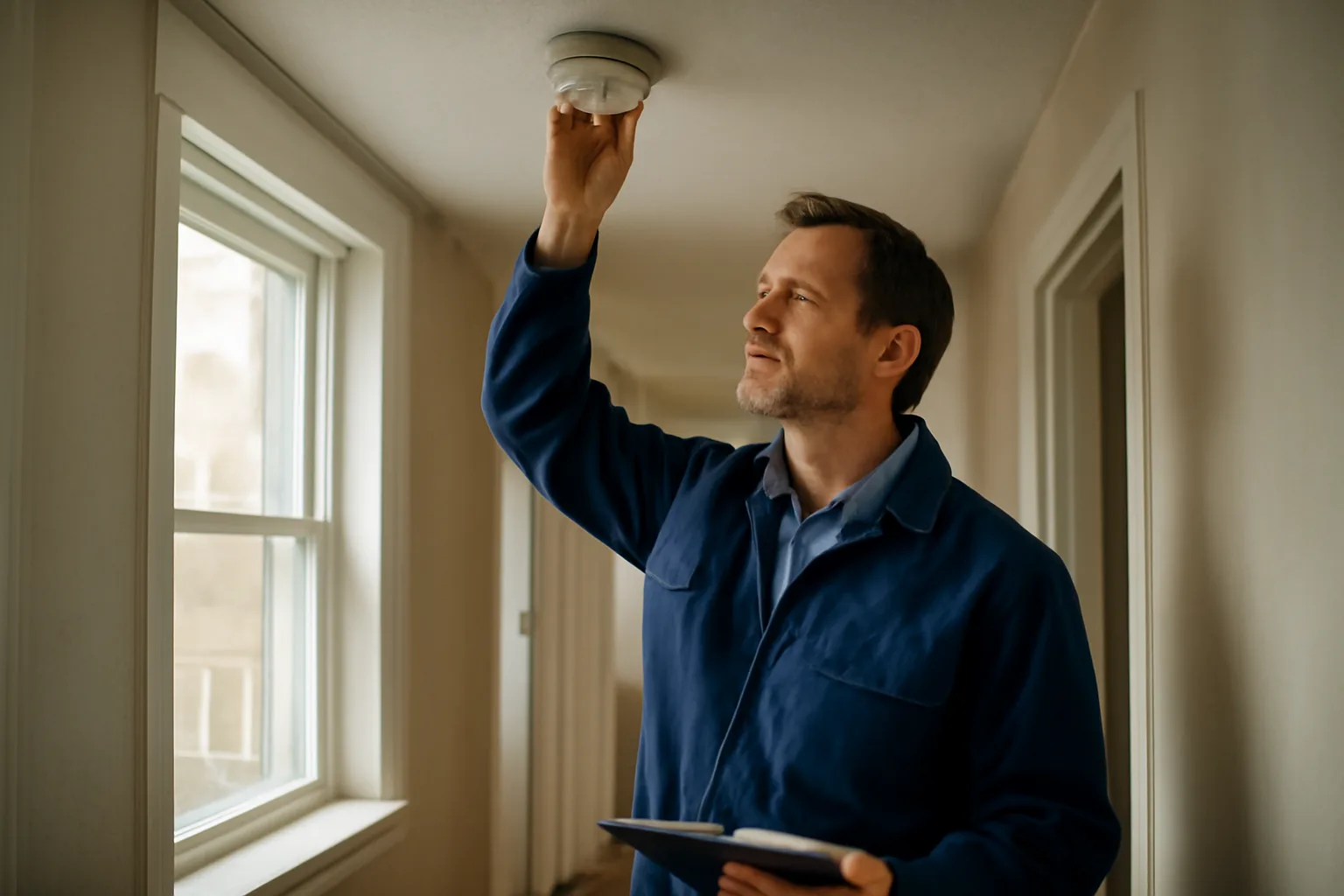
During a city rental inspection, the inspector is the one doing the looking, but it helps to know what they check so you can prep. Typical items include smoke alarms and carbon monoxide detectors in required locations, working electrical outlets and no exposed wiring, adequate egress (a working, unobstructed window or door in every bedroom), functioning plumbing with no active leaks, water heater temperature and pressure relief valve, handrails on stairs with more than a few steps, and no obvious pest infestation or mold. Inspectors typically check life-safety items first: smoke alarms, CO detectors, and egress windows are the most common causes of failed inspections nationally, based on patterns reported by municipal housing departments. The IPMC requires smoke alarms in each sleeping room and outside sleeping areas, and requires egress windows in every bedroom with a minimum opening size, though exact dimensions vary by code edition and local amendment [2]. Here's a table of the categories inspectors commonly check, though your city's checklist may add or drop items: | Category | Common check items |
How much notice does a landlord have to give before an inspection?
For city code inspections, the notice period comes from your local ordinance, and it's typically 24 to 48 hours, sometimes with a scheduled appointment window rather than a specific time. Some cities post a notice on the door if they can't reach anyone by phone or mail. For your own entry as a landlord (repairs, showings, or your own walk-throughs), state landlord-tenant law sets the notice requirement, and it's a different number than the city's inspection notice. California requires at least 24 hours written notice for entry in most circumstances under Civil Code Section 1954, with exceptions for emergencies or tenant agreement to shorter notice [4]. Many other states use a similar 24-hour standard, though a handful require 48 hours and some have no statutory minimum at all, leaving it to the lease or local ordinance. Don't assume your state's number matches the city's inspection notice number. They're set by different laws and can differ by a day or more. Check both.
What happens if I refuse to let the city inspector in?
You can refuse entry, but it rarely ends well. Cities generally can't force entry without either your consent or an administrative warrant, because the Fourth Amendment protects against warrantless searches, and the Supreme Court confirmed in Camara v. Municipal Court (1967) that this protection extends to routine code enforcement inspections of residential property [5]. In practice, refusal usually just delays things and adds cost. Most rental licensing ordinances allow the city to seek an administrative warrant after a refusal, and many make refusal itself a separate violation that can hold up your license renewal. Some cities will simply deny or suspend your rental license if you don't allow the required inspection, regardless of the property's actual condition. That means you can't legally rent the unit until the impasse is resolved. If you have a genuine scheduling conflict, call the office and reschedule. Most inspectors would rather set a new date than start the warrant process, which costs both sides more time and, in some cities, added fees.
What is landlording, and what does the job actually involve?
Landlording is the day-to-day work of owning and operating a rental property: finding and screening tenants, collecting rent, handling maintenance and repairs, complying with local code and licensing rules, managing the lease relationship, and eventually handling turnover or, when needed, eviction. It's part property management, part small business operation, part compliance work. The compliance side is often the part new landlords underestimate. A single-family rental in a mandatory-licensing city isn't just a lease and a rent check. It's an annual or biennial registration, a possible inspection, fire code items like smoke alarm placement, and sometimes a business license or transient occupancy registration depending on the city. If you're asking what is a landlord in the plainest legal sense: it's the party who owns or controls a rental property and leases it to a tenant in exchange for rent, taking on the legal obligations that come with that role under state landlord-tenant law and local housing code. Those obligations exist whether or not you have a written lease, which matters for the next question.
How do you become a landlord, step by step?
Becoming a landlord in a mandatory-licensing city involves more steps than just buying a property and finding a tenant. Here's the realistic sequence: 1. Confirm zoning allows rental use for your property type (single-family, duplex, accessory unit rules vary widely). 2. Register or license the rental with your city, if required. Check with your city rental licensing office for the specific form and fee. 3. Get the property inspection-ready: working smoke and CO alarms, no active leaks, functioning egress windows, GFCI outlets where required. 4. Set up landlord insurance (different from a standard homeowner's policy) and consider requiring tenant renters insurance. 5. Screen tenants consistently and lawfully, following Fair Housing Act rules on protected classes [6]. 6. Use a written lease that matches your state's landlord-tenant statute requirements. 7. Keep records of rent payments, repair requests, and any notices you serve, since these matter in disputes. Step 2 trips people up most often, because many first-time landlords don't realize their city requires registration until they get a notice or a neighbor complaint triggers an inspection. If you're renting out a first unit and want a structured way to get through the license application and inspection prep without missing a step, the City Rental License & Inspection Prep Packet walks through the common requirements city by city for a one-time $79 fee, though you should still confirm your specific city's current rules directly with its licensing office.
Why do landlords require renters insurance?
Landlords require renters insurance mainly to shift liability for the tenant's personal property and personal liability away from the landlord's own policy. A standard landlord or dwelling policy covers the structure and the landlord's own liability, but it typically doesn't cover a tenant's furniture, electronics, or clothing if there's a fire, burst pipe, or theft. There's also a liability angle: if a tenant's dog bites a visitor, or the tenant accidentally starts a kitchen fire that spreads to a neighboring unit, the tenant's renters insurance liability coverage can cover the claim instead of it falling entirely on the landlord's policy or out of pocket. Many landlords require proof of a policy with a minimum liability limit, often $100,000, written into the lease as a condition of tenancy. There's no federal law requiring tenants to carry renters insurance, and no state mandates it either, but landlords can require it as a lease condition in most states as long as it doesn't conflict with local rules (a few jurisdictions restrict how landlords structure insurance requirements, so check locally).
What rights do tenants have without a written lease?
Tenants without a written lease still have real legal rights. In every U.S. state, an oral or implied rental agreement creates a tenancy, usually classified as month-to-month, and it carries most of the same protections as a written lease under state landlord-tenant law. Those protections typically include the right to a habitable unit (working plumbing, heat, and structural safety), protection from illegal lockouts or utility shutoffs (self-help eviction is illegal in nearly every state), the right to proper notice before the landlord ends the tenancy (commonly 30 days for month-to-month tenancies, though this varies by state and sometimes by how long the tenant has lived there), and protection from retaliation for reporting code violations. The absence of a written lease also doesn't remove fair housing protections; Title VIII of the Civil Rights Act, better known as the Fair Housing Act, applies regardless of whether there's a written lease [6]. What a tenant without a lease usually loses is certainty. Rent amount, who pays for what repairs, and the exact notice period can all become disputes of fact instead of clear lease terms. That's exactly why landlords should always use a written lease, not because oral tenancies lack rights, but because ambiguity creates disputes that cost everyone money and time. For a broader look at what tenants can expect in these situations, see tenant rights and renters rights.
What can't a landlord do in Ohio specifically?
Ohio landlord-tenant law, primarily Ohio Revised Code Chapter 5321, sets specific limits on landlord conduct. A landlord in Ohio cannot shut off utilities, change the locks, or remove a tenant's belongings to force them out; this is illegal self-help eviction, and the tenant can sue for actual damages, though Ohio courts have interpreted the remedy narrowly compared to some other states [7]. Ohio landlords also cannot retaliate against a tenant for complaining to a government agency about code violations, joining a tenant union, or asserting rights under the landlord-tenant chapter. ORC 5321.02 specifically prohibits raising rent, decreasing services, or threatening eviction within a defined period after a tenant's protected complaint, creating a presumption of retaliation if the landlord acts within statutory time frames of the tenant's protected action [8]. Ohio law also requires landlords to maintain the premises in a fit and habitable condition, comply with building and housing codes, keep common areas safe, and maintain electrical, plumbing, and heating systems in good working order, per ORC 5321.04 . A landlord who ignores these duties can face a tenant's rent escrow deposit with the court, a remedy specifically available under Ohio law that lets tenants withhold rent into a court-held account until repairs happen. This is Ohio-specific. Every state's landlord-tenant code differs, sometimes significantly, so don't assume Ohio's rent escrow or retaliation rules apply elsewhere.
How often do cities actually inspect rental units?
Inspection frequency depends entirely on the local ordinance, and it ranges widely. Some cities inspect every unit annually. Others use a tiered system: clean properties with no violation history move to a 2 or 3 year cycle, while properties with prior violations get inspected annually or even more often. Minneapolis uses exactly this kind of tiered approach, where rental license terms and inspection frequency depend on a point system tied to code violation history, with better-performing properties earning longer license terms between inspections [1]. Other cities inspect only on a complaint basis for owner-occupied duplexes but require proactive inspection for anything with three or more units, or for properties owned by an out-of-state landlord. There's no national standard. If you own in more than one city, don't assume the inspection cadence is the same. Confirm your specific cycle and any point or tier system with your city rental licensing office, since this is one of the areas that changes most often as cities update ordinances.
What does an inspection failure cost, and what happens next?
Failing a rental inspection almost never means immediate license loss. Cities typically issue a notice of violation with a correction period, often 30 days for most items, though life-safety violations like a missing smoke alarm might require correction within days. Re-inspection fees are common and typically run $50 to $150 per visit in cities that charge them, on top of the original inspection fee, though exact figures vary and you should confirm current amounts with your city rental licensing office. If violations go uncorrected past the deadline, consequences escalate: daily fines (some cities allow $100 to $1,000 per day per violation under general code enforcement statutes), license suspension, or in repeat cases, a hold preventing you from renting the unit at all until compliance is confirmed. The cheapest fix is avoiding the fail in the first place. Walk your unit against the IPMC basics before the inspector shows up: test every smoke alarm, check every window opens and locks, run water in every fixture, and look for anything an inspector would flag as an obvious safety issue. A pre-inspection walk-through with a checklist catches the majority of common violations before they cost you a re-inspection fee.
How should a landlord prepare for a city rental inspection?
Preparation is mostly about fixing the predictable stuff before the inspector arrives. Test and replace batteries in every smoke alarm and CO detector. Confirm every bedroom window opens fully and isn't painted or nailed shut, since egress failures are among the most common violations cited by municipal inspectors. Check GFCI outlets in kitchens and bathrooms actually trip when tested. Fix any active leak, no matter how small. Clear stored items blocking electrical panels or water heaters. Make sure handrails on any stairway are secure. Gather your paperwork too. Have your rental license or registration number, prior inspection reports if you have them, and any permits for recent work (a new water heater, an electrical panel upgrade) ready to show. Inspectors sometimes ask for permit documentation on visible recent work, and unpermitted work can itself become a violation separate from the condition it created. If you manage several units across a city with a mandatory license and inspection program, tracking deadlines, fees, and required documents unit by unit gets complicated fast, and missing a renewal date is one of the more common ways landlords accidentally lapse into an unlicensed rental status. That's the specific gap the City Rental License & Inspection Prep Packet is built to close: a one-time $79 reference to help you track what your city's process actually requires, though the packet doesn't replace confirming current fees and deadlines directly with your city's licensing office, since ordinances change.
Frequently asked questions
How to become a landlord if you've never rented a property before?
Confirm your city allows rental use through zoning, register or license the property if your city requires it, make the unit inspection-ready (smoke alarms, egress, no leaks), get landlord insurance, screen tenants under Fair Housing Act rules, and use a written lease matching your state's landlord-tenant statute. Check your city rental licensing office early, since registration is the step most first-timers miss.
Who is responsible for a rental property walk-through inspection in California?
Under California Civil Code Section 1950.5, the landlord is responsible for offering an initial move-out inspection if planning to withhold any deposit for repairs, and the tenant has the right to be present. This is separate from city code inspections, which the local jurisdiction's inspector conducts, not the landlord.
What is landlording?
Landlording is the ongoing work of owning and operating a rental property: tenant screening, rent collection, maintenance, code and license compliance, and lease administration. It combines small-business operation with the legal obligations set by state landlord-tenant law and local housing codes.
What is a landlord, legally speaking?
A landlord is the person or entity that owns or controls a rental property and leases it to a tenant for rent, taking on the legal duties that come with that relationship under state landlord-tenant law, including habitability and proper notice requirements, regardless of whether the lease is written or oral.
What rights do tenants have without a lease?
Tenants without a written lease still get habitability protections, protection from illegal lockouts or self-help eviction, required notice before the tenancy ends (often 30 days for month-to-month), and full Fair Housing Act protections. What's missing is written certainty on rent amount and specific terms, which is why disputes are more common in oral tenancies.
Why do landlords require renters insurance?
Renters insurance shifts liability for the tenant's belongings and personal liability claims (dog bites, accidental fires) away from the landlord's own policy. A landlord's dwelling policy doesn't cover a tenant's possessions, so requiring renters insurance as a lease condition protects both parties financially.
How much notice does a landlord have to give before entering a unit?
It depends on the state and the reason for entry. California requires at least 24 hours written notice for routine entry under Civil Code Section 1954. Many states use a similar standard, though some require 48 hours and a few have no statutory minimum, leaving it to the lease. This is separate from city inspection notice periods, which local ordinance sets.
What can a landlord look at during a city inspection?
The inspector, not the landlord, is doing the looking, checking smoke and CO alarms, egress windows, electrical and plumbing condition, structural safety items like handrails, and signs of pest or moisture problems. Categories generally follow the International Property Maintenance Code baseline, with local amendments possible.
What can't a landlord do in Ohio?
Ohio landlords cannot shut off utilities, change locks, or remove belongings to force a tenant out (illegal self-help eviction), and cannot retaliate against a tenant for reporting code violations, under Ohio Revised Code Chapter 5321. Landlords must also keep the unit fit and habitable under ORC 5321.04.
Can I refuse to let a city inspector into my rental?
You can refuse, but the city can typically seek an administrative warrant after a refusal, since Camara v. Municipal Court (1967) confirmed code inspections need either consent or a warrant. Refusal often delays your license renewal and can trigger a separate violation, so rescheduling is usually the better move.
How often does a city inspect a licensed rental property?
It varies by city and often by your violation history. Some cities inspect annually; others use a tiered system where clean records earn a 2 to 3 year cycle between inspections, as Minneapolis does through its rental license point system. Confirm your city's specific cycle with its rental licensing office.
What happens if my rental fails the city inspection?
You typically get a notice of violation with a correction period (often 30 days for most issues, faster for life-safety items), then a re-inspection, which usually carries its own fee of roughly $50 to $150. Uncorrected violations can lead to daily fines or license suspension in many cities.
Sources
- International Code Council, International Property Maintenance Code: IPMC sets baseline requirements for smoke alarms and bedroom egress windows used by many U.S. cities
- California Legislative Information, Civil Code Section 1950.5: California landlords must offer an initial move-out inspection before withholding deposit for repairs, with tenant allowed to be present
- California Legislative Information, Civil Code Section 1954: California requires at least 24 hours written notice before landlord entry in most circumstances
- Justia US Supreme Court, Camara v. Municipal Court, 387 U.S. 523 (1967): Fourth Amendment protection against warrantless searches extends to routine municipal code enforcement inspections of residential property
- U.S. Department of Housing and Urban Development, Fair Housing Act overview: The Fair Housing Act prohibits discrimination in rental housing regardless of whether a lease is written or oral
- Ohio Laws, Ohio Revised Code Chapter 5321: Ohio landlord-tenant law prohibits self-help eviction such as utility shutoff or lockout, and this chapter governs Ohio landlord conduct
- Ohio Laws, Ohio Revised Code Section 5321.02: Ohio law creates a presumption of retaliation if a landlord raises rent or threatens eviction within a defined period after a tenant's protected complaint
- Ohio Laws, Ohio Revised Code Section 5321.04: Ohio landlords must maintain premises in a fit and habitable condition and comply with applicable building and housing codes