Last updated 2026-07-25
TL;DR
Most rental boiler inspections are visual: a licensed inspector checks the vent, pressure relief valve, combustion chamber, and controls. Thermal imaging is an optional add-on (often $150 to $400 extra) used to spot heat loss, blocked flues, or hidden leaks a visual check misses. Cities requiring rental licenses almost never mandate thermal imaging themselves; confirm with your city rental licensing office.
what does a boiler inspection for a rental property actually check
A standard boiler inspection is a visual and mechanical check, not an x-ray of your building. An inspector (often a licensed HVAC tech, sometimes a city building inspector, depending on your jurisdiction) looks at the burner, the pressure relief valve, the low-water cutoff, the flue and venting, the gas or oil supply line, and the general condition of the jacket and controls. They're checking for corrosion, soot buildup, leaks, and whether safety devices actually trip when tested. Many states with boiler safety laws require this at set intervals regardless of rental status. Massachusetts, for example, requires periodic boiler inspections under 520 CMR 6.00, administered by the Department of Public Safety's Boiler Rules [1]. New York City requires annual boiler inspections for most buildings with steam or hot water boilers under its Boiler Inspection and Repair program, filed through DOB NOW [2]. These are separate from your city's rental licensing inspection, though a rental inspector will often ask to see your current boiler certificate as proof. A visual inspection typically takes 30 to 60 minutes for a single residential boiler. It does not involve cutting into walls or running diagnostic instruments beyond a basic combustion analyzer some techs carry. If your rental license packet asks for 'proof of boiler inspection,' this is almost always what they mean: a dated certificate from a licensed inspector, not a thermal scan. If you're pulling together everything a city inspector wants to see before a rental license visit, our rental packet builder walks through the standard document list city by city, boiler certificates included.
what is thermal imaging and when do you actually need it for a boiler
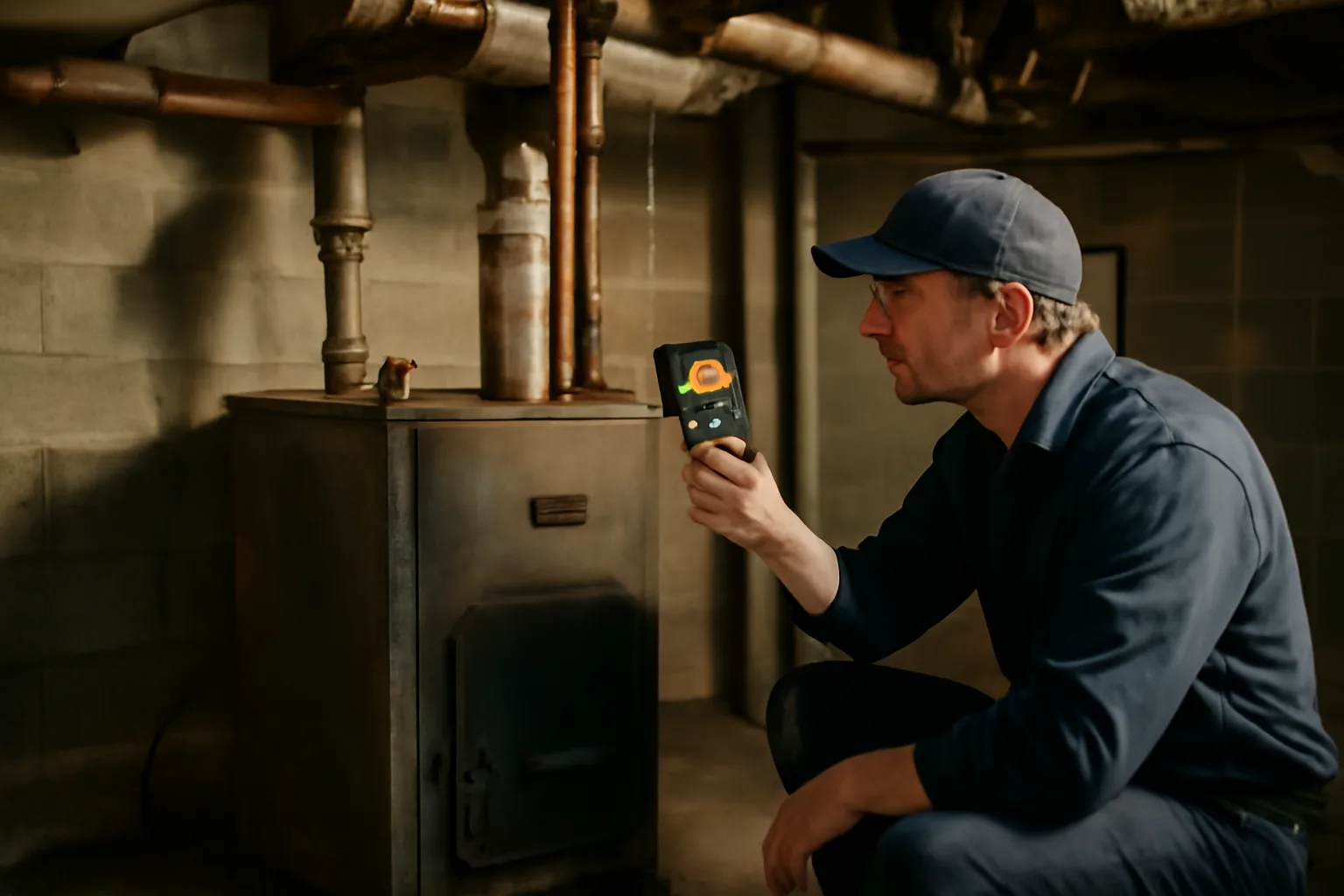
Thermal imaging (also called infrared thermography) uses a camera that reads surface temperature differences to reveal things you can't see with your eyes: a cracked heat exchanger showing an odd hot spot, a flue that's leaking combustion gases along a seam, or insulation gaps around pipes losing heat. It doesn't replace a mechanical inspection. It supplements one. Most city rental licensing programs do not require thermal imaging. It's an optional diagnostic tool some HVAC companies offer, and some insurance carriers or lenders request it for older commercial boiler systems as part of risk assessment. If your building has a history of carbon monoxide complaints, uneven heating between units, or unexplained high fuel bills, thermal imaging can find the problem faster than a tech poking around with a flashlight. Cost runs higher than a basic visual check. A standalone infrared inspection for a residential heating system often runs $150 to $400 depending on your market and whether it's bundled with the mechanical inspection or billed separately, though there's no single national rate and pricing isn't tracked by any government source, so treat that as a rough range from HVAC industry pricing guides rather than a hard number. For a landlord with one to ten units, thermal imaging is rarely necessary for licensing purposes. It's worth paying for if you've had a specific problem (a tenant complaint about a cold room, a suspicious fuel bill spike, or an older boiler you're deciding whether to replace) rather than as a routine add-on every year.
how much does a boiler inspection cost for a rental property
| Standard visual boiler inspection | $75 to $300 | State boiler safety law, city rental license | |
|---|---|---|---|
| Thermal imaging add-on | $150 to $400 | Optional, insurer or landlord request | |
| Combustion analysis (part of visual) | Often included | State boiler code, some city inspectors | |
| Annual re-inspection (NYC steam boilers) | Filing fee plus inspector cost | NYC DOB NOW program [2] | If a violation notice cites a specific boiler inspection deadline or fine, don't guess at the reinspection window. Municipal boiler codes often set specific re-inspection timelines (NYC's low-pressure boiler rule requires internal inspection every year and external inspection every year for most systems, with specifics depending on boiler type) [2]. |
Expect $75 to $300 for a standard visual boiler inspection performed by a licensed HVAC contractor or boiler inspector, with the low end for a small residential unit and the higher end for larger multi-family systems or commercial-grade boilers. Some states set fees for the government inspection portion separately from what a private inspector charges to prep the unit beforehand. Massachusetts charges inspection fees set by statute for state-conducted boiler inspections, and those fees vary by boiler horsepower and type under the Board of Boiler Rules fee schedule [1]. New York City's DOB NOW boiler filing system charges separate filing fees on top of whatever your inspector charges to do the physical check [2]. Neither of these fees has anything to do with your city's rental license fee, which is usually a flat per-unit or per-building charge collected by the housing or building department. Always confirm with your city rental licensing office which fees apply to your specific building, since boiler rules and rental licensing rules are usually run by two different departments with two different fee schedules. | Inspection type | Typical cost range | Who usually requires it |
how to become a landlord
Becoming a landlord starts well before you buy a rental property. You need to understand your state's landlord-tenant law, your city's rental licensing or registration requirements if any exist, and basic numbers: what rent covers, what a security deposit can legally be used for, and what maintenance obligations you're taking on. Most states require landlords to maintain a habitable unit under an implied warranty of habitability, meaning working heat, plumbing, and structural safety at minimum. This is a baseline in most jurisdictions, though the specific standards and enforcement mechanism (housing court, code enforcement, rent withholding rights) differ significantly by state, so check your state's specific statute rather than assuming national uniformity. Practically, becoming a landlord means: get a rental license or registration if your city requires one, get landlord liability insurance (a standard homeowner's policy usually doesn't cover a rented unit), set up a way to screen tenants that complies with fair housing law, and build a maintenance plan for things like boiler inspections, smoke detector checks, and lead paint disclosures if your building predates 1978 (federal law requires lead disclosure for pre-1978 housing under 42 U.S.C. 4852d) [3]. A lot of new landlords underestimate the compliance side. A single mandatory rental license inspection can flag a dozen small things, a missing GFCI outlet, an expired boiler certificate, a smoke detector in the wrong spot, that add up to real fines if you don't fix them before the deadline on your notice.
what is landlording and what is a landlord
A landlord is the person or entity that owns a rental property and leases it to a tenant in exchange for rent. Landlording is the ongoing work of managing that relationship: collecting rent, handling repairs, complying with local and state housing law, and keeping the property safe and legally rentable. It's more operational than people expect going in. Beyond the lease itself, landlording includes responding to maintenance requests within legally required timeframes (many states set specific response windows for things like no-heat complaints), keeping the unit compliant with your city's housing code, renewing any required rental license or registration, and handling boiler, electrical, and fire safety inspections on whatever schedule your state or city sets. Small landlords (one to ten units) often do this themselves rather than hiring a property manager, which means the compliance burden, licensing renewals, inspection scheduling, and violation responses, falls directly on you. That's exactly the gap our rental packet builder is built for: a one-time $79 packet that organizes what your specific city's rental license and inspection process actually requires, so you're not guessing at deadlines from a violation notice.
who is responsible for a rental property walk-through inspection in california
In California, the landlord is responsible for arranging and typically conducting (or hiring someone to conduct) the initial move-in and move-out walk-through inspections, but tenants have a specific legal right to participate. California Civil Code Section 1950.5 requires that if a landlord intends to withhold any part of a security deposit for repairs, the landlord must offer the tenant an initial inspection before move-out, give at least 48 hours' written notice of that inspection, and provide an itemized statement of anticipated deductions [4]. The tenant can decline the initial inspection offer. If they accept, the landlord or their agent walks the unit with the tenant present, notes any deficiencies, and gives the tenant a chance to fix minor issues before move-out to avoid deposit deductions. This is separate from any city rental inspection program (some California cities, including Los Angeles and Oakland, run their own rental registration and habitability inspection programs) [5]. So there are really two different 'walk-through' concepts in California: the security-deposit-related move-out inspection under state civil code, and a city housing or building department inspection tied to a rental license or proactive rental inspection program, which is a local government function, not a landlord-tenant deposit issue. Confirm with your city's rental licensing office whether it runs a separate inspection program on top of the state's deposit inspection rule.
what can a landlord look at during an inspection
A landlord conducting a routine or move-out inspection can generally look at anything related to the condition of the unit: walls, floors, appliances, plumbing fixtures, smoke and carbon monoxide detectors, HVAC or boiler equipment, and any damage beyond normal wear and tear. What a landlord cannot do is use an inspection as cover to search personal belongings, closets, or drawers unrelated to property condition, or to enter without proper notice except in a genuine emergency. Most states require advance written notice before a non-emergency entry, commonly 24 hours, though the specific number and required method (posted notice, mail, text if the lease allows it) varies by state statute. California requires 24 hours' written notice for most non-emergency landlord entries under Civil Code Section 1954, with exceptions for emergencies, tenant consent at the time, or move-out inspections under the 48-hour rule described above [4][6]. During a government-run rental license inspection (as opposed to a landlord's own walk-through), a code inspector typically checks for: working smoke and CO detectors, secure railings and stairs, no exposed wiring, functioning heat source, no active leaks or mold, proper egress from bedrooms (window size and height requirements), and pest evidence. They are not there to inspect the tenant's belongings and generally won't open closets or cabinets unless checking for something specific like a water leak source. If you're prepping for a first rental license inspection, walking through the common failure points before the inspector arrives (detector battery dates, missing outlet covers, an expired boiler certificate) catches most of what would otherwise become a violation notice. See our related guide on landlord responsibilities for a fuller breakdown of ongoing obligations beyond the inspection itself.
how much notice does a landlord have to give before entering or inspecting a unit
Most states require at least 24 hours' notice before a landlord or their agent enters an occupied rental unit for a non-emergency reason, including a routine inspection. California sets this at 24 hours under Civil Code 1954, written notice being the standard method [6]. Other states use similar windows but the exact number, and whether it must be written, verbal, or posted, varies, so check your specific state's landlord-tenant statute rather than assuming California's rule applies everywhere. Emergencies are the one universal exception: a burst pipe, a gas leak, a fire, anything posing immediate danger to people or property lets a landlord enter without advance notice in essentially every state. Outside of that, entering without proper notice, even to check on your own property, can expose a landlord to a claim for violation of the tenant's right to quiet enjoyment. City rental license inspections work a little differently. If a city inspector needs to access your unit as part of a mandatory licensing inspection, the notice requirement usually comes from the city's own ordinance rather than the general landlord entry statute, and the tenant is generally expected to allow access for a properly scheduled government inspection. Check your specific city's rental inspection ordinance for the notice period it requires, since this is set locally and isn't standardized nationally.
what rights do tenants have without a lease
A tenant without a written lease, sometimes called a month-to-month or at-will tenant, still has real legal rights. In most states, an oral or implied rental agreement creates a periodic tenancy (usually month-to-month), and the tenant is entitled to the same basic protections as someone with a written lease: the right to habitable housing, the right to proper notice before eviction, and protection from illegal lockouts or utility shutoffs. What changes without a written lease is mainly the terms that would otherwise be spelled out, rent amount, who pays for what repairs, pet policies, so those default to state law or whatever the parties can prove was agreed to verbally. Termination notice periods for month-to-month tenancies are set by state law regardless of whether there's a written lease, commonly 30 days, though some states require longer for longer-term tenants. A landlord still cannot evict a no-lease tenant without going through the proper legal eviction process (filing in court, getting a judgment, having a sheriff execute it) in any state. 'No lease' does not mean 'no rights' and it does not mean a landlord can remove someone by changing the locks or shutting off power, both of which are illegal self-help eviction tactics in essentially every state.
why do landlords require renters insurance
Landlords require renters insurance mainly to shift liability risk off themselves. A landlord's own property insurance covers the building and the landlord's belongings and liability, but it typically does not cover a tenant's personal property or a tenant's liability if, say, they accidentally start a fire or their dog bites a guest. Renters insurance closes that gap. It also protects the landlord indirectly: if a tenant's negligence causes damage (a bathtub overflow, a kitchen fire) and the tenant has no insurance and no assets, the landlord may be stuck eating the loss even if the tenant was legally responsible. A renters insurance policy with liability coverage gives the landlord something to actually collect against. Many landlords require proof of a policy with a minimum liability limit, commonly in the $100,000 to $300,000 range, as a lease condition, though this isn't a universal legal requirement, it's a landlord-imposed lease term, and its enforceability depends on state landlord-tenant law and whether it's clearly stated in the lease. There's no federal or state law mandating renters insurance in general residential leasing, so whether it's required comes down to what's actually written in your lease agreement.
what a landlord cannot do in ohio
Ohio landlord-tenant law, codified largely under Ohio Revised Code Chapter 5321, sets specific limits on landlord conduct. A landlord in Ohio cannot shut off utilities, change locks, or remove a tenant's belongings to force them out without going through formal eviction proceedings; these are illegal self-help eviction tactics regardless of how much rent is owed [7]. Ohio Revised Code 5321.04 requires landlords to keep the premises fit and habitable, comply with applicable building and housing codes, and maintain electrical, plumbing, heating, and other facilities in good working order [7]. A landlord who fails to meet these obligations can face a tenant's rent escrow deposit action in Ohio courts, which lets a tenant pay rent to the court instead of the landlord until repairs are made, under ORC 5321.07 [8]. Ohio law also restricts entry: while Ohio Revised Code 5321.04 doesn't set an exact notice number in the statute itself the way California does, Ohio case law and standard lease practice generally treat 24 hours' notice as reasonable for non-emergency entry, and a landlord cannot enter in a manner that constitutes harassment. A landlord cannot retaliate against a tenant for reporting a code violation or joining a tenant organization, which is explicitly barred under ORC 5321.02 . For a fuller picture of tenant protections that apply across most states, our guide on tenants rights and renters rights covers the common baseline before you check your specific state's statute.
how do city rental license inspections and boiler inspections fit together
These are usually two separate processes run by two different offices, and mixing them up is one of the most common landlord mistakes. Your city's rental license or registration inspection (run by a housing, building, or code enforcement department) checks the general habitability and safety of the unit: smoke detectors, egress windows, electrical safety, pest evidence, structural condition. Your boiler inspection is often a separate requirement under state boiler safety law, sometimes run by a state agency (like Massachusetts's Board of Boiler Rules) or a city agency with its own filing system (like NYC's DOB NOW) [1][2]. What connects them: many city rental license applications ask you to submit proof of a current, valid boiler inspection certificate as one item in the packet, alongside things like a valid certificate of occupancy, lead paint disclosure, and smoke detector certification. If your boiler certificate has lapsed, your rental license renewal can get held up even if the rest of your unit passes with no issues. The practical move is to track these on separate calendars with separate renewal dates, because a boiler certificate might be due every year while your rental license might renew every two years, and missing either one independently can trigger a violation notice or a fee. If you're assembling documents for a licensing inspection and you're not sure what your specific city's checklist includes, that's exactly what a structured rental packet builder is for: it lays out the document list by city so you're not discovering a missing boiler certificate the week of your inspection.
what happens if you fail a boiler inspection or miss the deadline
Failing a boiler inspection, or letting the certificate lapse, typically triggers one of three things depending on your jurisdiction: a violation notice with a correction deadline, a fine, or in serious safety cases (a cracked heat exchanger, a failed pressure relief valve) an order to take the boiler out of service until repaired. Under NYC's boiler inspection rules, a failed or overdue inspection can result in a violation and the boiler can be ordered shut down if the defect poses an immediate hazard, with the building required to file a repair report before the boiler can be recertified [2]. Massachusetts law similarly allows boiler inspectors to order a unit out of service for serious safety defects under 520 CMR 6.00 [1]. For a rental license specifically, a missing or expired boiler certificate is usually treated as an open item that has to be resolved before the license issues or renews, and some cities charge a reinspection fee if you fail the first attempt. Confirm with your city rental licensing office what the specific reinspection fee and timeline are for your building, since these numbers are set locally and vary widely, some cities charge a flat reinspection fee in the $50 to $150 range while others fold it into the original fee for a set number of attempts.
Frequently asked questions
Does a rental license inspection include thermal imaging of the boiler?
Almost never. Standard rental license inspections use a visual, mechanical check of the boiler (vent, relief valve, controls, general condition). Thermal imaging is an optional add-on some HVAC companies offer, not a standard requirement in city rental licensing programs. Confirm with your city rental licensing office if you're unsure what your specific inspection includes.
How much does a boiler inspection cost for a small rental property?
A standard visual boiler inspection for a residential unit typically runs $75 to $300, depending on your market and boiler size. Larger or commercial-grade systems cost more. This is separate from any state or city filing fee, like New York City's DOB NOW boiler filing fees, which are billed independently of the inspector's charge.
How to become a landlord starting from scratch?
Learn your state's landlord-tenant law and your city's rental licensing rules first, then get landlord liability insurance, set up compliant tenant screening, and build a maintenance calendar covering things like boiler certification, smoke detector checks, and lead paint disclosure for pre-1978 buildings. Most first-time landlords underestimate the ongoing compliance workload more than the upfront purchase.
Who is responsible for a rental property walk-through inspection in California?
The landlord arranges it, but California Civil Code 1950.5 gives the tenant the right to an initial move-out inspection with at least 48 hours' written notice before any deposit deductions for repairs. Tenants can decline this offer. Separately, some California cities run their own rental housing inspection programs independent of this deposit-related rule.
What is landlording?
Landlording is the ongoing work of owning and managing a rental property: collecting rent, handling repairs, maintaining habitability, and complying with state and local housing law, including rental licensing, registration, and inspection requirements where they apply. It's distinct from simply owning real estate; it's the active management role.
What rights do tenants have without a lease?
A tenant without a written lease still has full legal protections in nearly every state: the right to habitable housing, the right to proper notice before eviction, and protection from illegal lockouts or utility shutoffs. Verbal or implied agreements typically create a month-to-month tenancy governed by state default rules.
Why do landlords require renters insurance?
Mainly to cover gaps their own property insurance doesn't: a tenant's personal belongings and a tenant's personal liability (like an accidental fire or dog bite). It gives the landlord something to collect against if a tenant causes damage through negligence and has no assets of their own.
How much notice does a landlord have to give before an inspection?
Most states require at least 24 hours' written notice before non-emergency entry, including routine inspections. California sets this explicitly at 24 hours under Civil Code 1954. Exact rules vary by state, so check your specific state's landlord-tenant statute for the required notice period and method.
What can a landlord look at during an inspection?
A landlord can inspect anything related to the unit's condition: appliances, plumbing, HVAC or boiler equipment, smoke detectors, walls, and floors. They generally cannot search personal belongings or closets unrelated to property condition, and they need proper advance notice except in genuine emergencies.
What can a landlord not do in Ohio?
Under Ohio Revised Code Chapter 5321, a landlord cannot shut off utilities, change locks, or remove belongings to force a tenant out without formal eviction. They also cannot retaliate against a tenant for reporting code violations (ORC 5321.02) and must keep the unit compliant with housing codes (ORC 5321.04).
Is thermal imaging required by law for rental boiler inspections?
No state or major city rental licensing program currently mandates thermal imaging as a required boiler inspection method. It's an optional diagnostic tool. Standard visual and mechanical inspections satisfy state boiler safety laws and city rental license requirements in virtually every jurisdiction.
What's the difference between a boiler certificate and a rental license?
A boiler certificate proves your boiler passed a state or city-mandated safety inspection under boiler-specific law (like NYC's DOB NOW program). A rental license is a separate city permit allowing you to legally rent out the unit at all. Many cities require a valid boiler certificate as one document within the rental license application.
Sources
- Massachusetts Department of Public Safety, 520 CMR 6.00 Board of Boiler Rules: Massachusetts requires periodic boiler inspections under a state boiler code with fees set by boiler type and size
- U.S. Code, 42 U.S.C. 4852d, Disclosure requirements for lead-based paint: Federal law requires lead paint disclosure for housing built before 1978
- California Civil Code Section 1950.5: California requires landlords to offer an initial move-out inspection with 48 hours' written notice before withholding a security deposit for repairs
- City of Los Angeles Housing Department, Rent Escrow Account Program (REAP): Some California cities run their own rental habitability inspection programs separate from state deposit law
- California Civil Code Section 1954: California requires 24 hours' written notice before a landlord may enter a rental unit for non-emergency purposes
- Ohio Revised Code Section 5321.04: Ohio law requires landlords to maintain habitable premises and keep facilities in good working order, and bars illegal self-help eviction tactics
- Ohio Revised Code Section 5321.07: Ohio tenants may deposit rent with the court in an escrow action when a landlord fails to make required repairs
- Ohio Revised Code Section 5321.02: Ohio law prohibits landlord retaliation against tenants who report code violations or join tenant organizations